

On This Day in Business: October 22, 1938
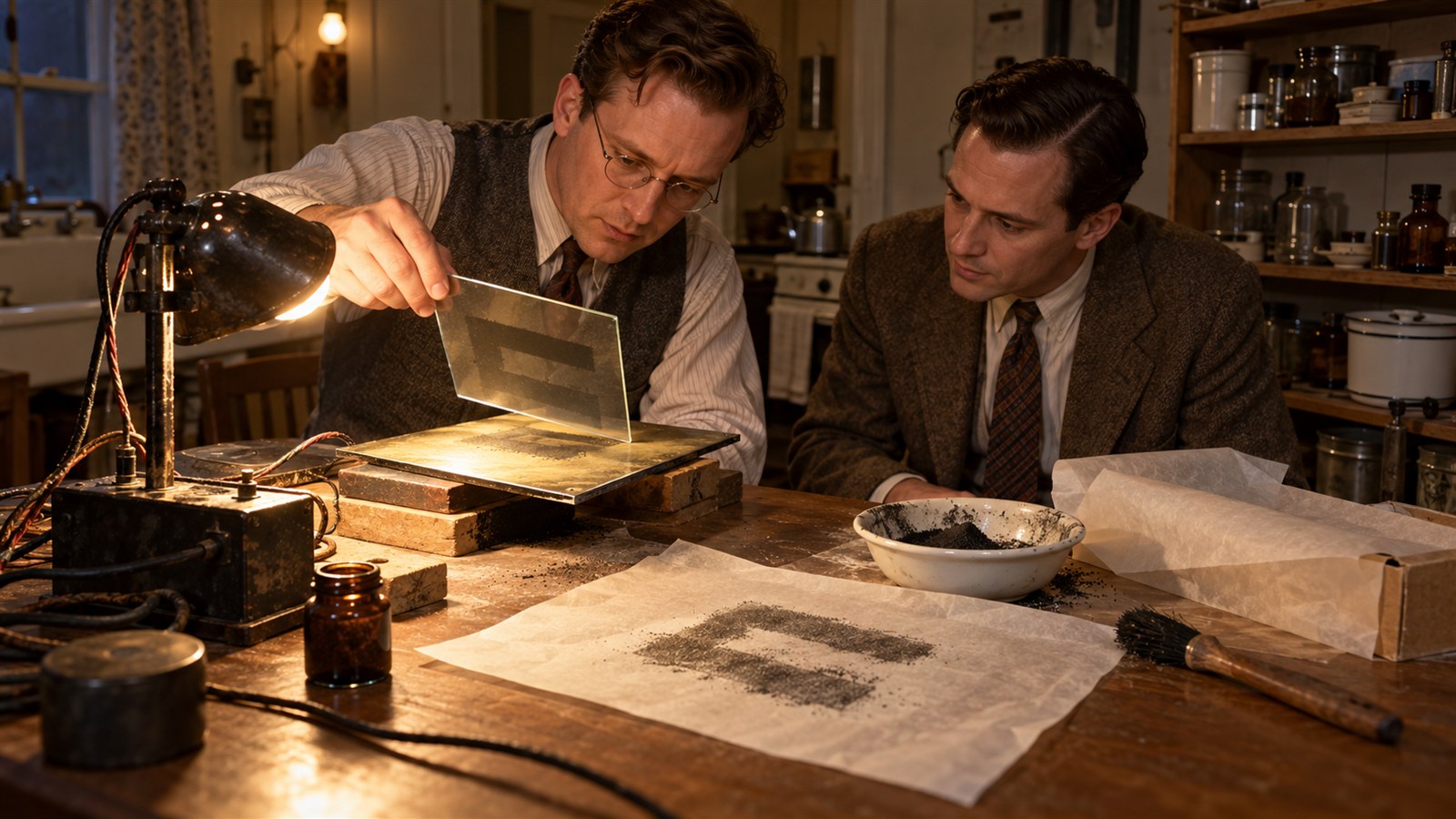
On October 22, 1938, Chester Carlson and assistant Otto Kornei produced the first successful image using the process that became xerography. In a makeshift laboratory in Astoria, Queens, they wrote a date and place on a glass slide, used light and static charge to form an invisible pattern on a sulfur-coated zinc plate, dusted it with powder, and transferred the result to wax paper. The words '10-22-38 Astoria' appeared. The image was rough, but it proved that dry electrostatic principles could copy marks without photographic chemicals or carbon paper.
Carlson understood the need from his work handling patent documents, where making copies was slow and expensive. He called the invention electrophotography and spent years seeking a company willing to develop it. Large firms rejected the idea because the apparatus was crude and the market uncertain. Battelle Memorial Institute eventually supported the research, and the Haloid Company of Rochester licensed the technology. The company and its advisers adopted the name xerography from Greek roots meaning dry writing; Haloid later became Xerox. Commercial success required far more than Carlson's first image: reliable materials, precision machinery, service networks, financing, and easy operation.
The Xerox 914, introduced in 1959, made high-quality copies on ordinary paper and became a landmark office product. A per-copy leasing model reduced the customer's initial cost and let revenue grow with use. Copying changed administrative work by making distribution fast and decentralized. Employees could reproduce reports, forms, correspondence, and teaching materials without sending every job to a print shop. Heavy use also created new expenses and concerns about paper consumption, document security, and copyright.
Carlson's experiment is a classic example of the distance between proof and product. More than two decades separated the first successful image from the machine that transformed offices. The intervening value came from organizations able to engineer, manufacture, finance, sell, and maintain a complex device. Xerography later contributed to laser printing and digital document systems, extending the underlying electrostatic process into new markets. October 22 shows why patient commercialization matters: an awkward demonstration can contain a powerful economic idea when it solves a frequent problem, but investors and partners must be willing to fund the long work that turns physical principle into dependable service. Service was especially important because early copiers were complicated machines used throughout the workday. A reliable technician network protected customer productivity and strengthened the leasing model. The commercial product was therefore uptime and accessible copying, not only the equipment sitting in an office.
Chester Carlson and Otto Kornei made the first successful xerographic image on October 22, 1938.
The dry process used light, electrostatic charge, powder, and transfer rather than wet photographic chemistry.
Carlson pursued the idea after seeing how difficult it was to reproduce patent documents.
Battelle and Haloid supplied the development resources that many larger firms had declined to provide.
The Xerox 914 and a per-copy leasing model later turned the process into a major office business.
More than twenty years from proof to mass product illustrate the importance of patient commercialization.
Explore more of "On This Day ..."
Discover more events from the same date across news, politics, technology, sports, and other fields. Each link highlights significant moments that shaped history on different fronts.