

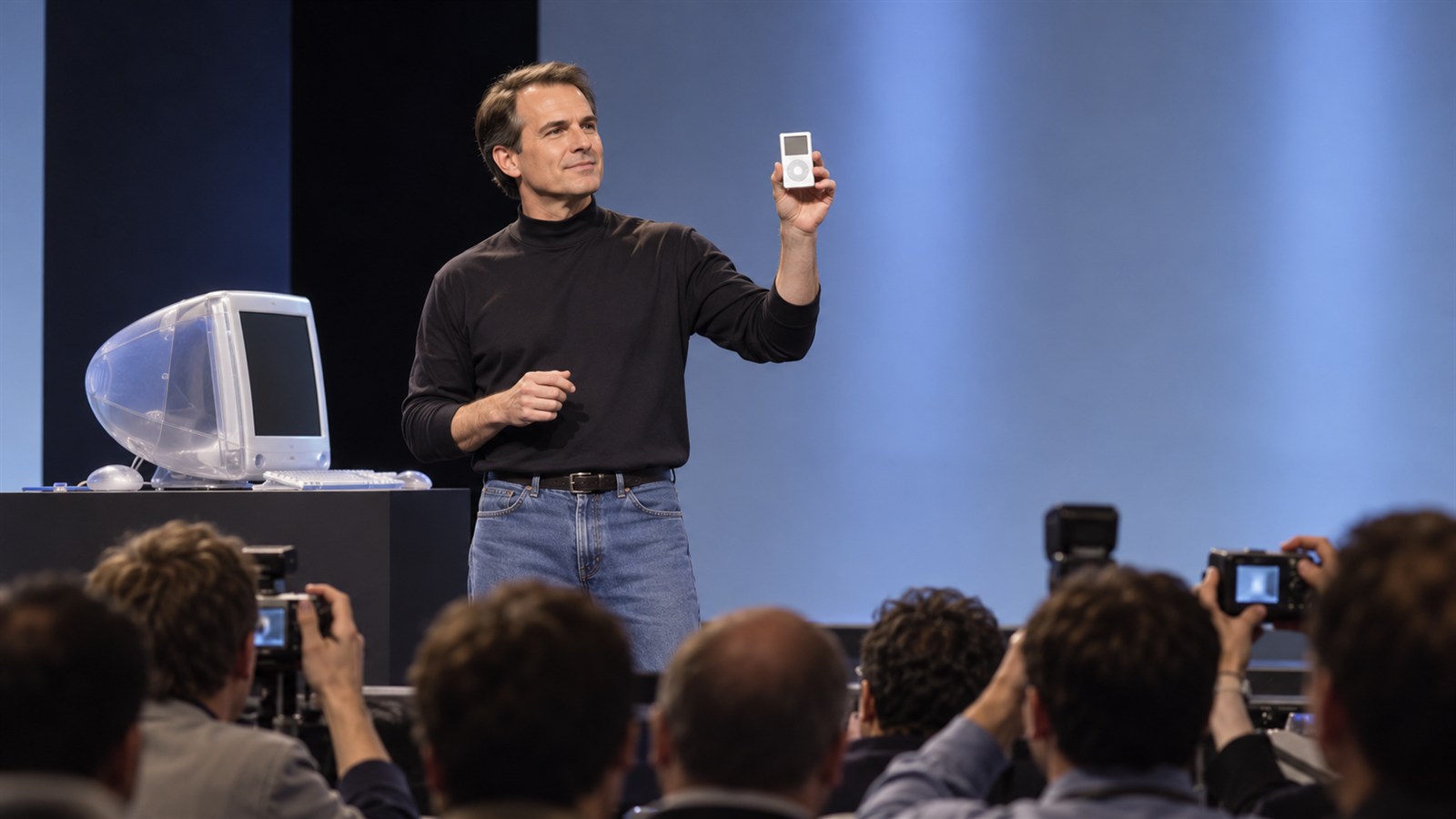
On This Day in Business: October 23, 2001
On October 23, 2001, Apple introduced the first iPod at an event in Cupertino, California. The small white music player used a five-gigabyte hard drive, stored up to 1,000 songs, offered about ten hours of battery life, and transferred music from a Mac through a fast FireWire connection. Its $399 price was high, and portable MP3 players already existed. Apple's proposition was integration: the device worked closely with iTunes, automatically synchronized a music library, and used a physical scroll wheel to navigate many songs with one hand. The company sold a simpler experience rather than claiming to invent digital audio.
The product arrived when Apple remained a relatively small computer maker and the recorded-music industry was struggling with online file sharing. The first iPod worked only with Macs, limiting its immediate market, but it gave Apple a distinctive accessory that made the computer more valuable. Later versions supported Windows and became smaller, cheaper, and more varied. Design, packaging, retail demonstration, and supply-chain execution reinforced the hardware. A network of drive, battery, semiconductor, and manufacturing partners made rapid product cycles possible.
The iTunes Store opened in 2003 and added licensed, per-song purchasing to the system. Apple negotiated with record labels, handled payment and digital rights management, and offered consumers a legal alternative to albums and unauthorized downloads. Hardware margins, software convenience, content relationships, and customer accounts became mutually reinforcing. The model shifted power in music distribution and taught Apple to manage a platform spanning devices, media, and commerce—capabilities later central to the iPhone and App Store.
Apple discontinued the iPod line in 2022 after smartphones absorbed its main functions, but the 2001 launch remains a pivotal business moment. It showed that a company can enter an existing category by removing friction across the entire workflow. Storage capacity alone was not the lasting advantage; synchronization, catalog management, industrial design, and eventually a content store made the device coherent. The iPod also revealed the strategic value of a gateway product. By bringing Apple into pockets, cars, gyms, and Windows households, it expanded the brand beyond the desktop and created relationships that supported the company's transformation into a consumer-electronics and services giant. The launch also displayed disciplined product focus. Apple omitted features common in other devices and emphasized a small number of promises that could be demonstrated immediately. Clear positioning made a complicated chain of components and software feel like one understandable consumer benefit.
Apple introduced the first iPod on October 23, 2001.
The five-gigabyte player was marketed as carrying up to 1,000 songs in a pocket.
FireWire and automatic iTunes synchronization reduced the effort of loading and organizing music.
Windows support and lower-priced models later expanded the addressable market.
The iTunes Store linked devices, accounts, licensing, payments, and digital content distribution.
The iPod became a gateway from Apple's computer business to a broader device-and-services ecosystem.
Explore more of "On This Day ..."
Discover more events from the same date across news, politics, technology, sports, and other fields. Each link highlights significant moments that shaped history on different fronts.