

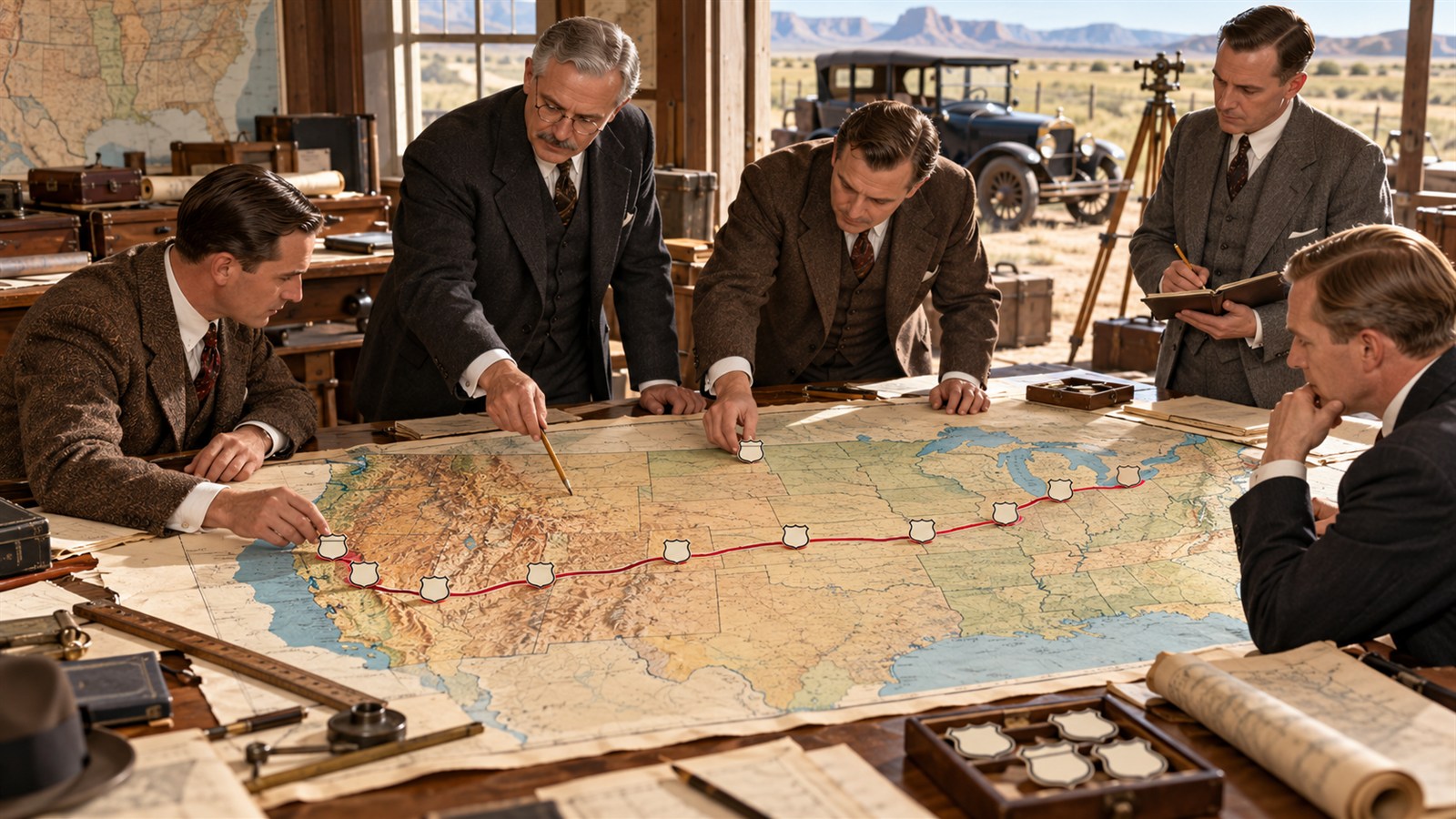
On This Day in Business: November 11, 1926
On November 11, 1926, the American Association of State Highway Officials adopted the U.S. numbered highway plan. Among the routes was U.S. 66, connecting Chicago with Los Angeles through the center and Southwest of the country. The designation gathered existing roads under a common identity, making a long trip easier to describe, mark, map, and promote. The event was the visible end of years of surveys, financing, engineering, negotiation, and labor. Infrastructure businesses concentrate risk before they produce benefits, so sponsors must coordinate technical design with rights of way, regulation, capital, and the practical needs of the customers expected to use the system.
A numbered route was an information system laid over physical infrastructure owned and maintained by different governments. Standard signs reduced confusion for motorists, while consistent mapping helped service stations, hotels, restaurants, garages, and towns market themselves to travelers. The road's value came from coordination across jurisdictions rather than from a single owner controlling every mile. Once operating, the asset changed more than travel time. It reorganized where firms could locate, how inventories moved, which markets became reachable, and how reliably people could plan. Those second-order effects often created more economic value than the toll, fare, rent, or fee collected directly by the operator.
Traffic along Route 66 supported migration, freight, tourism, and roadside enterprise. Businesses learned to attract passing customers with visible signs, dependable fuel, lodging, food, and repairs. The route's cultural fame later amplified that commercial ecosystem, even as interstate highways bypassed many original alignments and shifted traffic away from older communities. Scale also brought public obligations. Safety, access, maintenance, environmental effects, and monopoly power could not be treated as side issues because a failure in shared infrastructure reached far beyond the owner. Durable performance required governance strong enough to protect both commerce and the communities carrying its costs.
Route 66 shows how standards can make scattered assets behave like a network. A shared name and numbering convention lowered the mental cost of travel and allowed thousands of independent firms to participate in the same corridor economy. When transport patterns later changed, it also showed how businesses tied to one route must adapt to infrastructure decisions made elsewhere. The modern lesson is to judge infrastructure across its full life cycle. Construction headlines fade quickly; maintenance, capacity, resilience, and public legitimacy determine whether the asset keeps creating value. The best projects connect engineering discipline with transparent rules and a realistic plan for decades of operation. In practical terms, the advantage came from linking a clear customer promise to disciplined execution. Capital had to be allocated before demand was certain, employees and partners had to coordinate, and leaders had to keep learning after the initial milestone passed into history.
The U.S. numbered highway plan was adopted on November 11, 1926.
Route 66 linked Chicago and Los Angeles.
Standard numbering made multistate travel easier to navigate.
Roadside businesses clustered around traffic and traveler needs.
The corridor supported migration, freight, and tourism.
Later interstate construction redirected commerce from many original towns.
Explore more of "On This Day ..."
Discover more events from the same date across news, politics, technology, sports, and other fields. Each link highlights significant moments that shaped history on different fronts.