

On This Day in Health: February 12, 1941
On February 12, 1941, an Oxford research team began treating Albert Alexander with penicillin during an early clinical investigation of the antibiotic. Alexander, a police officer suffering from a severe bacterial infection, received material produced through a demanding laboratory process. His initial improvement offered a striking indication that the substance could have practical value in treating dangerous infections. Yet the team had only a limited supply, and the treatment could not be sustained. This anniversary belongs to the early development of penicillin as a systemic therapy, rather than to its discovery or the first occasion on which any human received it.
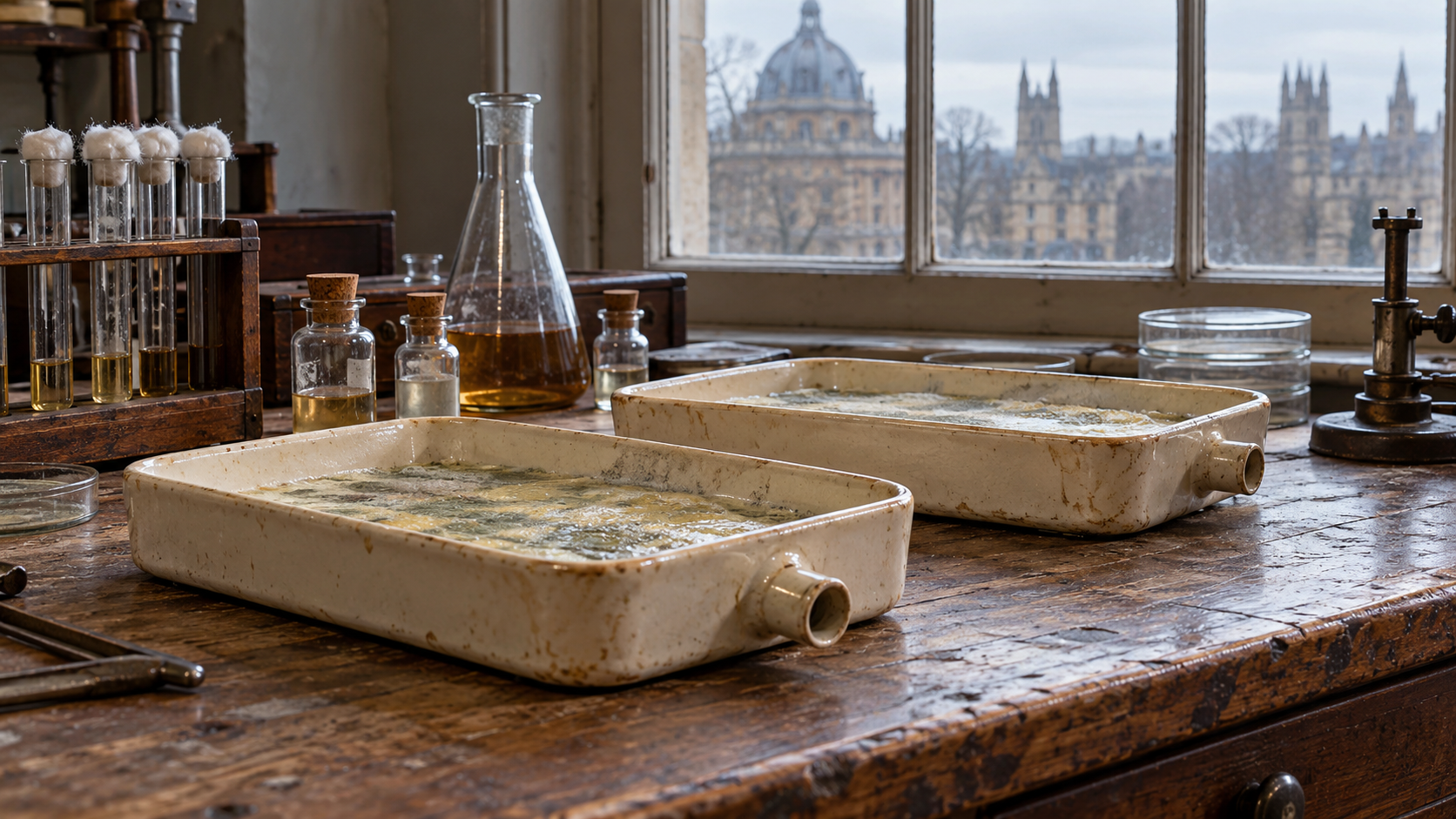
Alexander Fleming had observed the antibacterial effect of a mold years earlier, but turning that observation into a usable medicine required additional research. At Oxford, Howard Florey, Ernst Chain, Norman Heatley, and colleagues worked on growing the organism, extracting its active substance, and evaluating its effects. Producing enough material was an immediate obstacle. Culture vessels and improvised laboratory arrangements were part of an effort that demanded both scientific understanding and practical engineering. The substance also had to reach a patient in an active form. An interesting result on a laboratory plate did not by itself provide a dependable treatment for a person with a serious infection.
The response in Alexander's case encouraged the researchers, but the shortage exposed the limits of their production methods. Oxford accounts describe efforts to recover penicillin from his urine so that scarce material could be reused. Those measures could not provide a sufficient continuing supply, and he later died. His case therefore carried two lessons at once: a powerful therapeutic possibility and an urgent manufacturing problem. It would be misleading to remember the episode only as a straightforward rescue. The outcome showed how access to adequate quantities can determine whether a promising discovery becomes effective care. The work was taking place during wartime, when the potential value of treating infected wounds made the supply problem especially pressing.
Subsequent collaboration and industrial development helped move penicillin beyond the small quantities available to the Oxford team. Those later achievements should remain distinct from what had been accomplished on February 12. The date marks a difficult stage between experimental promise and dependable availability. Alexander's treatment also reminds us that medical milestones can include failure alongside insight: his initial response mattered scientifically even though it did not lead to his recovery. The broader history of antibiotics depended on laboratory discoveries, clinical investigation, production methods, and distribution working together. Remembering this episode keeps the patient and the practical limits of the experiment at the center of a story often reduced to a single famous discovery.
Fleming’s earlier observation did not immediately create a usable medicine. Oxford researchers pursued the extraction, testing, and production needed for clinical investigation.
Growing the mold and obtaining active penicillin required improvised equipment. Engineering and manufacturing became central parts of the scientific effort.
Albert Alexander initially improved during treatment. The limited laboratory supply could not sustain the course, and the case ended in his death.
Recovering penicillin from urine illustrates how scarce the material was. A potential treatment still needed dependable production in adequate quantities.
Later industrial work expanded availability. Those achievements followed the early clinical investigation rather than occurring on its anniversary date.
The episode connects therapeutic promise with the realities of supply. A discovery’s practical value depends on the ability to deliver effective care.
Explore more of "On This Day ..."
Discover more events from the same date across news, politics, technology, sports, and other fields. Each link highlights significant moments that shaped history on different fronts.