

On This Day in Health: February 13, 1929
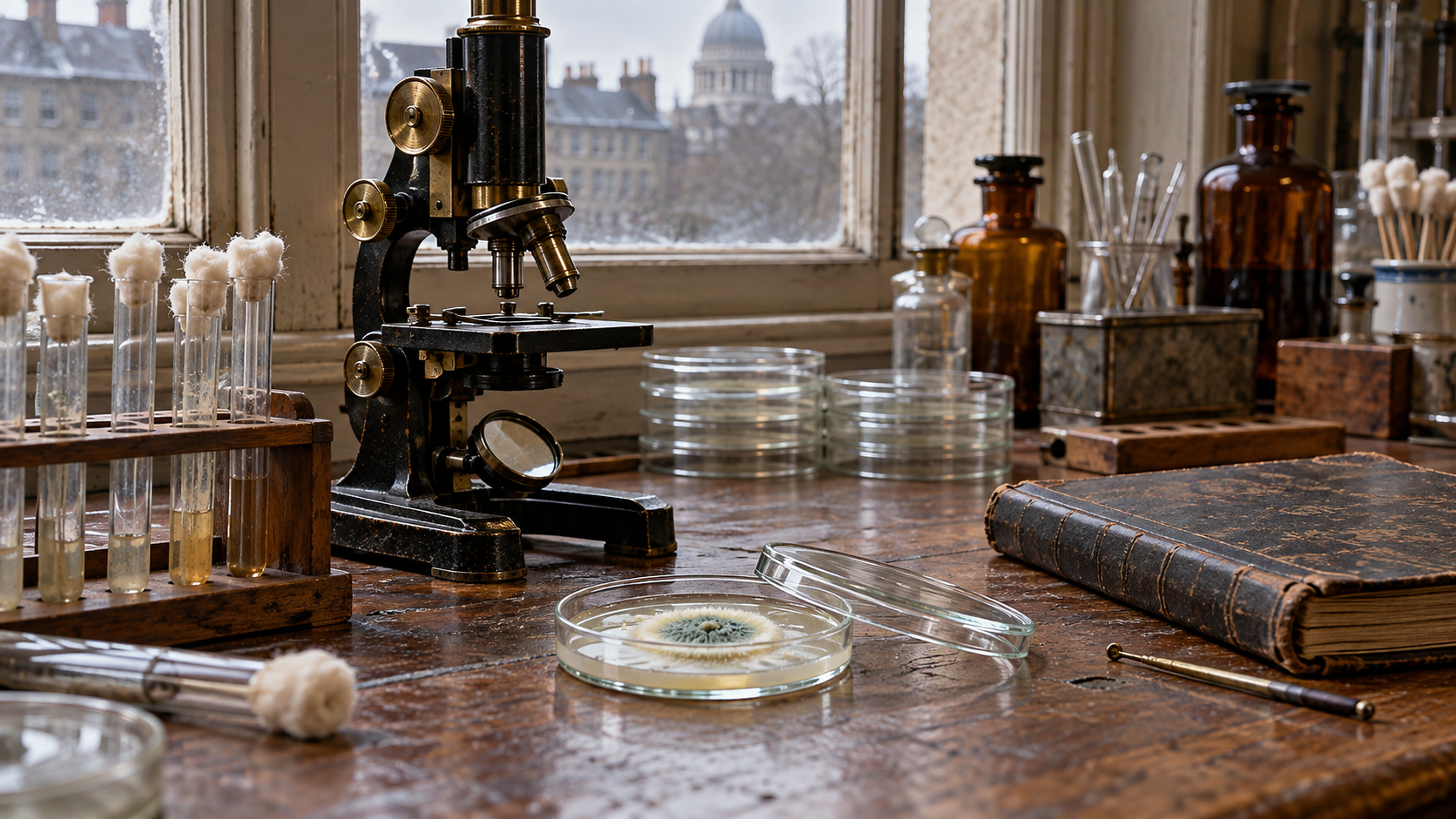
On February 13, 1929, Alexander Fleming presented his observations about penicillin to the Medical Research Club in London. The report followed his investigation of a mold that inhibited the growth of bacteria on a culture plate. It was an early opportunity to describe a finding that would later become part of one of medicine's most influential treatment developments. The date concerns the communication of research, not the moment of discovery and not the arrival of a ready antibiotic in hospitals. Fleming's original observation belonged to the preceding year, while the clinical and industrial developments that made penicillin widely useful still lay ahead.
The laboratory finding involved an unexpected contaminant and a visible change in bacterial growth around it. Fleming examined the mold's antibacterial activity and gave the active substance the name penicillin. This work combined close observation with follow-up experiments: an unusual plate could suggest a possibility, but research was needed to understand whether the effect was reproducible and what it might mean. Reporting to a professional scientific group was part of that process. It placed an emerging finding before other researchers, inviting scrutiny rather than immediately proving that the substance would succeed as a medicine in the human body.
The gap between a laboratory effect and dependable treatment was considerable. Investigators would need a way to obtain active material in useful quantities, assess its behavior, and establish how it could be given safely and effectively. Fleming's work did not solve all of those problems. Later research at Oxford, associated with Howard Florey, Ernst Chain, Norman Heatley, and their colleagues, was crucial to the development of systemic penicillin treatment. Manufacturing advances then helped make adequate supplies possible. These contributions illustrate why the history should not be compressed into a single person, a single meeting, or a discovery instantly followed by routine clinical use. Different stages called for different skills and different kinds of evidence.
The February 13 report is meaningful as an early link in that longer chain. Fleming published an account of his research later in 1929, providing a further channel through which the observations could be examined. Recognition eventually followed the therapeutic success of penicillin, including the shared Nobel Prize awarded in 1945 to Fleming, Florey, and Chain. From that later vantage point, the club presentation may look inevitable, but its eventual significance depended on work that had not yet happened. The anniversary highlights the importance of communicating a finding while also respecting its original limits. It remembers the start of a research conversation that would help change the treatment of bacterial infection over the following decades.
The observations followed Fleming’s work in 1928. February 13 marks a report to the Medical Research Club rather than the original discovery date.
An unexpected mold on a culture plate inhibited nearby bacterial growth. Follow-up investigation turned an unusual observation into a research question.
The presentation described an antibacterial substance with potential value. It did not introduce a fully developed treatment for hospital use.
Oxford investigators later addressed extraction, testing, and clinical development. Industrial production added another essential stage to the story.
Fleming’s published account appeared later in 1929. Scientific communication provided opportunities to examine and build on the findings.
The 1945 Nobel Prize recognized Fleming, Florey, and Chain together. Their shared recognition reflects contributions across several stages of development.
Explore more of "On This Day ..."
Discover more events from the same date across news, politics, technology, sports, and other fields. Each link highlights significant moments that shaped history on different fronts.