

On This Day in Health: July 30, 1965
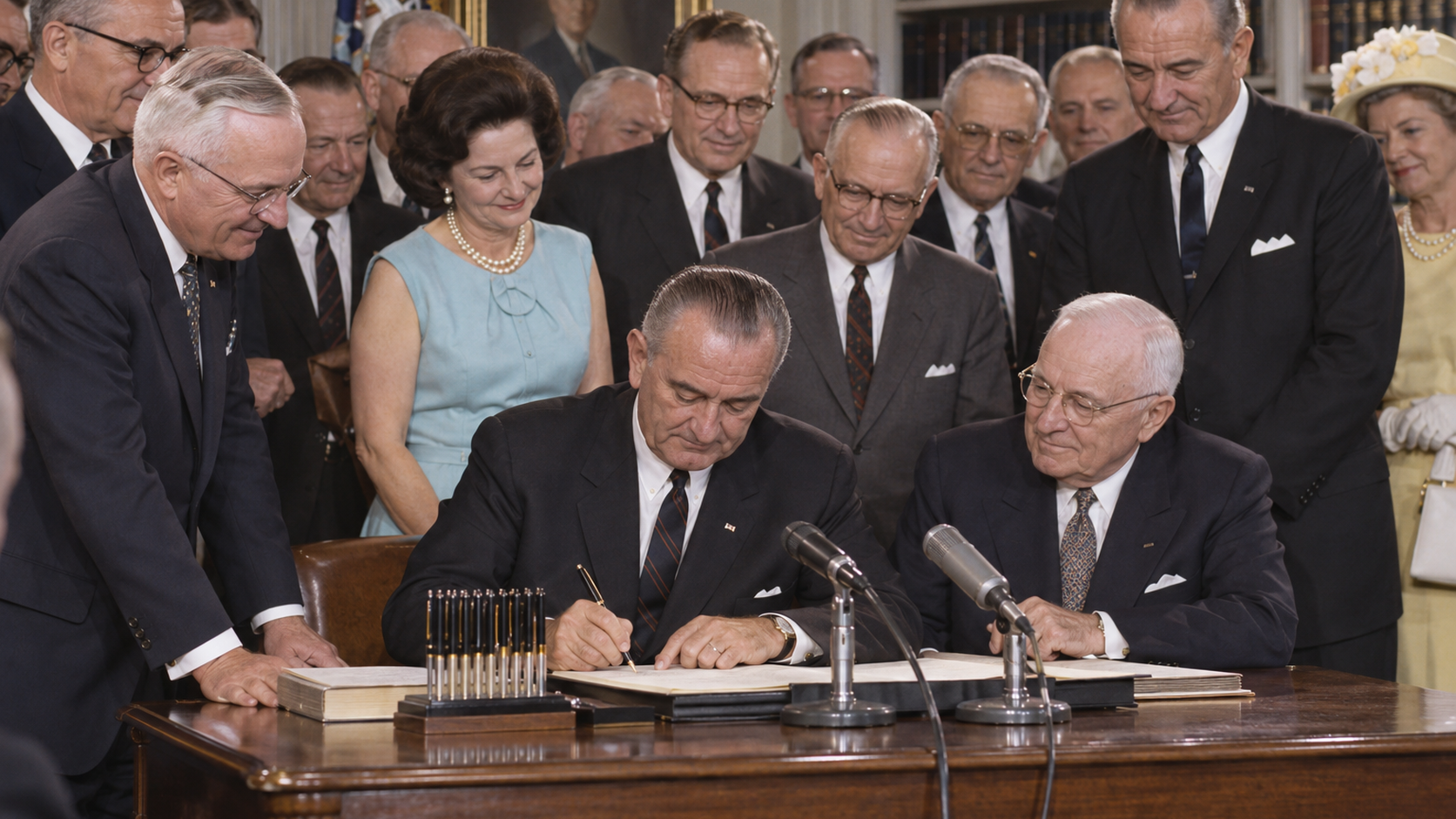
On July 30, 1965, President Lyndon B. Johnson signed the Social Security Amendments of 1965 at the Harry S. Truman Presidential Library in Independence, Missouri. Former President Harry Truman, who had pressed Congress for national health insurance two decades earlier, sat beside him. Johnson presented Truman with the first Medicare card, turning the ceremony into a link between an earlier proposal and a newly enacted program. Public Law 89-97 created Medicare for older Americans and Medicaid as a federal-state partnership for eligible people with low incomes. Together, the programs changed how the United States financed and organized medical care.
Medicare began with two major parts. Part A provided hospital insurance, financed largely through payroll taxes, while Part B offered voluntary coverage for physician and other outpatient services through premiums and federal funding. Medicaid expanded federal support for state medical assistance programs, with states administering benefits under national requirements. The design reflected political compromise rather than one unified insurance system. It preserved roles for private hospitals, physicians, insurers, and state governments while creating large public sources of payment. Eligibility, benefits, and administration would evolve, but the 1965 law established durable structures for covering groups often priced out of private insurance.
Implementation required an enormous administrative effort before benefits began in 1966. The Social Security Administration enrolled older adults, coordinated with hospitals and doctors, and built payment systems on a national scale. Medicare participation also became a powerful instrument for hospital desegregation because facilities receiving federal funds had to comply with civil rights requirements. Medicaid developed differently across states, producing variation in eligibility and services while supporting care for children, pregnant women, disabled people, older adults, and others with limited income. The programs increased access, reduced some financial risk, and became central to hospital, nursing home, physician, and community health financing.
Later laws expanded Medicare to certain younger people with disabilities and people with end-stage renal disease, added managed-care options and prescription drug coverage, and repeatedly changed payment rules. Medicaid grew through new eligibility pathways, waivers, children's coverage, and state choices. Both programs remain subjects of political debate over costs, benefits, access, equity, and federal-state responsibility. Their origins on July 30 explain why the signing remains a landmark in health policy: the federal government accepted a sustained role in helping millions pay for care. Medicare and Medicaid did not create universal coverage, but they permanently reshaped American medicine and the expectations surrounding public protection from medical expense.
President Johnson signed Public Law 89-97 in Independence, Missouri, with Harry and Bess Truman present, honoring Truman's earlier campaign for national health insurance.
The ceremony included presentation of the first Medicare card to Truman, while the law also established Medicaid through a federal-state financing partnership.
Medicare paired hospital insurance with voluntary physician coverage, and Medicaid built on state assistance systems rather than creating a single national plan.
Administrators had less than a year to enroll beneficiaries, certify providers, create payment operations, and prepare benefits to begin in July 1966.
Medicare and Medicaid expanded access to care and became major sources of health financing, influencing hospitals, clinicians, long-term care, and state budgets.
Eligibility and benefits have changed repeatedly, but the programs remain distinct systems whose reach, cost, and design continue to shape American health policy.
Explore more of "On This Day ..."
Discover more events from the same date across news, politics, technology, sports, and other fields. Each link highlights significant moments that shaped history on different fronts.