

On This Day in Health: August 12, 1865
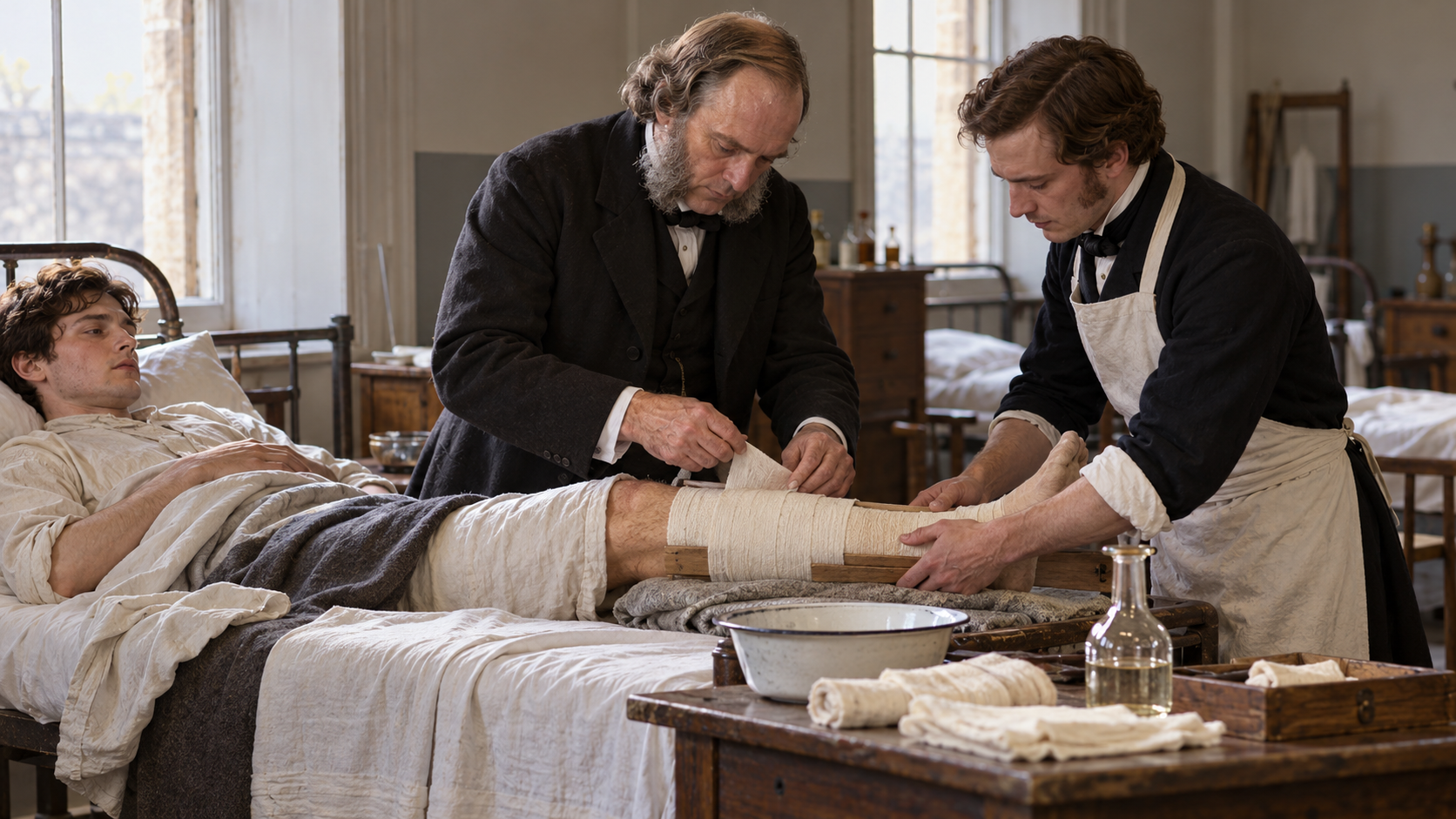
On August 12, 1865, at Glasgow Royal Infirmary, surgeon Joseph Lister treated an eleven-year-old boy, James Greenlees, after a cart wheel caused a compound fracture of his lower leg. In such injuries, broken bone pierced the skin and exposed tissue to contamination. Infection, suppuration, amputation, and death were common outcomes in nineteenth-century hospitals. Lister cleaned the wound and covered it with lint soaked in carbolic acid, then stabilized the leg with splints. Four days later, he found no suppuration beneath the dressing, and Greenlees ultimately recovered with the limb intact.
Lister’s reasoning joined clinical observation with Louis Pasteur’s work on microorganisms and putrefaction. Many surgeons still attributed wound infection to bad air or unavoidable changes in damaged tissue. Lister suspected that living germs entering from the environment caused decomposition in wounds. Carbolic acid, already used to reduce odors in sewage, offered a way to kill those organisms. His early method was harsh and changed repeatedly; concentrated carbolic acid could injure skin and tissue. The August 12 case did not by itself prove a universal system, but it encouraged Lister to treat more compound fractures and refine his dressings.
In 1867, Lister published a series of reports in The Lancet describing his antiseptic approach and its results. He later extended the system to instruments, hands, ligatures, operating spaces, and postoperative care. Adoption was uneven. Some surgeons doubted germ theory, found the procedures cumbersome, or achieved inconsistent results. The carbolic spray once associated with Lister eventually disappeared as medicine learned more about microbial transmission and developed aseptic practices designed to prevent contamination rather than continuously spray chemicals. Sterilized instruments, clean technique, gloves, and controlled operating rooms grew from the same central recognition.
The Greenlees case marks a practical beginning rather than the instant modern surgery appeared fully formed. Lister built on Pasteur, earlier work on hand hygiene, and the labor of nurses and surgical teams; later practitioners improved safety and standardization. Yet the change was profound. When infection was no longer accepted as an inevitable consequence of an operation, surgeons could attempt procedures that had once been too dangerous. Antisepsis helped make abdominal, orthopedic, and other complex surgery survivable. The anniversary also shows why medical breakthroughs must be judged by both mechanism and outcomes: Lister’s early chemicals were imperfect, but the idea that microbes could be controlled transformed surgical care. Hospitals also had to convert a personal technique into a shared routine. Staff needed dependable supplies, clean storage, consistent preparation, and training that continued when Lister was absent. Those organizational changes are easy to miss in stories centered on one surgeon, yet they determined whether antiseptic principles could protect ordinary patients every day.
James Greenlees arrived at Glasgow Royal Infirmary on August 12, 1865, with a compound fracture, an injury then strongly associated with infection and amputation.
Lister connected Pasteur’s research on microorganisms with wound putrefaction and looked for a practical way to prevent germs from multiplying in damaged tissue.
A carbolic-acid dressing was placed over the wound and the leg was splinted; when the dressing was removed four days later, Lister reported no suppuration.
Carbolic acid could damage tissue, and Lister’s methods required repeated revision, careful technique, and evidence from more than one successful patient.
His published system helped shift surgery toward microbial control, while later aseptic methods replaced sprays with sterilization and prevention of contamination.
Safer surgery emerged through cumulative work by scientists, surgeons, nurses, technicians, and hospitals that turned a theory into reliable practice.
Explore more of "On This Day ..."
Discover more events from the same date across news, politics, technology, sports, and other fields. Each link highlights significant moments that shaped history on different fronts.