

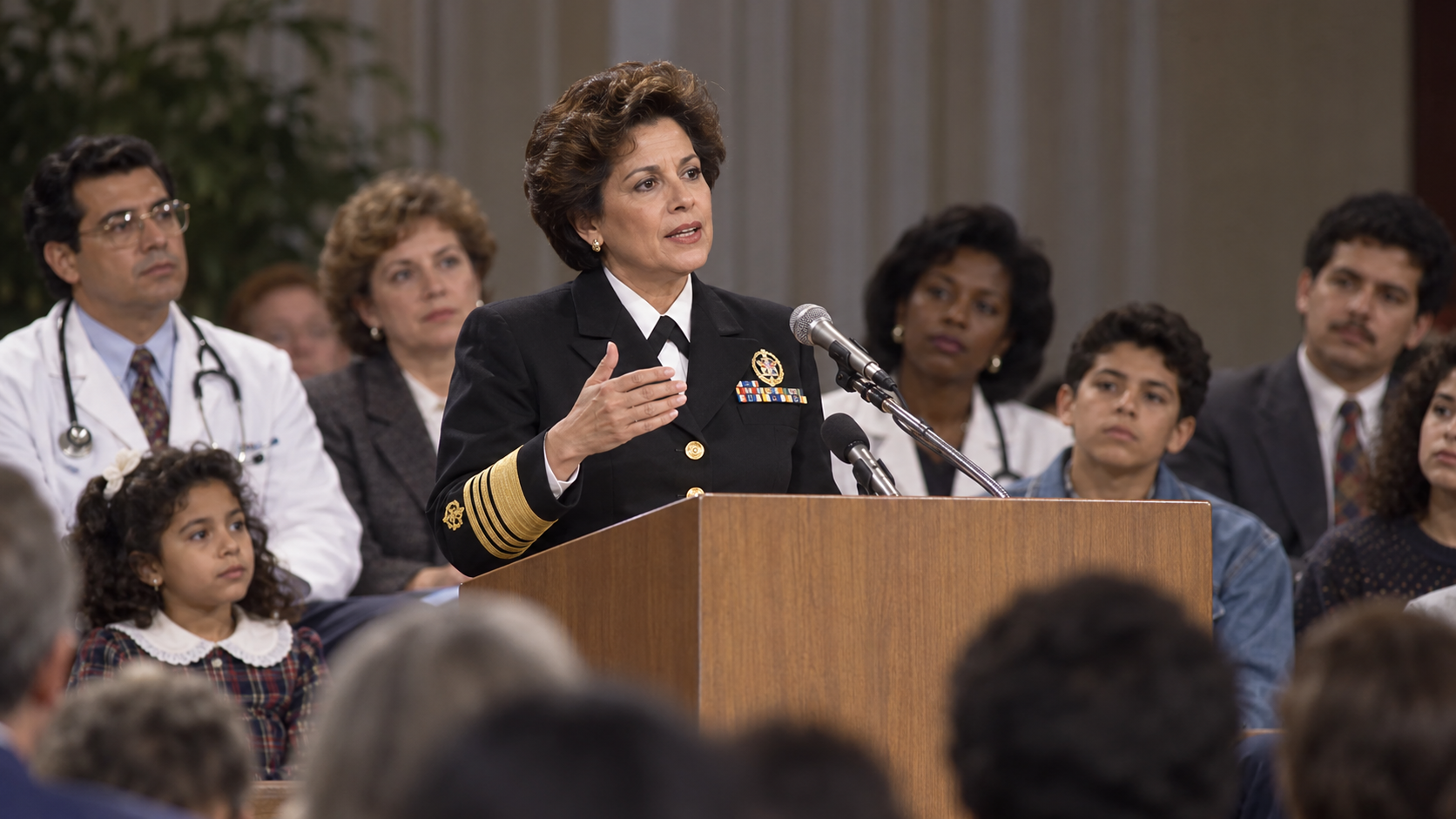
On This Day in Health: August 23, 1944
Antonia Coello Novello was born in Fajardo, Puerto Rico, on August 23, 1944. As a child she lived with a congenital intestinal disorder that was not corrected until her late teens, an experience that shaped her understanding of delayed care. She earned her medical degree at the University of Puerto Rico and trained in pediatrics and pediatric nephrology. After clinical work and further study in public health, she joined the U.S. Public Health Service Commissioned Corps in 1978 and held research and policy positions at the National Institutes of Health.
Novello worked on kidney disease, organ transplantation, and pediatric AIDS. During an assignment to the U.S. Senate Committee on Labor and Human Resources, she contributed to legislation related to organ-transplant procurement. In 1990, President George H. W. Bush appointed her the fourteenth surgeon general of the United States. She became the first woman, the first Hispanic person, and the first Puerto Rican to hold the office. The appointment carried symbolic weight, but her work focused on using the office’s public voice to change policy and behavior.
As surgeon general, Novello emphasized the health of children, women, and minority communities. She challenged tobacco marketing that appealed to young people, promoted childhood immunization, addressed underage drinking, and drew attention to HIV and AIDS among women and children. She also advocated better access to care for communities often overlooked in national policy. The surgeon general does not command the entire health system; the office educates, advises, convenes, and uses scientific authority to focus attention. Progress therefore depended on agencies, legislators, clinicians, schools, families, and community organizations acting on the issues she raised.
Novello later served with UNICEF, taught public health, and became New York State health commissioner. Her public career also included a later criminal case involving misuse of state employees; she accepted a plea agreement, paid restitution, and performed community service. Including that record prevents a milestone biography from becoming uncritical celebration. Her August 23 birthday still marks a major expansion of representation in American health leadership and a career that repeatedly centered young people and unequal access. The broader lesson is that visible leadership can open doors and set priorities, while public trust also requires accountability, evidence, and ethical use of authority. Her own childhood illness gave Novello a concrete language for delays that policymakers can otherwise treat as statistics. Timely specialist care depends on insurance, geography, transportation, family resources, language, and trust. Public leadership becomes meaningful when it connects those lived barriers with budgets, workforce planning, prevention programs, and measurable improvements in access.
Novello was born in Puerto Rico on August 23, 1944, experienced delayed treatment for a congenital condition, and trained in pediatrics and nephrology.
At NIH and in the Senate, she worked on pediatric AIDS, kidney disease, transplant policy, and the public systems connecting research with care.
Her 1990 appointment made her the first woman, first Hispanic person, and first Puerto Rican to serve as U.S. surgeon general.
She used the office to emphasize immunization, underage drinking, youth-focused tobacco marketing, women and children with HIV, and minority health access.
The surgeon general’s influence comes mainly through evidence, advice, convening, and communication rather than direct control of hospitals or state policy.
Her milestone and later accountability record together show that representation, service, public trust, and ethical responsibility must be considered side by side.
Explore more of "On This Day ..."
Discover more events from the same date across news, politics, technology, sports, and other fields. Each link highlights significant moments that shaped history on different fronts.