

On This Day in Health: August 24, 1899
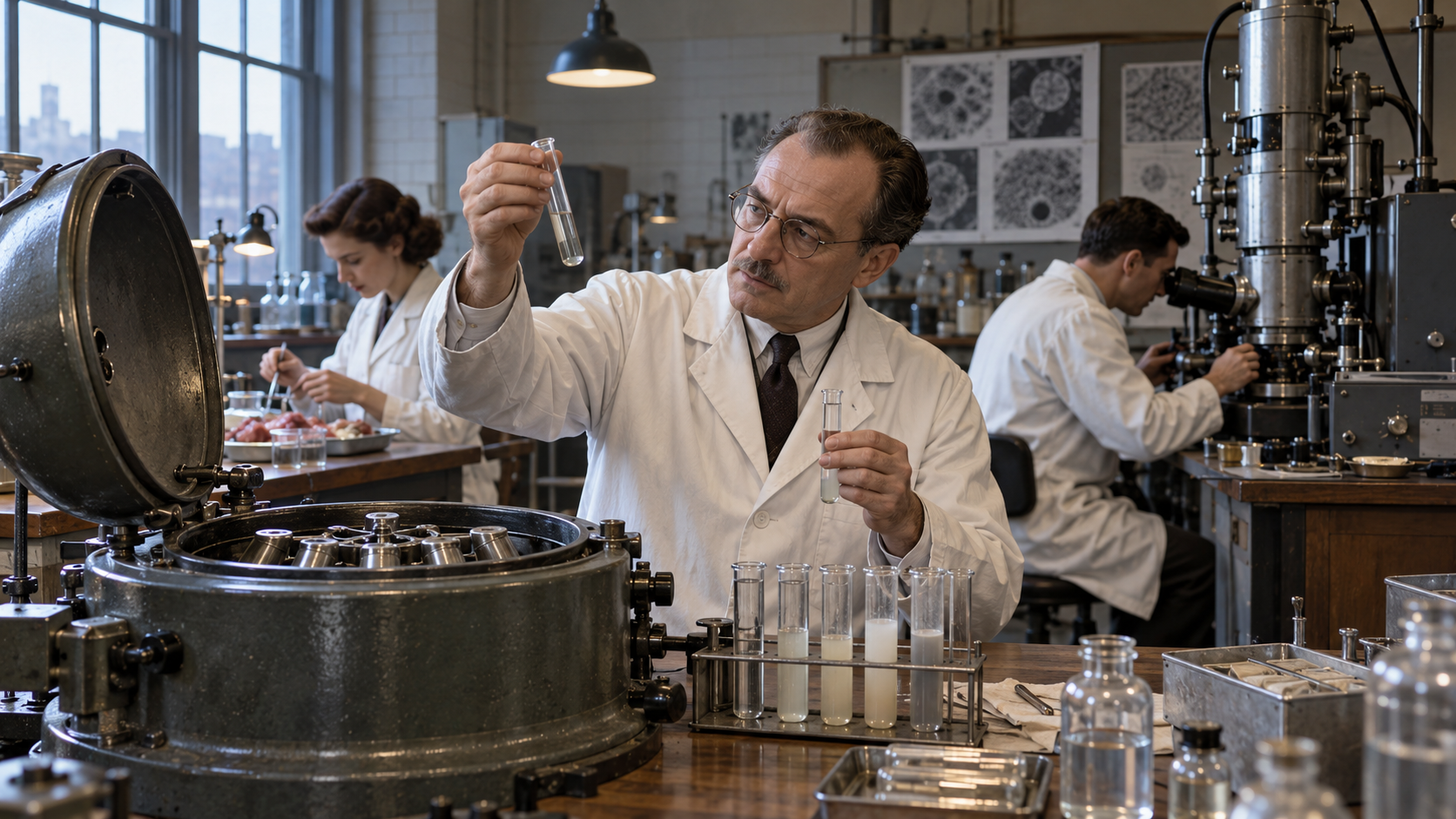
Albert Claude was born in Longlier, Belgium, on August 24, 1899. After medical training, he joined the Rockefeller Institute in New York and investigated how cells were organized below the limits of ordinary light microscopy. Researchers could see nuclei and broad cell shapes, but the smaller structures responsible for many functions remained difficult to isolate and identify. Claude combined mechanical disruption of cells with carefully controlled centrifugation, allowing components of different sizes and densities to separate into fractions that could be studied chemically.
Differential centrifugation turned the cell into an experimentally accessible system. Claude’s work helped identify a particle-rich fraction later associated with structures called ribosomes and endoplasmic reticulum. He also adapted the electron microscope, then a new instrument, to biological material. Electron beams could reveal much finer detail than visible light, but preparation methods risked distorting tissue. By comparing microscope images with separated fractions and biochemical tests, Claude and colleagues connected visual structures with cellular functions more reliably than either approach could alone.
The field expanded through the work of George Palade, Christian de Duve, Keith Porter, and many others. Palade described ribosomes and membrane systems involved in protein production and transport. De Duve used fractionation to identify lysosomes and peroxisomes. Claude, de Duve, and Palade shared the 1974 Nobel Prize in Physiology or Medicine for discoveries concerning the structural and functional organization of the cell. The award recognized complementary methods and findings that established modern cell biology, not a single isolated observation on Claude’s birthday.
Claude’s birth anniversary matters to health because disease unfolds inside cells. Cancer, inherited disorders, infection, metabolic disease, and drug effects all involve structures and pathways that these methods helped scientists examine. Today’s laboratories use advanced imaging, molecular labels, high-speed centrifuges, and genomic tools, but they still rely on the principle of separating components and matching structure with function. His career also shows the importance of instruments as sources of knowledge. A better question sometimes requires a new way to prepare, isolate, and see the material. By opening the cell’s interior to systematic study, Claude helped give medicine a map of the machinery that treatments seek to protect or change. Cell fractionation also taught researchers to distrust purity claims. A separated fraction could contain several structures, and preparation could damage the very components under study. Repeated centrifugation, marker enzymes, microscopy, and controls became essential for deciding what a fraction contained. That methodological caution still guides laboratories interpreting complex samples and subcellular measurements.
Claude was born in Belgium on August 24, 1899, trained in medicine, and joined the Rockefeller Institute to study structures hidden inside animal cells.
He used controlled cell disruption and differential centrifugation to separate components by size and density for chemical and functional analysis.
Early electron microscopy supplied unprecedented detail, while comparison with separated fractions helped prevent images from becoming detached from biology.
Colleagues including Palade and de Duve identified ribosomes, membrane systems, lysosomes, and other organelles through related and improved methods.
Claude, de Duve, and Palade shared the 1974 medicine prize for establishing how cellular structure and function could be studied together.
Modern pathology, genetics, pharmacology, and infection research still depend on the ability to visualize and isolate the machinery operating inside cells.
Explore more of "On This Day ..."
Discover more events from the same date across news, politics, technology, sports, and other fields. Each link highlights significant moments that shaped history on different fronts.