

On This Day in Health: August 29, 1904
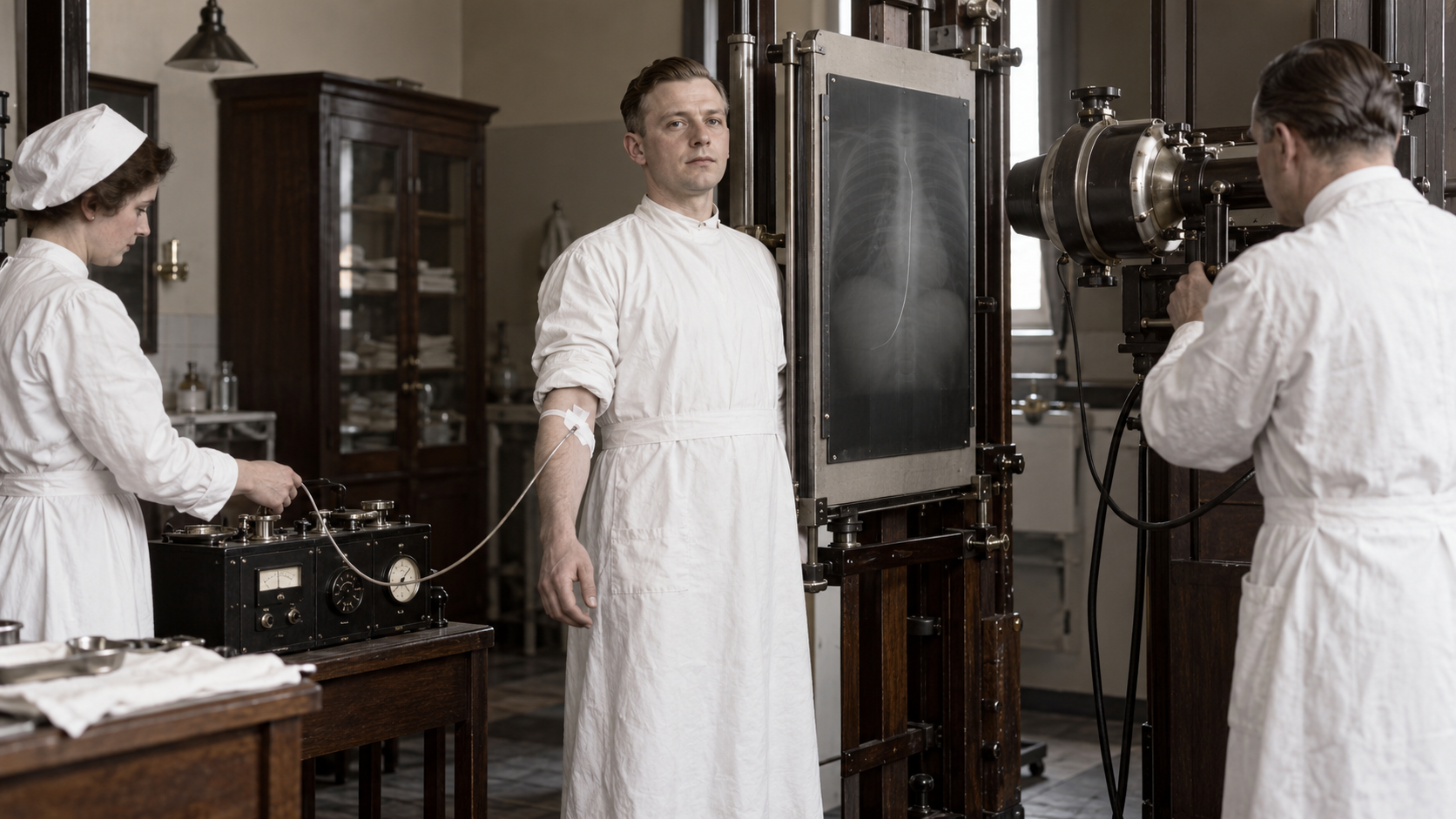
Werner Forssmann was born in Berlin, Germany, on August 29, 1904. After completing medical training, he worked as a young surgical resident at the Auguste Viktoria Home in Eberswalde. He believed a thin tube inserted through a vein could reach the heart safely, creating a route for measurement, diagnosis, and drug delivery without open surgery. In 1929, despite opposition from his supervisor, Forssmann used his own body to test the idea. He introduced a catheter through an arm vein and advanced it toward his right heart.
Forssmann then went to the X-ray department, where an image documented the catheter’s position in the right atrium. Accounts differ in some dramatic details about assistance and how he evaded supervision, but the published radiograph established the essential fact. The experiment was hazardous, lacked independent ethical oversight, and is not a model for how human research should be conducted today. At the time, many colleagues dismissed the work, and Forssmann left cardiology for surgery and urology. His demonstration nevertheless remained available for others to evaluate and refine.
In the 1940s, André Cournand and Dickinson Richards developed right-heart catheterization into a systematic clinical and research method. They measured pressures, blood oxygen, and cardiac function, creating tools for diagnosing congenital heart disease and understanding circulation. Forssmann, Cournand, and Richards shared the 1956 Nobel Prize in Physiology or Medicine for discoveries concerning heart catheterization and pathological changes in the circulatory system. Later advances led to coronary angiography, balloon procedures, stents, electrophysiology studies, valve interventions, and many forms of minimally invasive cardiovascular treatment.
Forssmann’s birthday highlights both bold invention and the safeguards medicine learned to require. Self-experimentation can produce striking stories, but courage does not replace protocol, peer review, informed consent, or protection from avoidable harm. The lasting advance came when other researchers made the technique reproducible, measurable, and clinically useful. Cardiac catheterization now helps teams diagnose blocked arteries, structural defects, abnormal pressures, and rhythm problems, yet it still carries risks such as bleeding, infection, vessel injury, contrast reactions, and radiation exposure. A daring path into the heart became a standard of care only through decades of validation, engineering, training, and ethical control. Catheters also made physiology measurable at the bedside. Pressures and oxygen levels sampled in different chambers could reveal shunts and valve problems that outward examination could only suggest. The technique bridged diagnosis and treatment, but its invasive nature is why noninvasive imaging is preferred whenever it can provide the necessary answer safely.
Forssmann was born in Berlin on August 29, 1904, trained as a physician, and proposed reaching the heart through the venous system.
In 1929 he advanced a catheter from his arm toward the right atrium and obtained an X-ray that documented access to the living human heart.
The self-experiment carried real danger and lacked modern oversight, so it should be understood historically rather than copied as a research model.
Cournand and Richards later made catheterization systematic, using pressure and oxygen measurements to study circulation and diagnose heart disease.
The three shared the 1956 medicine prize, and catheter techniques expanded into angiography, coronary treatment, electrophysiology, and valve procedures.
Modern catheterization depends on sterile technique, imaging, trained teams, informed consent, radiation control, and careful management of procedural risks.
Explore more of "On This Day ..."
Discover more events from the same date across news, politics, technology, sports, and other fields. Each link highlights significant moments that shaped history on different fronts.