

On This Day in Health: October 8, 1958
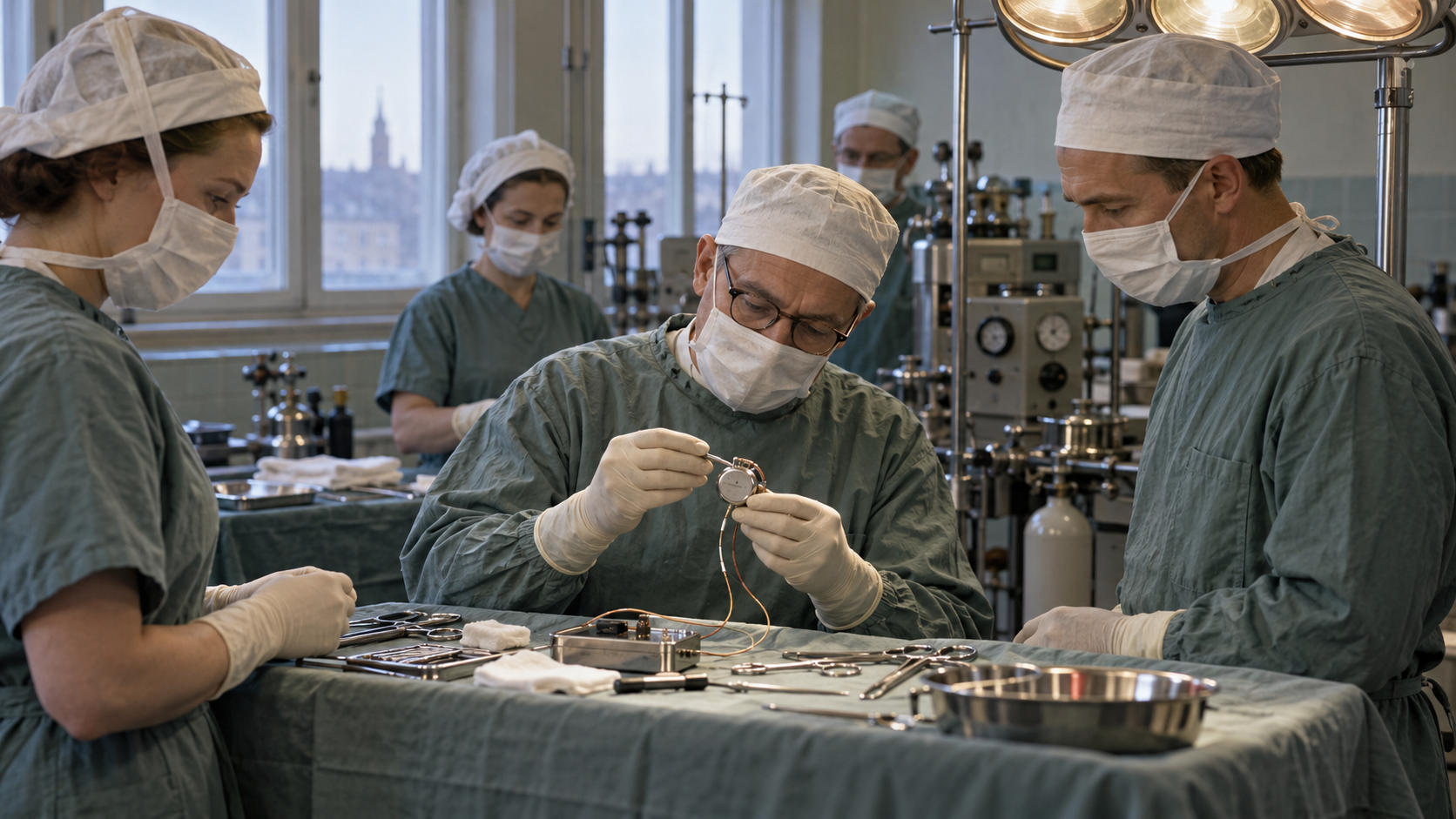
On October 8, 1958, surgeon Åke Senning implanted a fully internal electronic pacemaker designed by physician-engineer Rune Elmqvist in Arne Larsson at Karolinska Hospital in Stockholm. This date matters because it fixes a broad medical story to a specific moment, place, and group of people. It also shows how health history is shaped by institutions and practical choices as well as laboratory discoveries.
The background was already developing before that day. External pacing could rescue people with dangerous heart block, but wires crossing the skin invited infection and stationary equipment restricted movement. Larsson was experiencing repeated Stokes-Adams attacks and urgently needed a more durable solution. Those conditions defined what participants could attempt and what patients or communities could reasonably expect. The available tools, social expectations, and professional structures all shaped the result. Change also depended on cooperation among people whose roles were not always recorded equally. They also explain why later accounts sometimes compress years of preparation into a single anniversary. Looking at that preparation keeps credit broad and makes the turning point easier to understand without turning it into a miracle story.
What happened on the date was consequential but limited. The team attached epicardial electrodes to the heart and placed a rechargeable generator in the abdominal wall. The handmade first unit failed after only hours, so a second device was implanted the following day. The procedure was highly experimental, required open surgery, and did not produce a lasting device on the first attempt. Larsson eventually received more than twenty replacement pacemakers as batteries, leads, circuitry, and surgical methods evolved. The distinction is important: the event did not instantly solve the underlying health problem, and later progress depended on follow-up research, training, policy, funding, and public trust. Contemporary evidence also helps separate what participants knew then from interpretations added after the result became famous.
Its longer legacy reaches beyond the original setting. He lived for more than four decades after the operation, while implantable pacing became a standard treatment for symptomatic bradycardia and conduction disease. Today's compact pacemakers can sense rhythms, adjust pacing, store data, and communicate remotely, but they still require careful selection, implantation, follow-up, battery management, and equitable access. Seen in context, the anniversary is useful because it connects a concrete historical episode with continuing questions about evidence, access, safety, and responsibility in health care. That connection is stronger when the people affected, the limits of the achievement, and the work still unfinished remain part of the account.
The team attached epicardial electrodes to the heart and placed a rechargeable generator in the abdominal wall. The handmade first unit failed after only hours, so a second device was implanted the following day.
The procedure was highly experimental, required open surgery, and did not produce a lasting device on the first attempt. Larsson eventually received more than twenty replacement pacemakers as batteries, leads, circuitry, and surgical methods evolved.
He lived for more than four decades after the operation, while implantable pacing became a standard treatment for symptomatic bradycardia and conduction disease.
External pacing could rescue people with dangerous heart block, but wires crossing the skin invited infection and stationary equipment restricted movement. Larsson was experiencing repeated Stokes-Adams attacks and urgently needed a more durable solution.
surgeon Åke Senning implanted a fully internal electronic pacemaker designed by physician-engineer Rune Elmqvist in Arne Larsson at Karolinska Hospital in Stockholm.
Today's compact pacemakers can sense rhythms, adjust pacing, store data, and communicate remotely, but they still require careful selection, implantation, follow-up, battery management, and equitable access.
Explore more of "On This Day ..."
Discover more events from the same date across news, politics, technology, sports, and other fields. Each link highlights significant moments that shaped history on different fronts.