

On This Day in Health: November 2, 1869
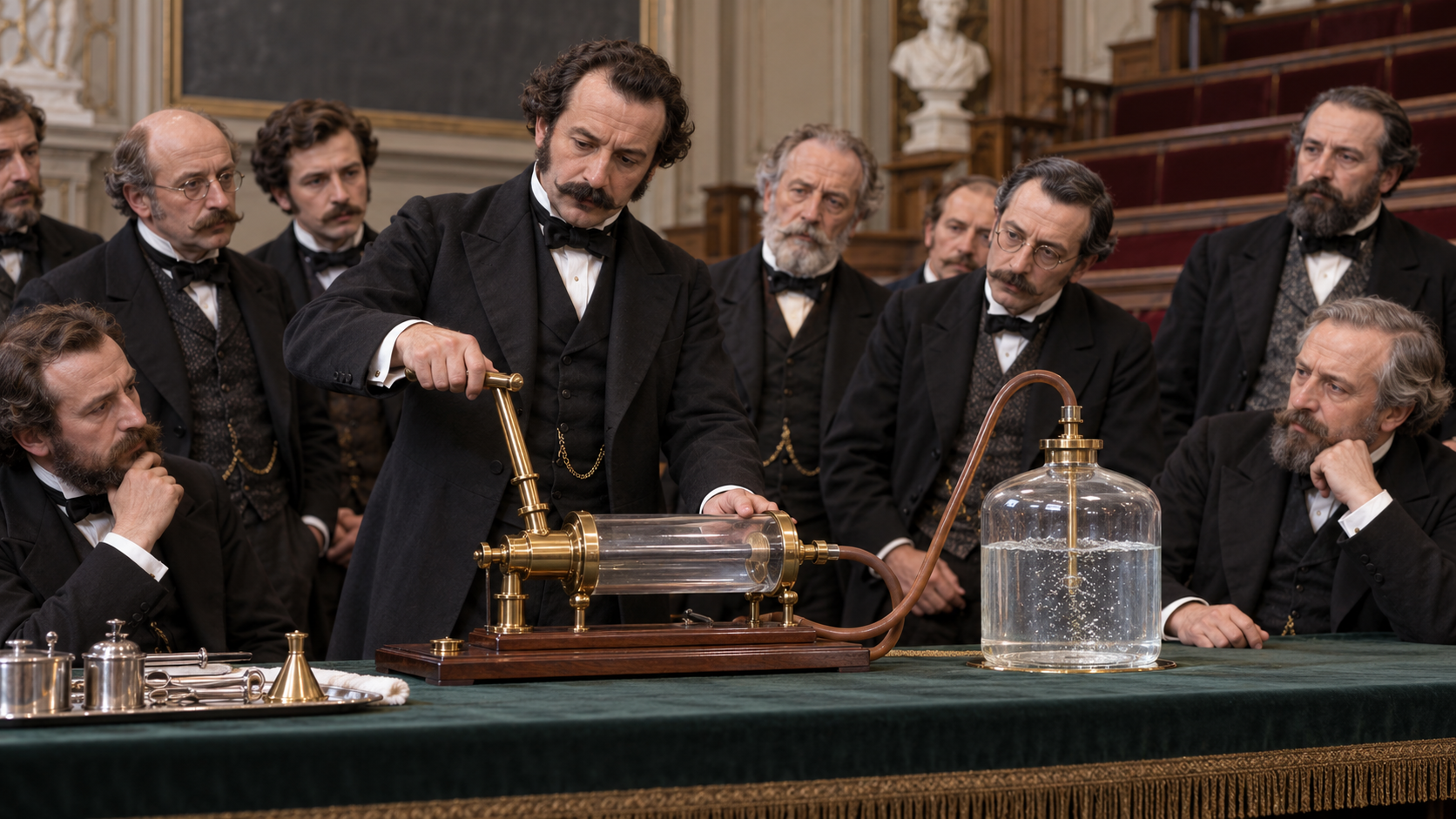
On November 2, 1869, physician Adolphe Gubler presented Georges Dieulafoy's subcutaneous aspirator to the French Academy of Medicine in Paris. This date matters because it fixes a broad medical story to a specific moment, place, and group of people. It also shows how health history is shaped carefully by institutions and practical choices as well as laboratory discoveries.
The background was already developing before that day. Doctors could puncture abscesses, cysts, and body cavities, but older trocars and open drainage carried pain, infection, bleeding, and injury risks. A controlled vacuum connected to a fine hollow needle promised a gentler way to sample or remove fluid. Those conditions defined what participants could attempt and what patients or communities could reasonably expect. The available tools, social expectations, and professional structures all shaped the result. Change also depended on cooperation among people whose roles were not always recorded equally. They explain why later accounts sometimes compress years of preparation into a single anniversary. Looking at that preparation keeps credit broad and makes the turning point easier to understand without turning it into a miracle story.
What happened on the date was consequential but limited. Dieulafoy's device used a glass syringe, stopcocks, and a preformed vacuum so the operator could aspirate without repeatedly moving the piston. It supported both diagnosis and treatment of pleural, pericardial, hepatic, and joint fluid collections. The instrument did not eliminate infection, organ injury, collapsed lung, or diagnostic error. Competing inventors disputed priority, and later designs improved valves, reservoirs, needles, sterility, and pressure control. The distinction is important: the event did not instantly solve the underlying health problem, and later progress depended on follow-up research, training, policy, funding, and public trust. Contemporary evidence also helps separate what participants knew then from interpretations added after the result became famous.
Its longer legacy reaches beyond the original setting. Aspiration became a basic clinical technique and helped move diagnosis from external signs toward direct sampling. The principle carried into thoracentesis, arthrocentesis, biopsy, drainage, and suction systems used across medicine. Modern image guidance and laboratory analysis make aspiration more precise, but safe practice still depends on anatomy, sterile technique, appropriate pressure, specimen handling, and plans for complications. Seen in context, the anniversary is useful because it connects a concrete historical episode with continuing questions about evidence, access, safety, and responsibility in health care. That connection is stronger when the people affected, the limits of the achievement, and the work still unfinished remain part of the account.
Dieulafoy's device used a glass syringe, stopcocks, and a preformed vacuum so the operator could aspirate without repeatedly moving the piston. It supported both diagnosis and treatment of pleural, pericardial, hepatic, and joint fluid collections.
The instrument did not eliminate infection, organ injury, collapsed lung, or diagnostic error. Competing inventors disputed priority, and later designs improved valves, reservoirs, needles, sterility, and pressure control.
Aspiration became a basic clinical technique and helped move diagnosis from external signs toward direct sampling. The principle carried into thoracentesis, arthrocentesis, biopsy, drainage, and suction systems used across medicine.
Doctors could puncture abscesses, cysts, and body cavities, but older trocars and open drainage carried pain, infection, bleeding, and injury risks. A controlled vacuum connected to a fine hollow needle promised a gentler way to sample or remove fluid.
physician Adolphe Gubler presented Georges Dieulafoy's subcutaneous aspirator to the French Academy of Medicine in Paris.
Modern image guidance and laboratory analysis make aspiration more precise, but safe practice still depends on anatomy, sterile technique, appropriate pressure, specimen handling, and plans for complications.
Explore more of "On This Day ..."
Discover more events from the same date across news, politics, technology, sports, and other fields. Each link highlights significant moments that shaped history on different fronts.