

On This Day in Health: November 3, 1906
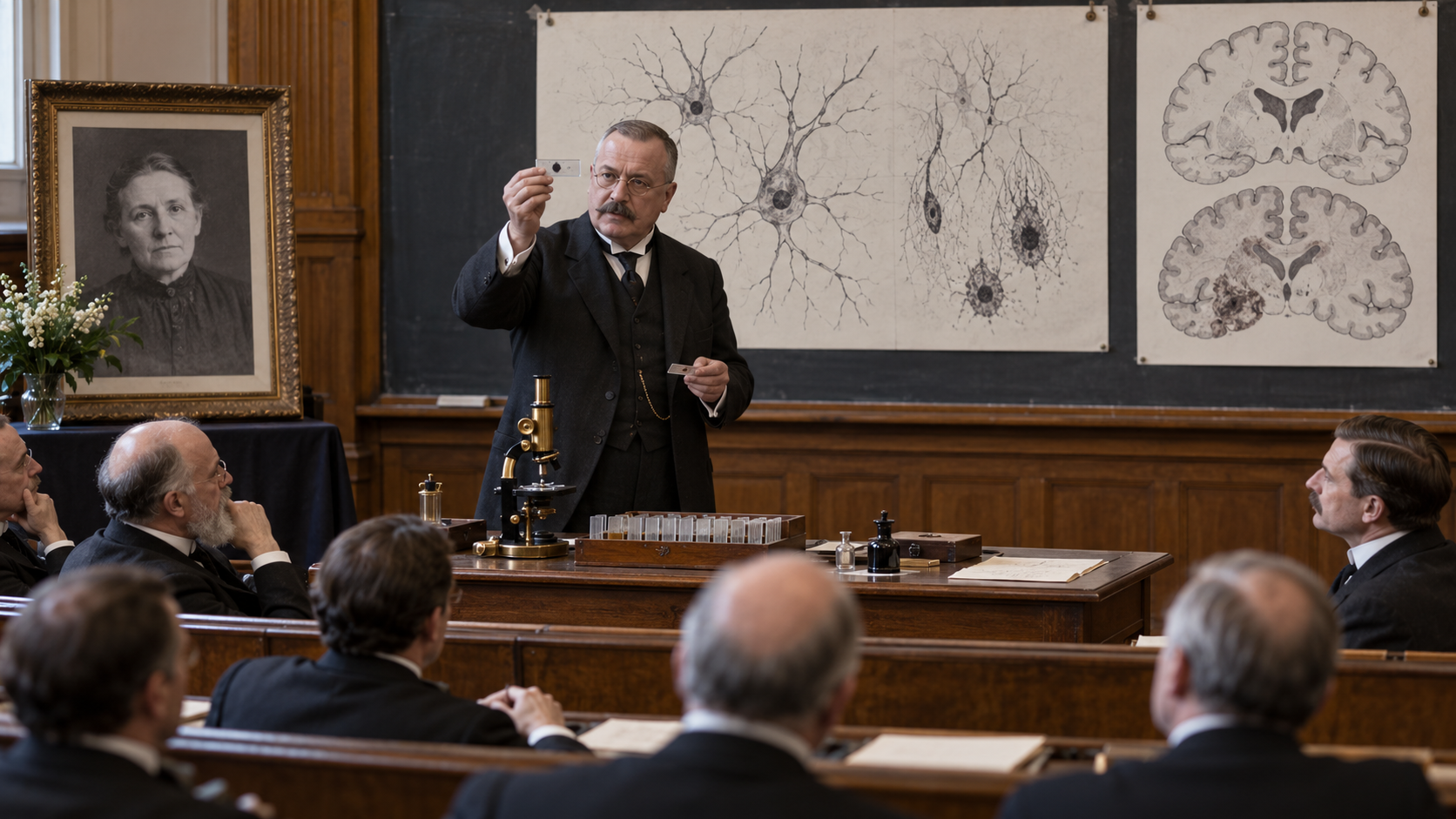
On November 3, 1906, Alois Alzheimer presented the clinical course and postmortem brain findings of Auguste Deter at a psychiatry meeting in Tubingen. This date matters because it fixes a broad medical story to a specific moment, place, and group of people. It also shows how health history is shaped carefully by institutions and practical choices as well as laboratory discoveries.
The background was already developing before that day. Deter had developed memory loss, disorientation, language difficulty, behavioral changes, and declining independence in her early fifties. Alzheimer followed her course in Frankfurt and later examined her brain with new silver-staining methods in Munich. Those conditions defined what participants could attempt and what patients or communities could reasonably expect. The available tools, social expectations, and professional structures all shaped the result. Change also depended on cooperation among people whose roles were not always recorded equally. They explain why later accounts sometimes compress years of preparation into a single anniversary. Looking at that preparation keeps credit broad and makes the turning point easier to understand without turning it into a miracle story.
What happened on the date was consequential but limited. He described unusual deposits and changes inside nerve cells, now recognized as amyloid plaques and neurofibrillary tangles, alongside the patient's progressive cognitive symptoms. The presentation connected a distinctive clinical course with visible pathology. The audience offered little discussion, and a single case could not define a disease. Later work showed that similar pathology also occurred in older adults, while modern diagnosis recognizes many causes of dementia and large differences among patients. The distinction is important: the event did not instantly solve the underlying health problem, and later progress depended on follow-up research, training, policy, funding, and public trust. Contemporary evidence also helps separate what participants knew then from interpretations added after the result became famous.
Its longer legacy reaches beyond the original setting. Emil Kraepelin later used the name Alzheimer's disease, and the case helped establish clinicopathological research in dementia. Rediscovered records and tissue have also kept Auguste Deter's individual story visible. Research now uses biomarkers, imaging, genetics, longitudinal observation, and trials, while care still requires support for autonomy, communication, caregivers, and equitable access as well as disease-modifying treatments. Seen in context, the anniversary is useful because it connects a concrete historical episode with continuing questions about evidence, access, safety, and responsibility in health care. That connection is stronger when the people affected, the limits of the achievement, and the work still unfinished remain part of the account.
He described unusual deposits and changes inside nerve cells, now recognized as amyloid plaques and neurofibrillary tangles, alongside the patient's progressive cognitive symptoms. The presentation connected a distinctive clinical course with visible pathology.
The audience offered little discussion, and a single case could not define a disease. Later work showed that similar pathology also occurred in older adults, while modern diagnosis recognizes many causes of dementia and large differences among patients.
Emil Kraepelin later used the name Alzheimer's disease, and the case helped establish clinicopathological research in dementia. Rediscovered records and tissue have also kept Auguste Deter's individual story visible.
Deter had developed memory loss, disorientation, language difficulty, behavioral changes, and declining independence in her early fifties. Alzheimer followed her course in Frankfurt and later examined her brain with new silver-staining methods in Munich.
Alois Alzheimer presented the clinical course and postmortem brain findings of Auguste Deter at a psychiatry meeting in Tubingen.
Research now uses biomarkers, imaging, genetics, longitudinal observation, and trials, while care still requires support for autonomy, communication, caregivers, and equitable access as well as disease-modifying treatments.
Explore more of "On This Day ..."
Discover more events from the same date across news, politics, technology, sports, and other fields. Each link highlights significant moments that shaped history on different fronts.