

On This Day in Health: November 23, 1667
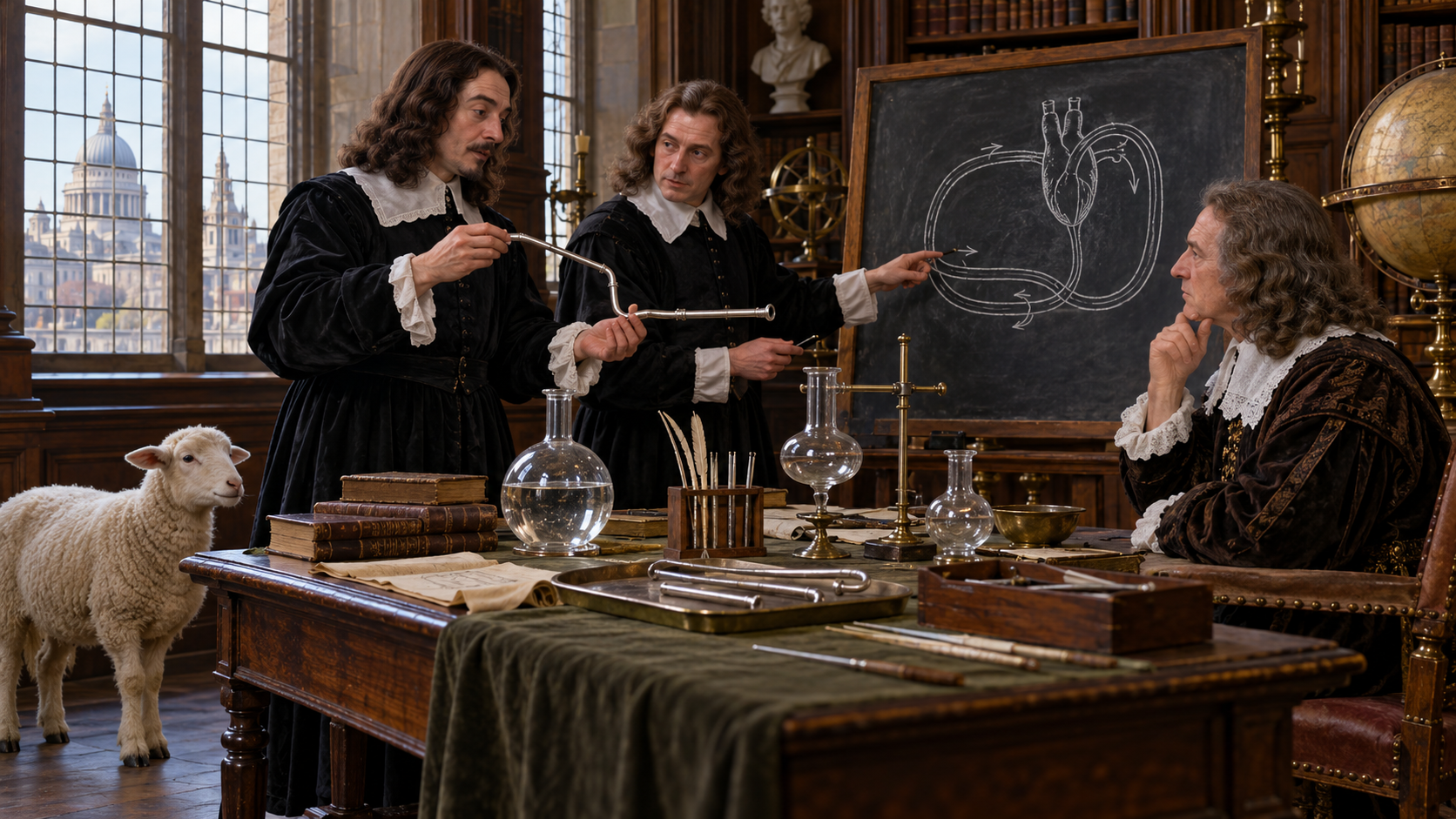
On November 23, 1667, physicians Richard Lower and Edmund King transfused a small amount of sheep's blood into Arthur Coga before members of the Royal Society in London. This date matters because it fixes a broad medical story to a specific moment, place, and group of people. It also shows how health history is shaped carefully by institutions and practical choices as well as laboratory discoveries.
The background was already developing before that day. William Harvey's account of circulation had encouraged animal experiments connecting vessels between living creatures. Investigators wondered whether transfusion might replace lost blood or alter temperament, but blood groups, immunity, infection, and compatibility were unknown. Those conditions defined what participants could attempt and what patients or communities could reasonably expect. The available tools, social expectations, and professional structures all shaped the result. Change also depended on cooperation among people whose roles were not always recorded equally. They explain why later accounts sometimes compress years of preparation into a single anniversary. Looking at that preparation keeps credit broad and makes the turning point easier to understand without turning it into a miracle story.
What happened on the date was consequential but limited. Using quills and silver tubes, Lower and King connected a lamb's artery to a vein in Coga's arm. He survived the procedure and returned for another demonstration, making it one of the best documented early animal-to-human transfusions. Survival did not prove benefit or safety. The volume was probably small, adverse reactions were poorly measured, payment and public spectacle complicated consent, and later xenotransfusions caused severe reactions and deaths before the practice was restricted. The distinction is important: the event did not instantly solve the underlying health problem, and later progress depended on follow-up research, training, policy, funding, and public trust. Contemporary evidence also helps separate what participants knew then from interpretations added after the result became famous.
Its longer legacy reaches beyond the original setting. The experiment kept questions about transfusion alive until nineteenth- and twentieth-century discoveries of blood groups, anticoagulation, storage, and testing made human donor transfusion practicable. Modern transfusion relies on voluntary donation, compatibility testing, infection screening, component therapy, traceability, and informed consent; experimental xenotransplantation now proceeds under far stricter scientific and ethical oversight. Seen in context, the anniversary is useful because it connects a concrete historical episode with continuing questions about evidence, access, safety, and responsibility in health care. That connection is stronger when the people affected, the limits of the achievement, and the work still unfinished remain part of the account.
Using quills and silver tubes, Lower and King connected a lamb's artery to a vein in Coga's arm. He survived the procedure and returned for another demonstration, making it one of the best documented early animal-to-human transfusions.
Survival did not prove benefit or safety. The volume was probably small, adverse reactions were poorly measured, payment and public spectacle complicated consent, and later xenotransfusions caused severe reactions and deaths before the practice was restricted.
The experiment kept questions about transfusion alive until nineteenth- and twentieth-century discoveries of blood groups, anticoagulation, storage, and testing made human donor transfusion practicable.
William Harvey's account of circulation had encouraged animal experiments connecting vessels between living creatures. Investigators wondered whether transfusion might replace lost blood or alter temperament, but blood groups, immunity, infection, and compatibility were unknown.
physicians Richard Lower and Edmund King transfused a small amount of sheep's blood into Arthur Coga before members of the Royal Society in London.
Modern transfusion relies on voluntary donation, compatibility testing, infection screening, component therapy, traceability, and informed consent; experimental xenotransplantation now proceeds under far stricter scientific and ethical oversight.
Explore more of "On This Day ..."
Discover more events from the same date across news, politics, technology, sports, and other fields. Each link highlights significant moments that shaped history on different fronts.