

On This Day in Health: November 24, 1861
On November 24, 1861, August Karl Gustav Bier was born in Helsen, Germany, and later became a surgeon whose experiments helped establish neuraxial and regional anesthesia. This date matters because it fixes a broad medical story to a specific moment, place, and group of people. It also shows how health history is shaped carefully by institutions and practical choices as well as laboratory discoveries.
The background was already developing before that day. Cocaine's local anesthetic effect suggested that blocking nerves could prevent pain without general unconsciousness. James Corning had injected cocaine near the spine, but whether the drug entered the spinal fluid and produced true spinal anesthesia remained disputed. Those conditions defined what participants could attempt and what patients or communities could reasonably expect. The available tools, social expectations, and professional structures all shaped the result. Change also depended on cooperation among people whose roles were not always recorded equally. They explain why later accounts sometimes compress years of preparation into a single anniversary. Looking at that preparation keeps credit broad and makes the turning point easier to understand without turning it into a miracle story.
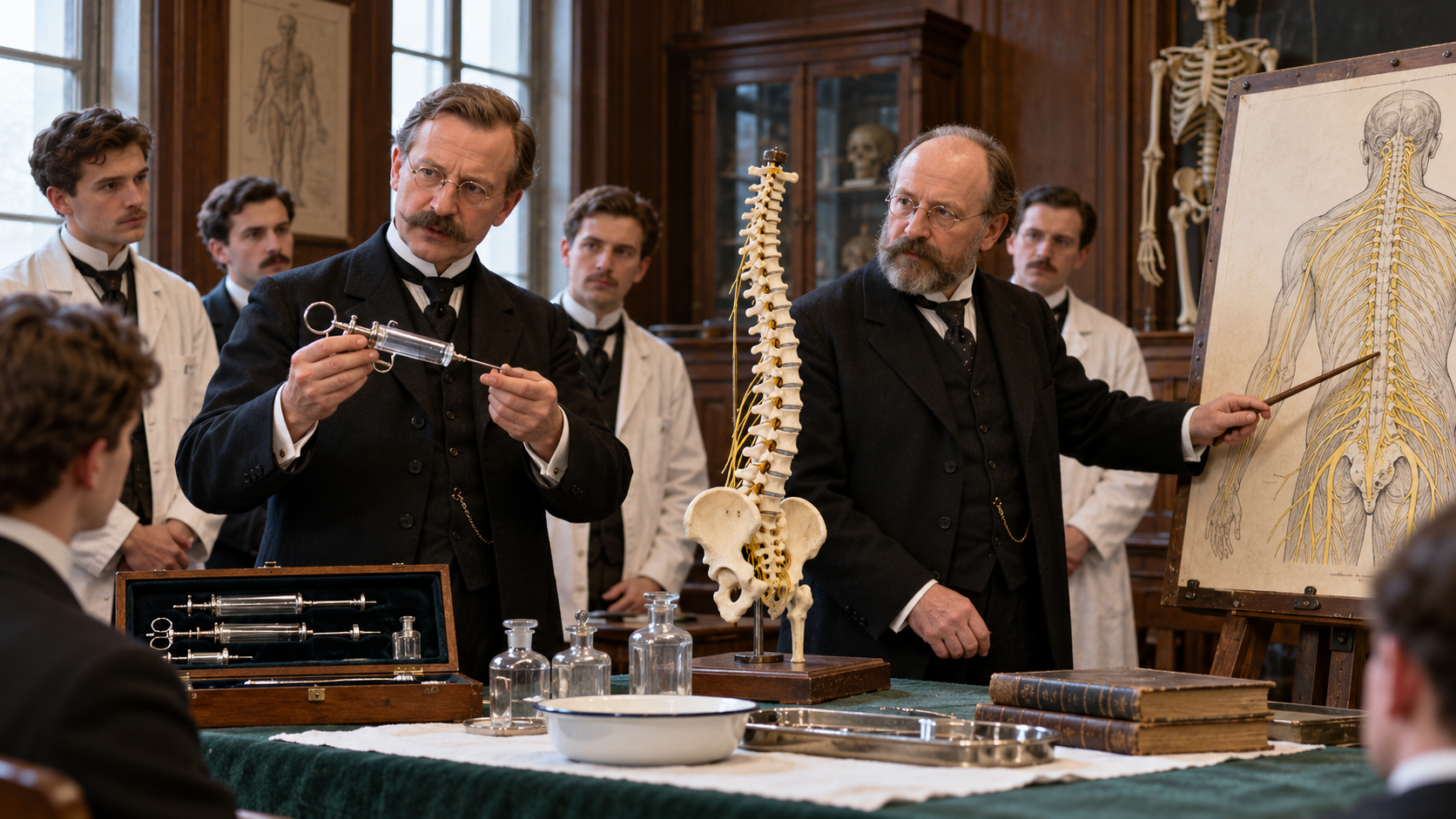
What happened on the date was consequential but limited. In 1898 Bier injected cocaine into the subarachnoid space for surgery, then tested the method with his assistant August Hildebrandt. He documented profound numbness as well as severe headache, nausea, and other complications. Self-experimentation and testing on subordinates do not meet modern consent standards, and cocaine carried toxicity and dependence risks. Early needles, dosing, sterility, fluids, and monitoring made spinal anesthesia unpredictable. The distinction is important: the event did not instantly solve the underlying health problem, and later progress depended on follow-up research, training, policy, funding, and public trust. Contemporary evidence also helps separate what participants knew then from interpretations added after the result became famous.
Its longer legacy reaches beyond the original setting. Bier's reports helped define spinal anesthesia, and his later intravenous regional technique offered another way to confine anesthetic effect to a limb. Safer local anesthetics, fine needles, sterile practice, ultrasound, monitoring, resuscitation, and patient selection now support regional techniques for surgery, childbirth, and pain control. Seen in context, the anniversary is useful because it connects a concrete historical episode with continuing questions about evidence, access, safety, and responsibility in health care. That connection is stronger when the people affected, the limits of the achievement, and the work still unfinished remain part of the account.
In 1898 Bier injected cocaine into the subarachnoid space for surgery, then tested the method with his assistant August Hildebrandt. He documented profound numbness as well as severe headache, nausea, and other complications.
Self-experimentation and testing on subordinates do not meet modern consent standards, and cocaine carried toxicity and dependence risks. Early needles, dosing, sterility, fluids, and monitoring made spinal anesthesia unpredictable.
Bier's reports helped define spinal anesthesia, and his later intravenous regional technique offered another way to confine anesthetic effect to a limb.
Cocaine's local anesthetic effect suggested that blocking nerves could prevent pain without general unconsciousness. James Corning had injected cocaine near the spine, but whether the drug entered the spinal fluid and produced true spinal anesthesia remained disputed.
August Karl Gustav Bier was born in Helsen, Germany, and later became a surgeon whose experiments helped establish neuraxial and regional anesthesia.
Safer local anesthetics, fine needles, sterile practice, ultrasound, monitoring, resuscitation, and patient selection now support regional techniques for surgery, childbirth, and pain control.
Explore more of "On This Day ..."
Discover more events from the same date across news, politics, technology, sports, and other fields. Each link highlights significant moments that shaped history on different fronts.