

On This Day in Lifestyles: January 3, 1888
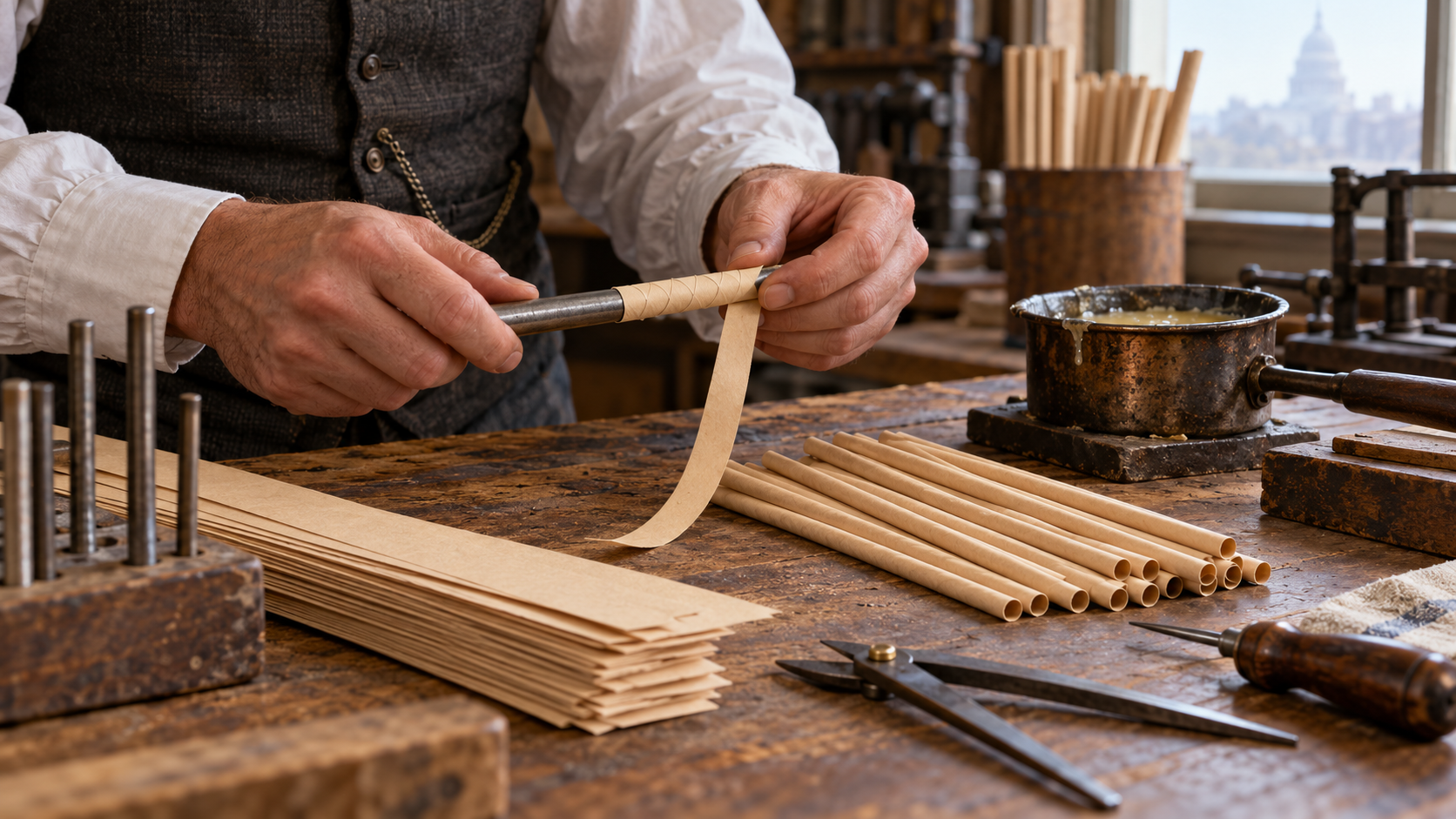
On January 3, 1888, the United States granted Patent No. 375,962 to Marvin C. Stone of Washington, D.C., for an “artificial straw.” Stone’s idea answered an ordinary annoyance: natural rye straws could soften, shed fibers, and give drinks an earthy taste. His alternative began as a narrow strip of paper wound spirally around a spindle. The overlapping edges were glued together, creating a light but uniform tube. The patent described dipping the finished straw in paraffin or another waterproof coating so that it would resist liquid without becoming soggy. At a time when soda fountains were becoming important social gathering places, a reliable tube also made a served drink look cleaner and more consistent.
Stone was already experienced with spiral-wound paper products. His factory made paper cigarette holders, and the same basic machinery could produce drinking tubes in consistent sizes. The patent application, filed in May 1887, specified a design strong enough for everyday use while remaining inexpensive to manufacture. Beveled ends helped the paper wrap overlap neatly, avoiding a weak seam. Unlike a reed selected by nature, each finished straw could have the same diameter, length, and smooth interior. That predictability suited soda fountains and other businesses serving drinks quickly to many customers. It also translated a hand-selected natural object into something a factory could count, package, ship, and replace without changing the experience for the person using it.
The paper straw did not instantly create the modern drinking-straw market, but it turned a perishable plant stem into a standardized consumer product. By 1890, according to the Smithsonian’s history of the invention, Stone’s factory was making more straws than cigarette holders. Later inventors changed the form: Joseph Friedman patented a bendable drinking straw in the 1930s after watching his daughter struggle with a straight one. Plastics eventually displaced much of the paper market because they were cheap, flexible, and durable, benefits that also created a persistent waste problem. Stone’s original patent should not be confused with Friedman’s flexible design; the 1888 breakthrough was the straight, spiral-wound paper tube and its moisture-resistant treatment.
Stone’s patent matters because it shows how small design improvements can reshape daily habits. The product was not a spectacular machine; it was a carefully engineered answer to taste, cleanliness, and consistency. More than a century later, concerns about single-use plastic have returned paper straws to restaurants and public debate, although modern versions use different materials and coatings. The familiar tube beside a glass therefore carries a layered history: a natural reed, Stone’s rolled paper, the flexible straw, mass-produced plastic, and today’s renewed search for disposable products with a lighter environmental cost. That long cycle also complicates simple claims that one material alone is the answer, since strength, coating chemistry, manufacturing energy, and local waste systems all shape a straw’s real impact.
Marvin Stone received U.S. Patent No. 375,962 on January 3, 1888, after applying in May 1887. His artificial straw replaced variable natural rye stems with a manufactured tube.
The patented method wound a paper strip spirally around a spindle, glued the overlapping edges, and treated the tube with paraffin or another waterproof coating.
Stone adapted expertise from making paper cigarette holders, giving his factory a practical route to produce straws in uniform lengths and diameters.
The 1888 product was a straight straw, not the bendable version patented by Joseph Friedman decades later, and early paper coatings differed from those used today.
By 1890, Stone’s factory reportedly made more drinking straws than cigarette holders, helping turn an improvised drinking aid into a standardized consumer product.
Plastic later dominated the market, but concerns about persistent waste have renewed interest in paper and made the material history of the straw newly relevant.
Explore more of “This Day in Lifestyles”
Discover more moments in everyday life, design, education, travel, food, fashion, and culture. Each story connects a calendar date with an event that changed how people lived.