

On This Day in Life: August 5, 1914
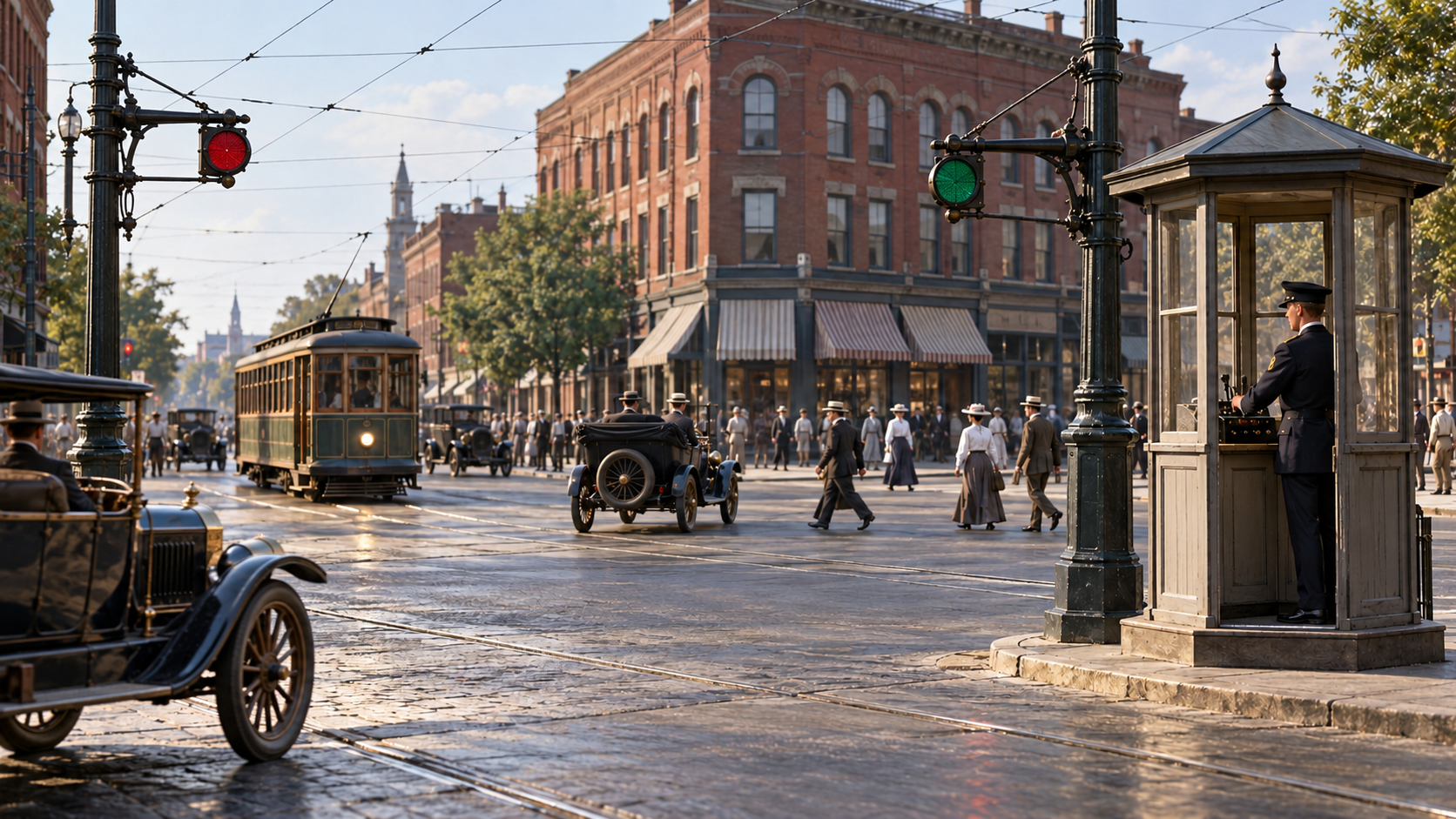
On August 5, 1914, Cleveland officials tested a new electric traffic-control system at Euclid Avenue and East 105th Street, using interlocked red and green signals controlled by an officer from a roadside booth. The date matters in lifestyle history because a controlled intersection changed how strangers negotiated shared urban space without speaking to one another. It was not merely a headline for institutions or specialists; it touched the settings, objects, expectations, and shared rituals through which people organized ordinary days. Streetcars, early automobiles, a horse-drawn wagon, cyclists, and pedestrians waited beneath paired signal lamps while an officer watched from a small corner booth among brick buildings and overhead trolley wires. Seen at human scale, the episode shows how a public milestone becomes meaningful through repeated personal choices, conversations, and memories.
Engineer James Hoge designed the municipal system for streets crowded with automobiles, streetcars, bicycles, wagons, and pedestrians. Four pairs of lights faced the approaches, bells warned that the right of way was changing, and the interlocking controls prevented conflicting directions from receiving a proceed signal at once. Connections also allowed emergency traffic to be cleared. The setting is essential to understanding why the event attracted attention. New ideas rarely arrive in isolation: they meet existing technology, commerce, custom, law, and desire. Contemporary newspapers, public spaces, shops, schools, workplaces, or homes carried the story outward, giving people practical ways to interpret it. Some welcomed the change, others doubted it, and many first encountered it indirectly. That mixture of novelty and familiarity helped the moment travel from a single date into a broader change in behavior.
The installation moved the officer away from the dangerous center of the junction and gave road users a shared visual rule. It was not the first traffic signal of every kind: London had tried a gas-lit semaphore in 1868, and other American inventors had experimented with electric devices. Cleveland’s system is widely treated as the first permanent municipal electric signal installation. In daily life, the consequences appeared through altered routines, new expectations, and different ways of spending time or money. Three-color signals, automatic timing, synchronized corridors, pedestrian indications, sensors, and computer control followed. The red-yellow-green language became so familiar that it spread beyond roads into classrooms, sports, warnings, and everyday speech. The benefits were never the whole story; major changes also exposed questions about access, responsibility, fairness, cost, and who had power to define progress. Those tensions deserve a place beside the celebration because they show how culture actually develops. The event mattered not because everyone experienced it in the same way, but because it opened a durable argument about how people wanted to live.
Today, the legacy remains visible: traffic lights remain basic urban infrastructure, even as cities add transit priority, accessible pedestrian cues, cameras, sensors, and designs intended to protect people outside cars. Familiarity can make that inheritance easy to overlook, yet the practices surrounding it were built through years of experimentation, adaptation, criticism, and use. Looking back does more than celebrate an anniversary. It reveals the chain between public decisions and private habits, between ambitious ideas and the small acts that make them ordinary. On this day, one historical moment became part of the texture of modern life. Remembering the full setting lets the milestone feel less like a frozen fact and more like a living part of experience.
On August 5, 1914, Cleveland officials tested a new electric traffic-control system at Euclid Avenue and East 105th Street, using interlocked red and green signals controlled by an officer from a roadside booth.
Engineer James Hoge designed the municipal system for streets crowded with automobiles, streetcars, bicycles, wagons, and pedestrians. Four pairs of lights faced the approaches, bells warned that the right of way was changing, and the interlocking controls prevented conflicting directions from receiving a proceed signal at once. Connections also allowed emergency traffic to be cleared.
The installation moved the officer away from the dangerous center of the junction and gave road users a shared visual rule. It was not the first traffic signal of every kind: London had tried a gas-lit semaphore in 1868, and other American inventors had experimented with electric devices. Cleveland's system is widely treated as the first permanent municipal electric signal installation.
The event matters in lifestyle history because a controlled intersection changed how strangers negotiated shared urban space without speaking to one another.
Three-color signals, automatic timing, synchronized corridors, pedestrian indications, sensors, and computer control followed. The red-yellow-green language became so familiar that it spread beyond roads into classrooms, sports, warnings, and everyday speech.
The legacy remains visible today: traffic lights remain basic urban infrastructure, even as cities add transit priority, accessible pedestrian cues, cameras, sensors, and designs intended to protect people outside cars.
Explore more of "On This Day ..."
Discover more events from the same date across news, politics, technology, sports, and other fields. Each link highlights significant moments that shaped history on different fronts.