

On This Day in Lifestyles: August 7, 1888
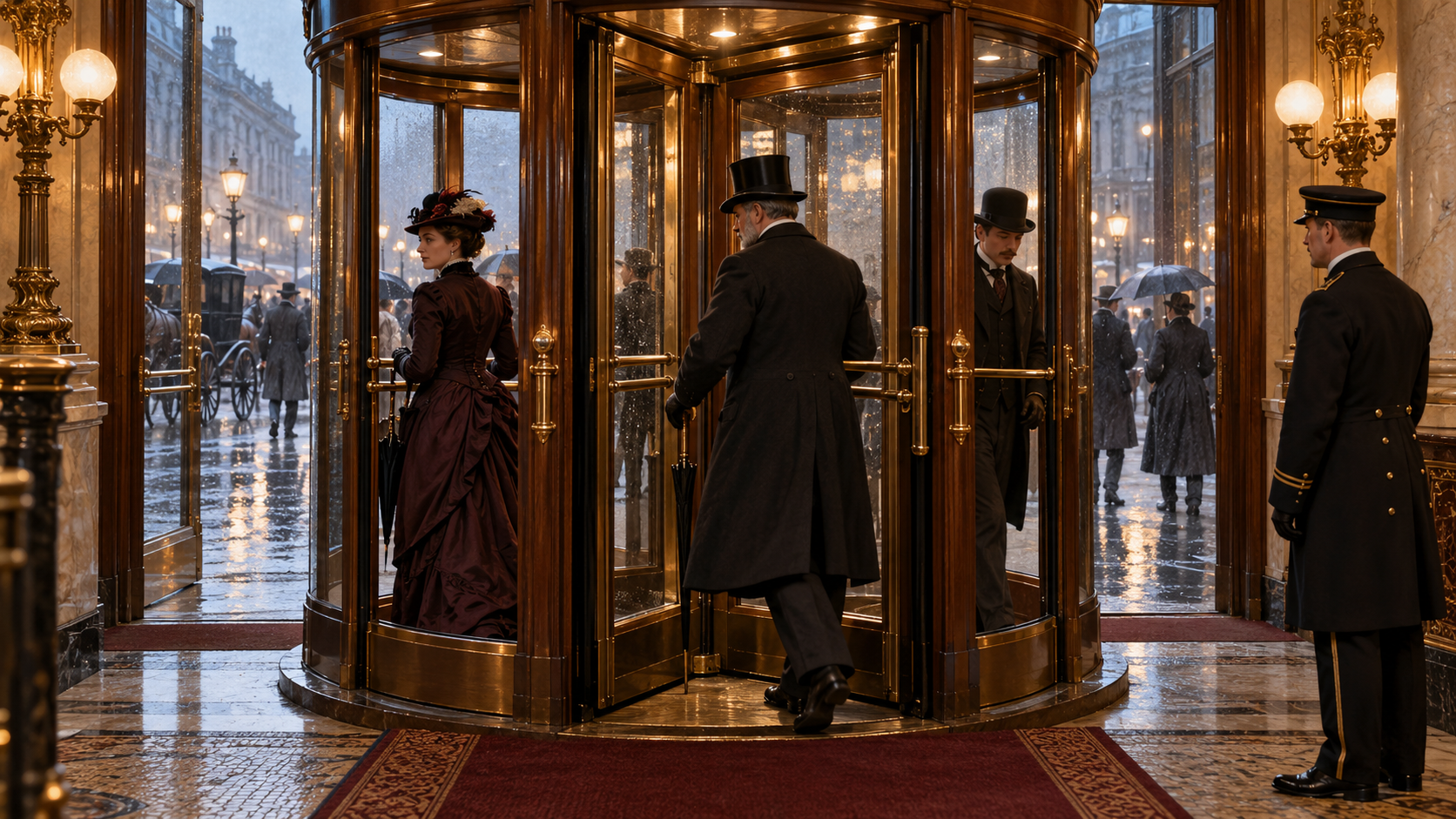
On August 7, 1888, Philadelphia inventor Theophilus Van Kannel received U.S. Patent No. 387,571 for his revolving storm door, a rotating entrance intended to keep weather out while people moved continuously through a building. The date matters in lifestyle history because a small mechanical invention changed the physical rhythm of entering public buildings. It was not merely a headline for institutions or specialists; it touched the settings, objects, expectations, and shared rituals through which people organized ordinary days. Inside a late-Victorian hotel entrance, visitors in coats and hats moved through a dark wood-and-glass revolving door while wind pressed rain against the outer vestibule. Seen at human scale, the episode shows how a public milestone becomes meaningful through repeated personal choices, conversations, and memories.
Van Kannel described three or four wings fitted inside a circular enclosure, with weather stripping that maintained a nearly constant barrier between interior and exterior air. Unlike paired swinging doors, the design could prevent gusts from rushing through an open entrance and could channel people entering and leaving without direct collision. The setting is essential to understanding why the event attracted attention. New ideas rarely arrive in isolation: they meet existing technology, commerce, custom, law, and desire. Contemporary newspapers, public spaces, shops, schools, workplaces, or homes carried the story outward, giving people practical ways to interpret it. Some welcomed the change, others doubted it, and many first encountered it indirectly. That mixture of novelty and familiarity helped the moment travel from a single date into a broader change in behavior.
The mechanism answered a practical problem in hotels, offices, shops, and other busy buildings: how to welcome a steady stream of visitors without surrendering indoor comfort to wind, dust, rain, and winter cold. Its rotating compartments also became a recognizable piece of urban etiquette and architecture. In daily life, the consequences appeared through altered routines, new expectations, and different ways of spending time or money. Revolving doors spread through commercial construction and later gained speed controls, collapsible wings, improved glass, accessible adjacent entrances, and safety standards. Their energy-saving effect remains useful because they greatly reduce uncontrolled air exchange at a frequently used doorway. The benefits were never the whole story; major changes also exposed questions about access, responsibility, fairness, cost, and who had power to define progress. Those tensions deserve a place beside the celebration because they show how culture actually develops. The event mattered not because everyone experienced it in the same way, but because it opened a durable argument about how people wanted to live.
Today, the legacy remains visible: revolving doors remain common in large buildings, balanced with automatic and accessible swing doors so that comfort, energy use, emergency egress, and inclusive access can work together. Familiarity can make that inheritance easy to overlook, yet the practices surrounding it were built through years of experimentation, adaptation, criticism, and use. Looking back does more than celebrate an anniversary. It reveals the chain between public decisions and private habits, between ambitious ideas and the small acts that make them ordinary. On this day, one historical moment became part of the texture of modern life. Remembering the full setting lets the milestone feel less like a frozen fact and more like a living part of experience.
On August 7, 1888, Philadelphia inventor Theophilus Van Kannel received U.S. Patent No. 387,571 for his revolving storm door, a rotating entrance intended to keep weather out while people moved continuously through a building.
Van Kannel described three or four wings fitted inside a circular enclosure, with weather stripping that maintained a nearly constant barrier between interior and exterior air. Unlike paired swinging doors, the design could prevent gusts from rushing through an open entrance and could channel people entering and leaving without direct collision.
The mechanism answered a practical problem in hotels, offices, shops, and other busy buildings: how to welcome a steady stream of visitors without surrendering indoor comfort to wind, dust, rain, and winter cold. Its rotating compartments also became a recognizable piece of urban etiquette and architecture.
The event matters in lifestyle history because a small mechanical invention changed the physical rhythm of entering public buildings.
Revolving doors spread through commercial construction and later gained speed controls, collapsible wings, improved glass, accessible adjacent entrances, and safety standards. Their energy-saving effect remains useful because they greatly reduce uncontrolled air exchange at a frequently used doorway.
The legacy remains visible today: revolving doors remain common in large buildings, balanced with automatic and accessible swing doors so that comfort, energy use, emergency egress, and inclusive access can work together.
Explore more of “This Day in Lifestyles”
Discover more moments in everyday life, design, education, travel, food, fashion, and culture. Each story connects a calendar date with an event that changed how people lived.