

On This Day in Lifestyles: August 17, 1907
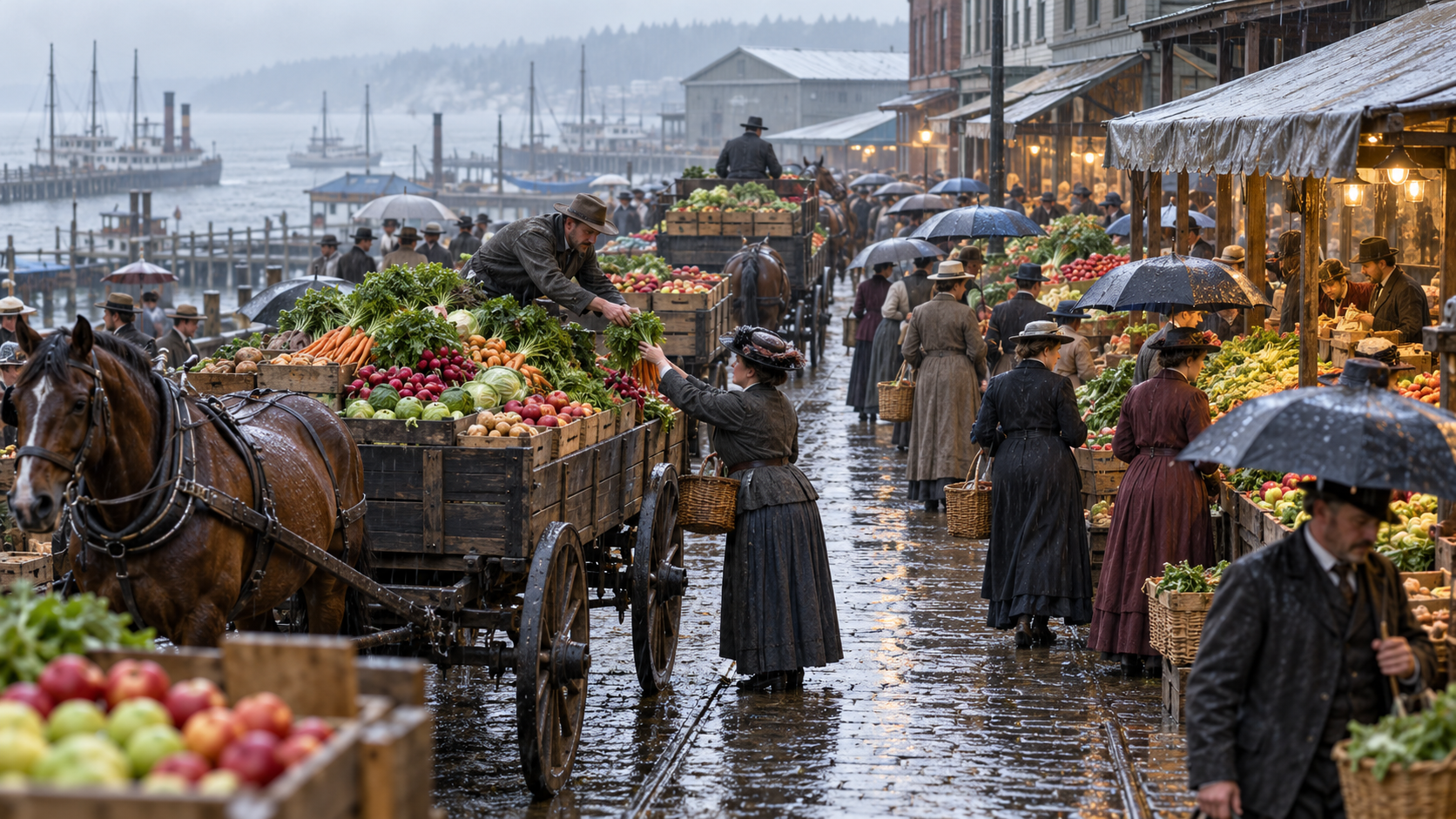
On August 17, 1907, Seattle opened a public farmers’ market along Pike Place, allowing growers to sell produce directly to city shoppers. The date matters in lifestyle history because a direct meeting between growers and customers reshaped the price, place, and social meaning of food shopping. It was not merely a headline for institutions or specialists; it touched the settings, objects, expectations, and shared rituals through which people organized ordinary days. Farm wagons lined a rain-darkened Seattle street as shoppers with baskets crowded around heaps of berries, vegetables, eggs, and flowers beneath umbrellas. Seen at human scale, the episode shows how a public milestone becomes meaningful through repeated personal choices, conversations, and memories.
Food prices had risen rapidly, and city council member Thomas Revelle proposed a market that would bypass wholesalers accused of widening the gap between farm and retail prices. On a rainy Saturday, only a small group of farmers arrived, but crowds quickly bought their wagons empty. More producers came the next week. The setting is essential to understanding why the event attracted attention. New ideas rarely arrive in isolation: they meet existing technology, commerce, custom, law, and desire. Contemporary newspapers, public spaces, shops, schools, workplaces, or homes carried the story outward, giving people practical ways to interpret it. Some welcomed the change, others doubted it, and many first encountered it indirectly. That mixture of novelty and familiarity helped the moment travel from a single date into a broader change in behavior.
The market made bargaining, seasonal food, immigrant enterprise, neighborhood sociability, and the visible labor of farming part of downtown life. Permanent arcades, shops, lodging, and services grew around the curbside exchange, creating a layered commercial district rather than a single building. In daily life, the consequences appeared through altered routines, new expectations, and different ways of spending time or money. By the 1960s the aging market faced demolition, but citizens won a preservation campaign and created a historic district. Rehabilitation protected low-income housing and small businesses alongside tourism, though affordability and stewardship remain continuing concerns. The benefits were never the whole story; major changes also exposed questions about access, responsibility, fairness, cost, and who had power to define progress. Those tensions deserve a place beside the celebration because they show how culture actually develops. The event mattered not because everyone experienced it in the same way, but because it opened a durable argument about how people wanted to live.
Today, the legacy remains visible: Pike Place remains a working market and global visitor destination where farmers, fish sellers, craftspeople, residents, restaurants, social services, and preservation rules share limited space. Familiarity can make that inheritance easy to overlook, yet the practices surrounding it were built through years of experimentation, adaptation, criticism, and use. Looking back does more than celebrate an anniversary. It reveals the chain between public decisions and private habits, between ambitious ideas and the small acts that make them ordinary. On this day, one historical moment became part of the texture of modern life. Remembering the full setting lets the milestone feel less like a frozen fact and more like a living part of experience.
On August 17, 1907, Seattle opened a public farmers' market along Pike Place, allowing growers to sell produce directly to city shoppers.
Food prices had risen rapidly, and city council member Thomas Revelle proposed a market that would bypass wholesalers accused of widening the gap between farm and retail prices. On a rainy Saturday, only a small group of farmers arrived, but crowds quickly bought their wagons empty. More producers came the next week.
The market made bargaining, seasonal food, immigrant enterprise, neighborhood sociability, and the visible labor of farming part of downtown life. Permanent arcades, shops, lodging, and services grew around the curbside exchange, creating a layered commercial district rather than a single building.
The event matters in lifestyle history because a direct meeting between growers and customers reshaped the price, place, and social meaning of food shopping.
By the 1960s the aging market faced demolition, but citizens won a preservation campaign and created a historic district. Rehabilitation protected low-income housing and small businesses alongside tourism, though affordability and stewardship remain continuing concerns.
The legacy remains visible today: Pike Place remains a working market and global visitor destination where farmers, fish sellers, craftspeople, residents, restaurants, social services, and preservation rules share limited space.
Explore more of “This Day in Lifestyles”
Discover more moments in everyday life, design, education, travel, food, fashion, and culture. Each story connects a calendar date with an event that changed how people lived.