

On This Day in News: January 1, 1959
In the early hours of January 1, 1959, Cuban President Fulgencio Batista fled Havana under mounting military and political pressure, signaling the end of his authoritarian government and a dramatic turning point in Cuban history. For years, Batista had ruled with the support of elements of the military, influential business interests, and U.S. backing. His rule became increasingly associated with corruption, political repression, and deepening inequality. The urban unrest and guerrilla resistance that grew during the 1950s culminated in a national crisis. Batista’s departure created a power vacuum that allowed Fidel Castro and the July 26 Movement to claim victory in the Cuban Revolution after more than two years of armed struggle.
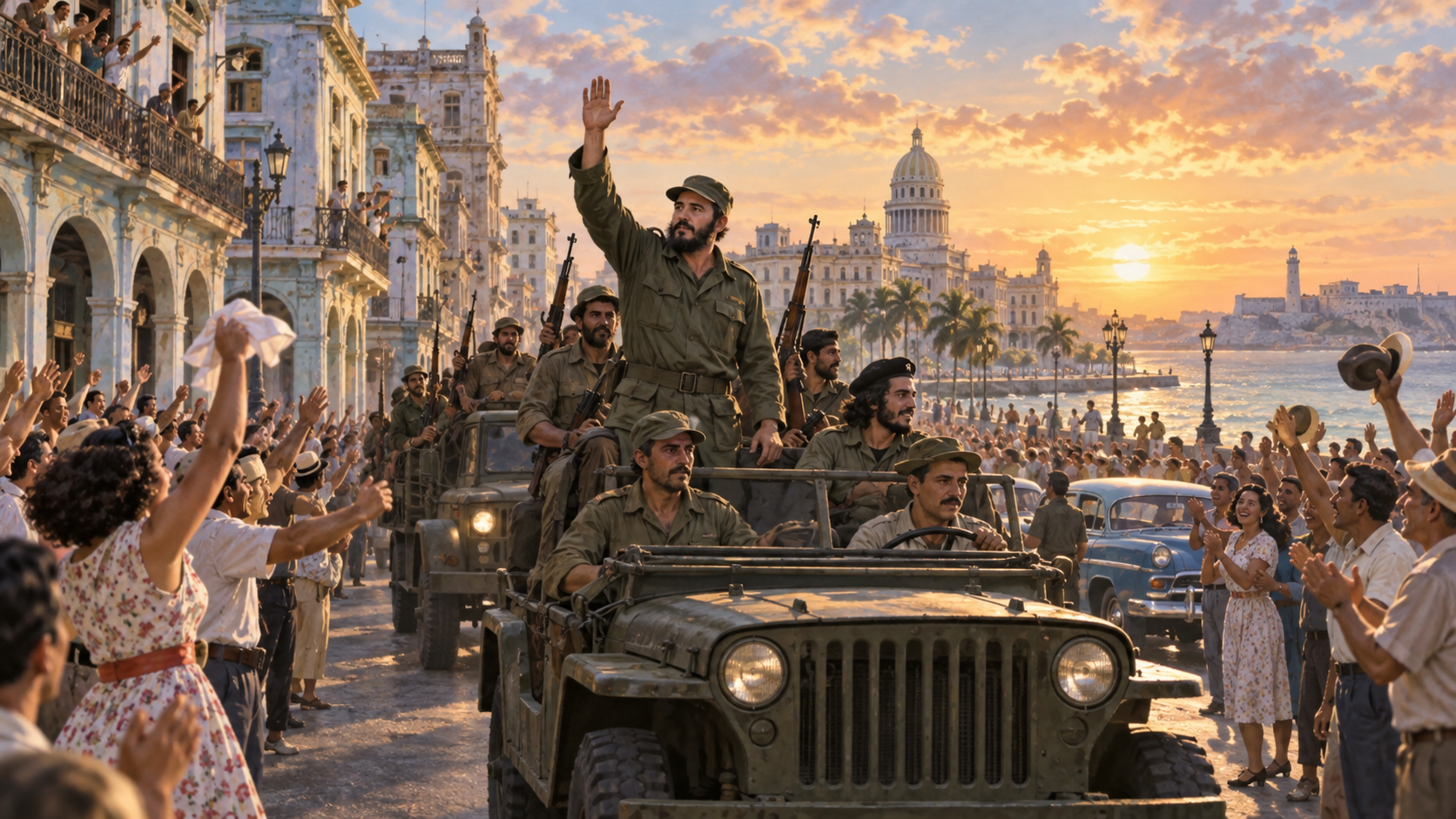
The fall of the Batista regime was welcomed by many Cubans who saw the revolution as a moment of national renewal. Castro’s supporters promised sweeping change, including political reform, elections, and an end to corruption. As revolutionaries advanced triumphantly toward Havana in the first days of January, large crowds gathered to celebrate. The event was covered widely across the world, capturing the attention of governments, foreign correspondents, and the international public. Many viewed the revolution as a popular uprising against dictatorship, the culmination of grassroots discontent that had moved from the Sierra Maestra to the center of political power.
In the months that followed, Castro consolidated political authority and began reshaping Cuba’s domestic and international posture. The revolution soon evolved beyond the ousting of Batista, transforming into a broader social and economic project. Agrarian reform, nationalization of private assets, and the reorientation of foreign policy reshaped Cuba’s role on the global stage. The United States, which had long maintained a dominant presence in Cuban affairs, saw its influence diminish. Tensions between Havana and Washington escalated, and Cuba’s closer alignment with the Soviet Union helped define the Cold War in the Western Hemisphere. The shift ultimately contributed to events such as the Bay of Pigs invasion and the Cuban Missile Crisis, reinforcing January 1, 1959 as not only a domestic political transformation but a defining moment in global geopolitics.
While the revolution remains a symbol of liberation for some and a source of contention for others, the significance of January 1, 1959 is undisputed. It marked the beginning of a new era in Cuban identity, regional politics, and international relations. The overthrow of Batista changed how nations viewed the dynamics of revolution, nationalism, and superpower rivalry. Decades later, the events of that day continue to be studied for what they represented: a dramatic reversal of power and a moment that reshaped the course of the 20th century.
By January 1, 1959, the Cuban Revolution had reached a decisive moment. For several years, Fidel Castro and the July 26 Movement had waged a guerrilla campaign against the U.S.-backed government of President Fulgencio Batista, drawing support from students, rural communities, and urban opposition groups frustrated by corruption and political repression.
In the final days of 1958, rebel forces captured key cities in central Cuba, cutting off government troops and weakening Batista’s control. Facing mounting military defeats and loss of political backing, Batista fled Havana in the early hours of New Year’s Day, leaving a power vacuum that allowed Castro’s movement to claim victory and begin shaping a new political order.
The immediate effect of Batista’s departure was the rapid collapse of the existing government structure. Rebel columns entered Havana amid public celebrations, and provisional authorities loyal to the revolution took over key institutions. Many Cubans viewed the moment as a fresh start after years of censorship, inequality, and violence under Batista’s rule.
Yet the direction of the new government was not fully defined on January 1. While there was broad agreement on the need for reform, different factions within the anti-Batista coalition held varying visions for Cuba’s future. Over the following months, as Castro consolidated power, some early expectations of pluralistic politics and quick elections gave way to a more centralized revolutionary leadership and a restructured political system.
In the long term, the revolution that triumphed on January 1, 1959 reshaped Cuba’s political and constitutional framework. Land reform, nationalization of major industries, and the restructuring of state institutions gradually replaced the old order. These changes were accompanied by a one-party political model and a new constitution that formalized the role of the revolutionary leadership.
Internationally, the event transformed Cuba’s place in global affairs. Tensions with the United States grew as the new government pursued policies that clashed with U.S. interests and moved closer to the Soviet Union, contributing to key Cold War confrontations such as the Bay of Pigs invasion and the Cuban Missile Crisis. The revolution’s victory on this day thus became a pivotal reference point for debates about nationalism, social justice, and ideological conflict throughout the second half of the 20th century.
Explore more of "On This Day ..."
Discover more events from the same date across news, politics, technology, sports, and other fields. Each link highlights significant moments that shaped history on different fronts.