

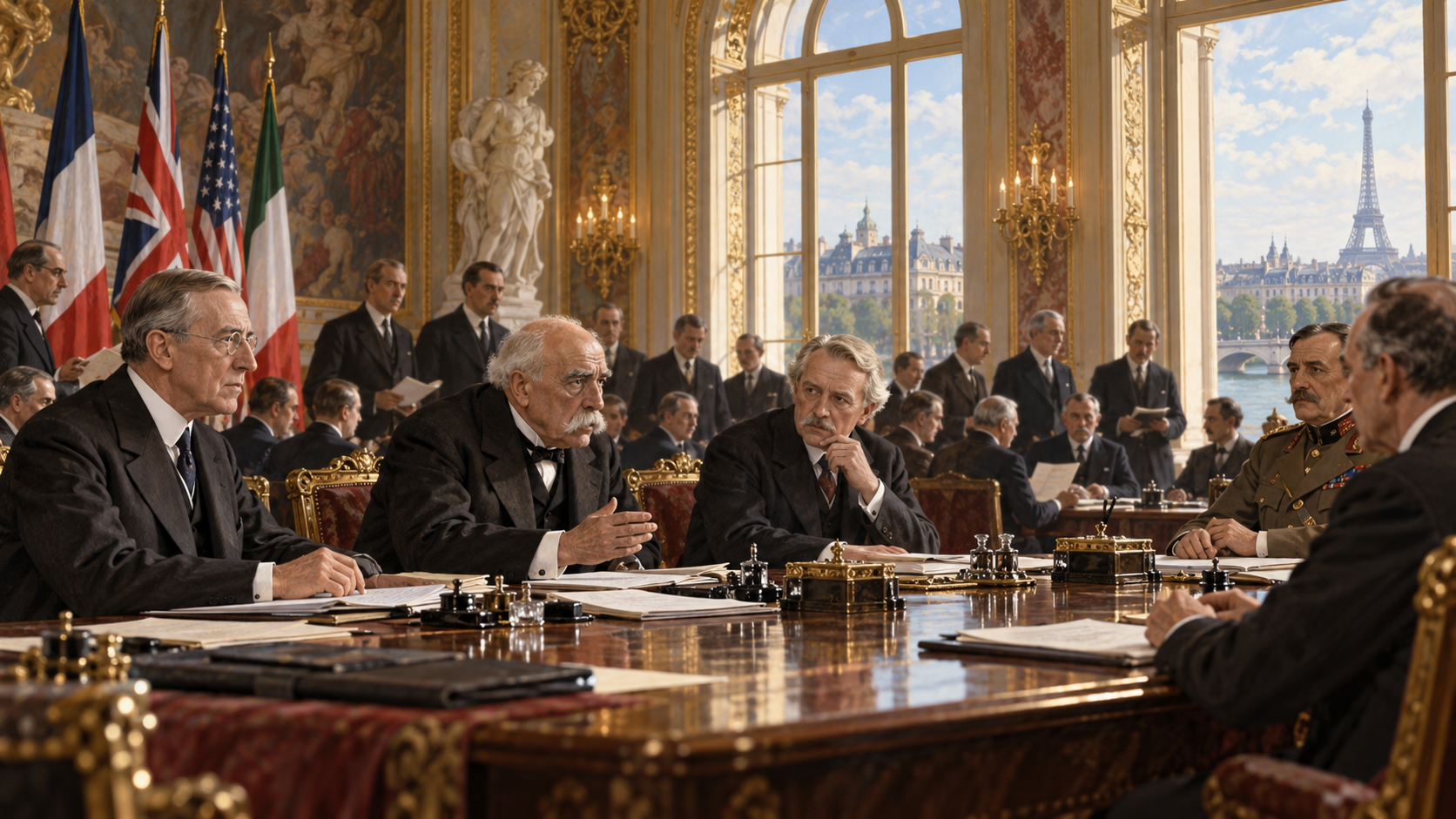
On This Day in News: January 18, 1919
On January 18, 1919, diplomats, generals and political leaders converged on Paris to open the Paris Peace Conference, the vast effort to define the peace after the First World War. Delegates from around thirty nations took their seats, but real power quickly centered on the “Big Four”: French prime minister Georges Clemenceau, U.S. president Woodrow Wilson, British prime minister David Lloyd George and Italian prime minister Vittorio Orlando. They gathered at the French foreign ministry on the Quai d’Orsay and in the nearby palace of Versailles to decide how to deal with defeated Central Powers and the wider question of what a postwar international order should look like. The date itself was symbolic, echoing January 18, 1871, when the German Empire had been proclaimed in the Hall of Mirrors at Versailles; this time, the former victors of that moment were summoned as the defeated.
Over the months that followed, the conference wrestled with issues that had no easy precedents. The Allies sought to dismantle the empires of Germany, Austria-Hungary and the Ottomans while trying to prevent a new conflict in Europe. Committees studied redrawn borders in Central and Eastern Europe, the future of the Rhineland and the creation of a restored Polish state with access to the sea. At the same time, delegates debated the fate of colonies in Africa, the Middle East and the Pacific, where former German and Ottoman territories were reassigned as “mandates” largely to British and French control. One of the most ambitious projects to emerge from the talks was the League of Nations, an international body intended to provide a forum for resolving disputes and fostering collective security, reflecting Wilson’s belief that new institutions were needed to keep the peace.
From the outset, however, the Paris Peace Conference revealed tensions and contradictions that would resonate through the 20th century. Many smaller nations and colonial delegations arrived in Paris inspired by language of self-determination, only to discover that their aspirations mattered less than the priorities of the great powers. In Germany, the eventual Treaty of Versailles, with its “war guilt” clause and heavy reparations, fueled a sense of humiliation and injustice that later political movements would exploit. Elsewhere, new borders sometimes cut across ethnic and linguistic lines, sowing disputes that persisted for generations. Yet the conference also marked a turning point: it signaled the end of old empires, encouraged the spread of national movements and introduced the idea that international institutions could play a role in managing global tensions. The legacy of that first day in Paris remains contested, but it is widely seen as one of the defining starting points of the modern international system
By January 18, 1919, the First World War had ended with the armistice of November 11, 1918, but a formal peace had not yet been defined. Europe was devastated, old empires were collapsing, and millions of people were displaced or living under military occupation.
On this day, the Paris Peace Conference opened in France, bringing together delegates from around thirty nations to negotiate the postwar settlement. Real authority quickly rested with the “Big Four”: French prime minister Georges Clemenceau, U.S. president Woodrow Wilson, British prime minister David Lloyd George and Italian prime minister Vittorio Orlando.
The choice of date carried symbolic weight. It echoed January 18, 1871, when the German Empire had been proclaimed in the Hall of Mirrors at Versailles. In 1919, former victors arrived as the defeated, underscoring how dramatically power in Europe had shifted.
In its early months, the conference focused on dismantling the defeated empires and redrawing borders in Europe and the Middle East. Committees examined the future of territories taken from Germany, Austria-Hungary and the Ottoman Empire, while planners debated new states such as a restored Poland and the shape of frontiers in Central and Eastern Europe.
The conference also reassigned former German and Ottoman colonies as “mandates,” largely under British and French administration, and began to design the League of Nations as a new international body for collective security. At the same time, tensions emerged between the ideals of self-determination and the strategic interests of the great powers, leaving many smaller nations and colonial delegations frustrated.
For Germany and other defeated states, the negotiations signaled that tough terms were coming. Reparations, territorial losses and restrictions on military power were all on the table, setting the stage for the eventual Treaty of Versailles and the grievances it would provoke.
Over the long term, the Paris Peace Conference helped reshape the international system. It marked the formal end of several dynastic empires, encouraged the spread of national movements and introduced the idea that international organizations, such as the League of Nations, could play a role in managing disputes between states.
At the same time, many of its decisions sowed lasting instability. The “war guilt” clause and reparations imposed on Germany fueled a sense of humiliation that later political movements would exploit, while new borders sometimes cut across ethnic and linguistic lines, contributing to future conflicts in Europe and beyond.
The conference also influenced debates about sovereignty, minority rights and the responsibilities of major powers in global affairs. Even as historians continue to argue over whether its terms were too harsh or too lenient, January 18, 1919 remains a key reference point for understanding how the modern international order took shape.
Explore more of "On This Day ..."
Discover more events from the same date across news, politics, technology, sports, and other fields. Each link highlights significant moments that shaped history on different fronts.