

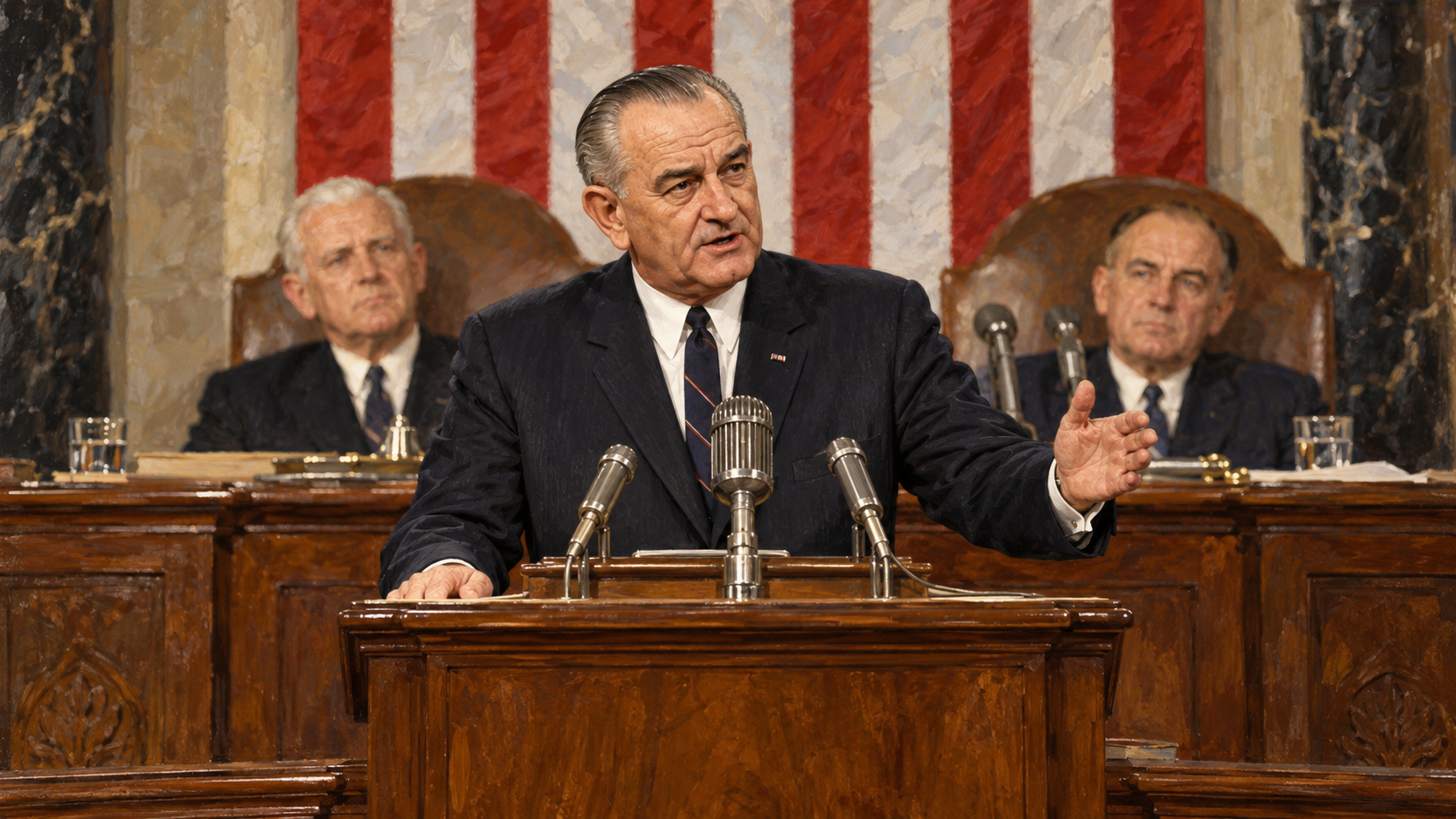
On This Day in Politics: January 8, 1964
On January 8, 1964, President Lyndon B. Johnson delivered his State of the Union address to a nation still grieving the assassination of John F. Kennedy. In his speech, Johnson announced what he called an “unconditional War on Poverty,” defining it as a central mission of his administration and an essential step toward building what he would later describe as the Great Society. The moment marked the beginning of one of the most significant expansions of federal domestic policy since the New Deal. Johnson argued that the federal government had a responsibility not only to manage the economy but to lift up those left behind by its progress. The speech signaled an aspiration to create a fairer, more inclusive society at a time when the United States was experiencing both economic growth and expanding inequality.
The War on Poverty encompassed a broad range of initiatives aimed at education, job training, health care, and community development. In the months that followed, Congress passed landmark legislation including the Economic Opportunity Act, which created programs such as Job Corps, VISTA, and Head Start. These initiatives sought to strengthen pathways out of poverty, particularly for children and young adults, by improving early education, expanding access to employment opportunities, and supporting local anti-poverty efforts. Johnson envisioned these programs working in tandem with civil rights legislation, arguing that equal access to opportunity could not exist alongside racial discrimination. The political coalition behind these reforms reflected a belief, shared by many at the time, that targeted federal intervention could reshape long-term social outcomes.
Yet the War on Poverty also encountered strong political resistance. Critics from different perspectives raised concerns about the scale, cost, and underlying philosophy of Johnson’s proposals. Some argued that federal programs risked becoming too centralized or inefficient, while others believed they did not go far enough in addressing structural inequities. Debates over the proper role of government in reducing poverty became a persistent theme in American politics, shaping party identities and influencing future policy battles. Despite the challenges, many of the programs launched during this period endured and expanded, becoming core components of the modern social safety net. Head Start, Medicare, Medicaid, and community health centers are among the enduring legacies of this era, continuing to support millions of Americans across generations.
Looking back, January 8, 1964 stands as a defining moment in the evolution of American domestic policy. Johnson’s declaration of a War on Poverty reflected both the optimism and the tensions of the mid-20th century—a belief in the government’s ability to address national problems, alongside disagreements over the limits of that power. Whether viewed as a bold and compassionate initiative or as an overly ambitious government reach, the moment reshaped expectations about federal responsibility and laid the foundation for enduring debates about social policy. For “This Day in Politics,” the date marks a turning point when the United States committed, at the highest levels, to confronting poverty not as an individual failing but as a national challenge requiring collective action.
By January 8, 1964, the United States was in a period of economic growth but also marked by persistent poverty and inequality, especially in rural areas and inner cities. The nation was still grieving the assassination of President John F. Kennedy less than two months earlier, and Lyndon B. Johnson had assumed the presidency with a promise to carry forward and expand Kennedy’s agenda.
In his State of the Union address on this day, President Johnson announced an “unconditional War on Poverty,” declaring that the federal government would take a more active role in addressing economic hardship. He framed poverty as a national challenge, not simply an individual failing, and called for new programs in education, job training, and community development to expand opportunity for Americans with limited resources.
Johnson’s declaration quickly translated into a legislative push that produced the Economic Opportunity Act of 1964 and a range of new initiatives, including Job Corps, VISTA, and Head Start. These programs aimed to provide early education, job skills, and local support structures designed to help people move out of poverty, particularly children and young adults.
At the same time, the War on Poverty faced immediate criticism and practical limits. Some lawmakers questioned the scale and cost of the effort, while others argued that the programs did not fully address structural issues such as discrimination and unequal access to housing or credit. Implementation varied from place to place, and results were uneven, highlighting the difficulty of using federal policy to solve complex social problems.
Over the long term, the agenda Johnson launched on January 8 helped shape the modern American social safety net. Many programs associated with the broader Great Society era, including expansions of federal support for education, health care, and nutrition, became enduring features of domestic policy and influenced how later administrations approached questions of poverty and opportunity.
The War on Poverty also left a lasting mark on political debate. It sharpened disagreements over the role of the federal government, the best strategies for reducing inequality, and how to measure policy success. Supporters view the initiatives as important steps toward a more inclusive society, while critics see them as examples of federal overreach. The speech delivered on this day continues to serve as a reference point in ongoing discussions about economic justice and national responsibility.
Explore more of "On This Day ..."
Discover more events from the same date across news, politics, technology, sports, and other fields. Each link highlights significant moments that shaped history on different fronts.