

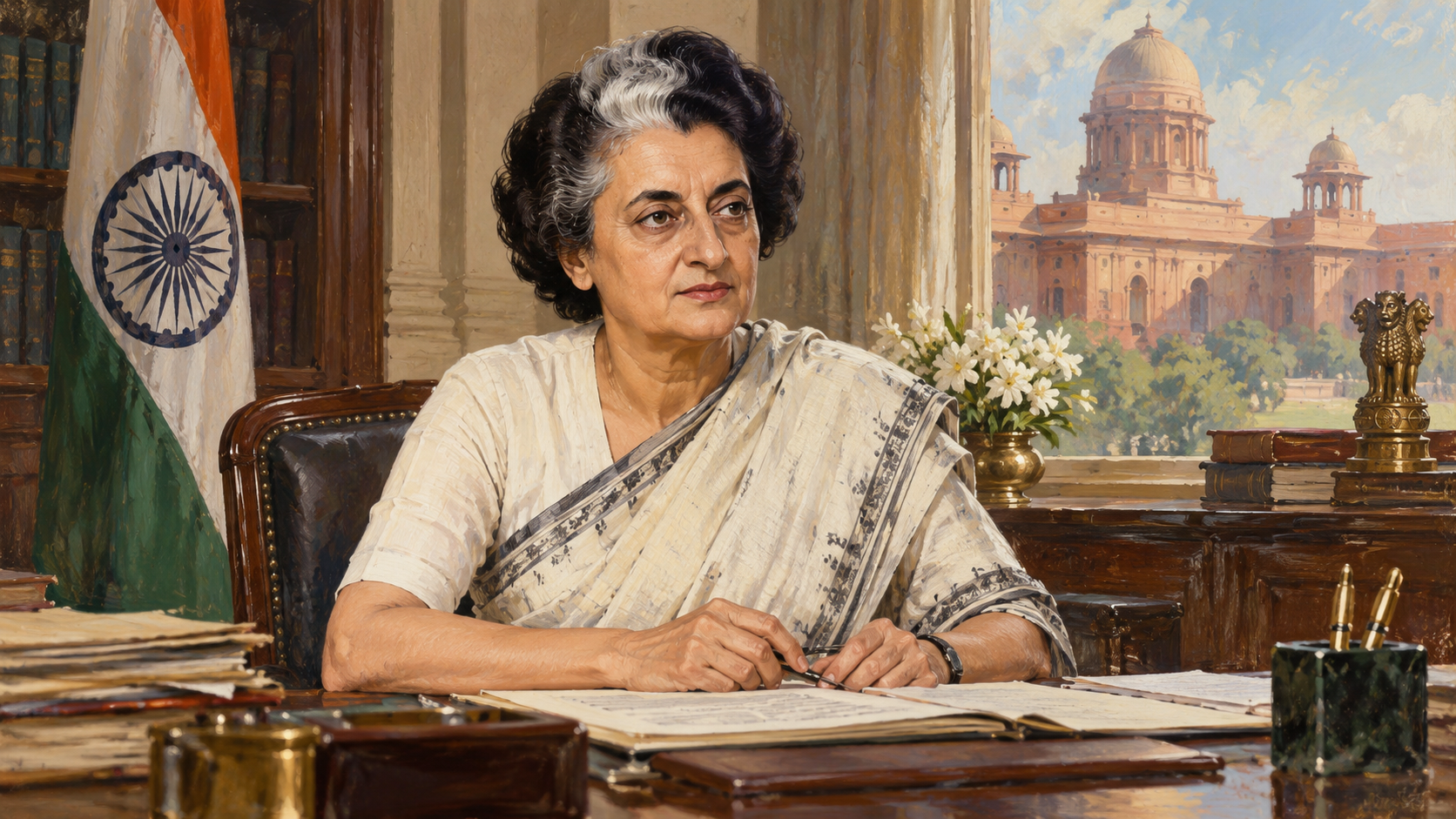
On This Day in Politics: January 19, 1966
Indira Gandhi’s elevation to prime minister on January 19, 1966, came at a moment of deep uncertainty for India. Just days earlier, Prime Minister Lal Bahadur Shastri had died suddenly in Tashkent after signing a peace agreement with Pakistan, leaving the country without a clear leader and the ruling Congress Party without an obvious successor. Senior party figures, wary of a divisive contest that might damage a still-young republic, gathered behind closed doors to choose a compromise candidate. They settled on Gandhi, then minister of information and broadcasting and the daughter of India’s first prime minister, Jawaharlal Nehru, believing her family name and reserved public manner would unify the party while preserving continuity with the Nehru era.
The decision carried enormous symbolic weight at home and abroad. Less than two decades after independence, India was still confronting poverty, food shortages, and security tensions with both Pakistan and China. Against that backdrop, the emergence of a woman as head of government stood out in a world where national leaders were overwhelmingly male. Gandhi instantly became one of the most visible women in global politics, and her appointment suggested new possibilities for women’s participation in public life, even as many Indian women continued to face sharp social and economic barriers. Internationally, her rise was interpreted as a sign of India’s democratic resilience: a reminder that, after the deaths of two prime ministers in quick succession, leadership could still change through party procedures and parliamentary norms rather than military intervention.
Inside the Congress Party, Gandhi was initially viewed less as a transformative figure than as a convenient one. Powerful state leaders and senior ministers assumed they would shape policy while she served as a unifying national face. Some critics dismissed her as a “stopgap” leader whose authority depended on party bosses and the prestige of the Nehru name. Yet even in her early months, Gandhi began to show an independent streak, asserting stronger central authority and tying her public image to promises of social justice, economic reform, and national self-reliance. Her careful public messaging, combined with a direct, often informal speaking style, helped her connect with voters who felt distant from the elite circles of New Delhi.
In hindsight, January 19, 1966, stands out as a turning point not only in Indian politics but in the broader story of democratic leadership in the postcolonial world. Gandhi would go on to lead India through periods of war, economic change, and intense controversy, including decisions that drew sharp criticism at home and abroad. Yet the day she assumed office, much of that future remained unwritten. What was already clear, however, was that her selection as prime minister marked a new phase in independent India’s political life—one in which questions of gender, dynasty, party power, and popular mandate would intersect in ways that continued to shape the country’s democracy for decades to come.
By January 19, 1966, India was facing a leadership vacuum and deep uncertainty. Prime Minister Lal Bahadur Shastri had died suddenly just days earlier after signing a peace agreement with Pakistan, and the ruling Congress Party needed to choose a new leader who could steady the government and maintain continuity after the Nehru and Shastri years.
Senior party leaders met behind closed doors to avoid a bruising internal struggle. After internal debate, they selected Indira Gandhi, then minister of information and broadcasting and the daughter of India’s first prime minister, Jawaharlal Nehru. Her selection was seen as a compromise meant to unify the party, reassure voters, and project stability at a sensitive moment in India’s post-independence history.
Gandhi’s elevation immediately drew global attention because she was a woman becoming head of government in a major democracy at a time when national leaders were overwhelmingly male. Her rise signaled that India’s parliamentary system could manage abrupt change at the top without a constitutional crisis or military intervention, even after the loss of two prime ministers in quick succession.
Within the Congress Party, however, her position was initially viewed as limited. Many influential regional bosses and senior ministers assumed she would depend on them for policy direction and organization. Some regarded her as a “compromise” or transitional figure whose authority rested on the Nehru name and party consensus rather than personal political strength, setting up tensions that would soon reshape the party’s internal balance of power.
In the longer term, Gandhi’s selection on this day marked the beginning of a new phase in India’s political development. She would go on to centralize authority in the prime minister’s office, redefine the relationship between national and state leaders, and present herself as a direct champion of the poor, altering how electoral mandates and leadership were understood in India’s democracy.
Her tenure would later include both major achievements and serious controversies, but the decision made on January 19, 1966, had already changed expectations about who could lead a large, postcolonial nation. It helped establish India as a prominent example of a democracy where a woman could rise to the highest elected office, influencing global conversations about gender, representation, and political leadership for decades to come.
Explore more of "On This Day ..."
Discover more events from the same date across news, politics, technology, sports, and other fields. Each link highlights significant moments that shaped history on different fronts.