

On This Day in Politics: January 18, 1871
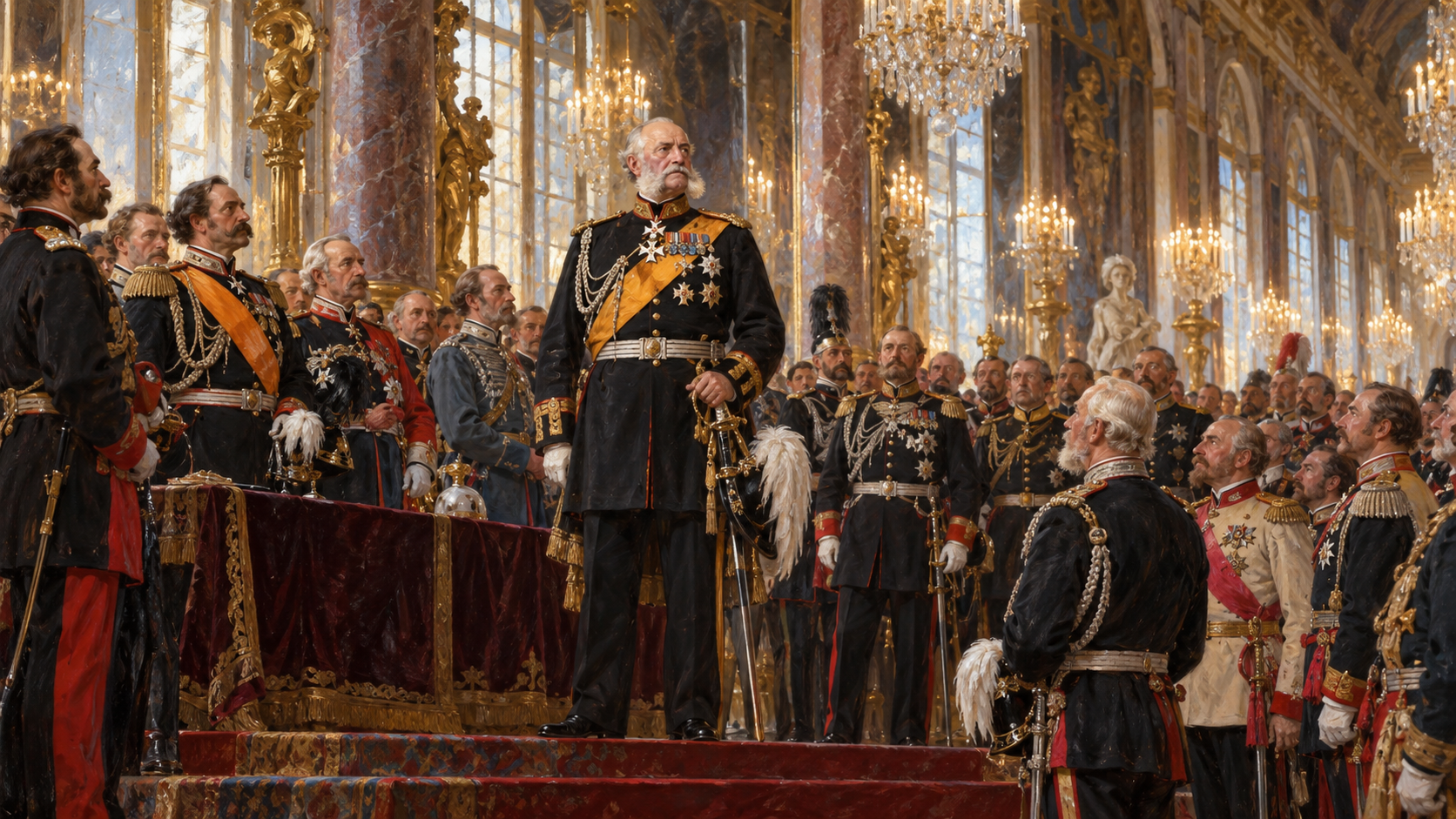
On January 18, 1871, the German states formally unified under Prussian leadership, culminating in the proclamation of King Wilhelm I as German Emperor inside the Hall of Mirrors at the Palace of Versailles. The ceremony followed the decisive Prussian victory in the Franco-Prussian War, a conflict that accelerated nationalist sentiment and brought together dozens of independent kingdoms, duchies, and city-states that had historically acted independently. Unification marked a dramatic turning point in European politics, transforming a patchwork of German-speaking territories into a centralized empire that would rapidly become one of the continent’s most powerful states.
The unification effort had been shaped heavily by Otto von Bismarck, the Prussian chancellor whose mix of political strategy, diplomatic maneuvering, and targeted military conflicts guided the German states toward unity. Bismarck believed that a strong, Prussian-led Germany would bring stability to Central Europe, but his approach—often summarized as “blood and iron”—relied on calculated wars and the assertion of military strength. The Franco-Prussian War of 1870–71 provided the final catalyst. French defeat weakened Paris diplomatically and encouraged southern German states, once hesitant to join a northern-led federation, to embrace a united German nation. The setting of the proclamation at Versailles was a symbolic decision meant to underscore Prussian triumph and shift the balance of prestige in Europe.
The new German Empire reshaped the political landscape of the late nineteenth century. With its rapidly growing industrial economy, strong military, and cohesive national administration, Germany quickly emerged as a major European power capable of influencing global trade, colonial competition, and diplomatic alliances. Its rise also disrupted the balance of power that had been relatively stable since the Congress of Vienna in 1815. Britain, France, Russia, and Austria-Hungary all adjusted their strategies in response to Germany’s emergence, setting the stage for new rivalries. Domestic politics within the empire also evolved rapidly, blending regional cultures with central authority and sparking debates about identity, governance, and the role of Prussia in the new national framework.
For “This Day in Politics,” January 18 serves as a reminder of how national unification can alter international relationships and redefine political identities. Germany’s creation as a unified empire would have lasting consequences—its economic strength, cultural influence, and political ambitions shaped the course of European diplomacy through the early twentieth century. While unification fulfilled long-standing nationalist aspirations among German-speaking peoples, it also contributed to tensions that would eventually help lead the world toward larger conflicts. The events of January 18, 1871 stand as one of the pivotal moments in European statecraft, demonstrating how quickly the geopolitical order can shift when political ambition meets military success.
By January 18, 1871, the German states had recently achieved a decisive victory over France in the Franco–Prussian War. For decades, German-speaking territories had been divided among kingdoms, duchies, and city-states, loosely connected through economic and cultural ties but lacking a single national government.
Under the leadership of Prussia and its chancellor Otto von Bismarck, a series of wars and diplomatic moves had drawn the northern and southern German states closer together. On this day, in the Hall of Mirrors at the Palace of Versailles, King Wilhelm I of Prussia was proclaimed German Emperor, formally unifying most of the German states into the German Empire.
The proclamation of the German Empire immediately altered the political map of Europe. A previously fragmented region became a powerful, centralized state with significant military strength and a rapidly expanding industrial economy. The defeat of France and the ceremony held on French soil underscored the shift in prestige and power toward Berlin.
At the same time, unification did not erase all internal differences. Regional identities remained strong, and Prussia’s dominant role raised questions about how authority would be shared among the various kingdoms and states. The new constitutional structure balanced imperial institutions with local governments, but tensions over representation, civil rights, and political participation persisted beneath the surface.
In the long term, the unification announced on January 18, 1871 reshaped European diplomacy and security. The new German Empire quickly became a major continental power, influencing trade, military planning, and alliance systems. Its rise disrupted the balance of power established after the Napoleonic Wars and prompted other states to reassess their own strategic positions.
The political order created that day also helped set the stage for future conflicts. Rivalries over territory, colonial ambitions, and military competition intensified as Germany sought a larger role on the world stage. For historians and policymakers alike, the proclamation of the German Empire stands as a key moment in understanding how national unification, military success, and great-power politics can combine to transform the international system.
Explore more of "On This Day ..."
Discover more events from the same date across news, politics, technology, sports, and other fields. Each link highlights significant moments that shaped history on different fronts.