

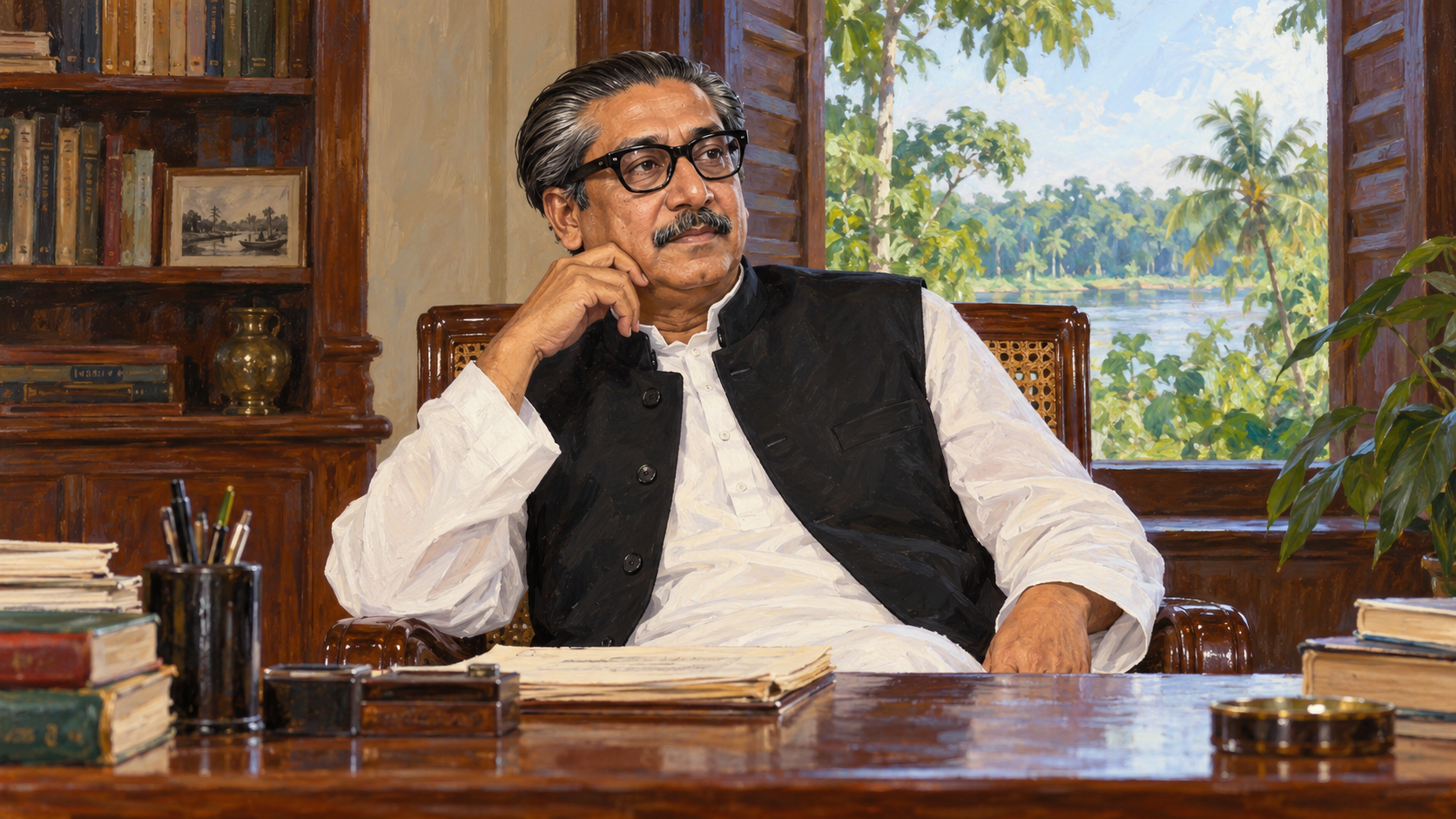
On This Day in Politics: January 25, 1971
On January 25, 1971, Sheikh Mujibur Rahman, leader of the Awami League and the most prominent political figure in East Pakistan, was elected as the first Prime Minister–designate of what would soon become Bangladesh. The election followed his party’s sweeping victory in the general elections of December 1970, where the Awami League won an overwhelming majority in Pakistan’s National Assembly. Despite securing the democratic mandate to form the central government, Mujibur Rahman faced resistance from the political leadership in West Pakistan, deepening political tensions that had been building for years between the two wings of the country. His election marked a pivotal moment in the transformation of East Pakistan’s autonomy movement into a full-scale struggle for independence.
The election held on this day occurred in the shadow of long-standing economic, cultural, and political disparities. East Pakistan, though more populous, had historically been marginalized in national governance and received a disproportionately small share of development funding. The devastating Bhola cyclone of November 1970, which killed hundreds of thousands of people, further intensified frustrations as many in the eastern wing felt that the federal response had been inadequate. Against this backdrop, the Awami League campaigned on a platform centered on regional autonomy as articulated in its Six-Point Program, which sought greater provincial control over taxation, military affairs, and economic policy. Mujibur Rahman’s victory made clear that the electorate overwhelmingly supported these demands.
However, the political leadership in West Pakistan, particularly military ruler General Yahya Khan and Pakistan Peoples Party chairman Zulfikar Ali Bhutto, resisted allowing Mujibur Rahman to assume the premiership. Negotiations faltered as both sides held firm to their positions: the Awami League insisted on implementing its autonomy program as the foundation for governance, while leaders in West Pakistan feared that doing so would weaken or dissolve the federation. As the crisis deepened, public demonstrations, strikes, and political unrest spread throughout East Pakistan. Mujibur Rahman’s election on January 25 symbolized both the democratic will of the Bengali population and the widening divide between the two wings of the nation.
The events that followed this political turning point escalated into the Bangladesh Liberation War of 1971. After months of stalled negotiations and intensifying tensions, the Pakistani military launched Operation Searchlight in March, a brutal crackdown that triggered a full-scale conflict. Supported by a growing international movement and later by India’s military intervention, the independence struggle ultimately led to the creation of Bangladesh on December 16, 1971. Looking back, the election of Sheikh Mujibur Rahman on January 25 stands as a defining step toward the birth of a new nation and a moment that underscored the power of democratic mandates to shape geopolitical outcomes.
On January 25, 1971, Sheikh Mujibur Rahman of the Awami League emerged as the undisputed Prime Minister–designate following his party’s sweeping victory in Pakistan’s first general elections held in December 1970. With a strong majority of seats in the National Assembly, the Awami League had a clear democratic mandate to form the central government.
The result reflected years of political and economic grievances in East Pakistan, where many Bengalis believed they were consistently marginalized by decision makers in West Pakistan. The Awami League’s campaign, built around its Six-Point Program for greater regional autonomy, resonated deeply with voters who wanted more control over their own political and economic affairs.
Despite the electoral outcome, political leaders in West Pakistan, including military ruler General Yahya Khan and Pakistan Peoples Party chairman Zulfikar Ali Bhutto, resisted allowing Mujibur Rahman to take office as prime minister of a unified Pakistan. Negotiations over power sharing and the implementation of the Six-Point Program quickly stalled.
As talks faltered, frustration grew across East Pakistan. Strikes, mass rallies, and civil disobedience intensified, with many Bengalis viewing the refusal to transfer power as a direct rejection of their democratic choice. Mujibur Rahman’s position as Prime Minister–designate, formally recognized by the election results, thus became the focal point of a widening political and constitutional crisis.
In the months that followed, the unresolved dispute over Mujibur Rahman’s right to govern contributed directly to the breakdown of the Pakistani state. The military crackdown launched in March 1971 and the subsequent Bangladesh Liberation War led to a large-scale humanitarian crisis and, ultimately, the emergence of Bangladesh as an independent nation later that year.
The events surrounding January 25, 1971, came to symbolize the power of electoral mandates and the risks when those mandates are not honored. Mujibur Rahman’s status as Prime Minister–designate highlighted tensions between centralized authority and regional self-determination, leaving a lasting imprint on South Asian politics and on international discussions about democracy, autonomy, and the right of peoples to shape their own political future.
Explore more of "On This Day ..."
Discover more events from the same date across news, politics, technology, sports, and other fields. Each link highlights significant moments that shaped history on different fronts.