

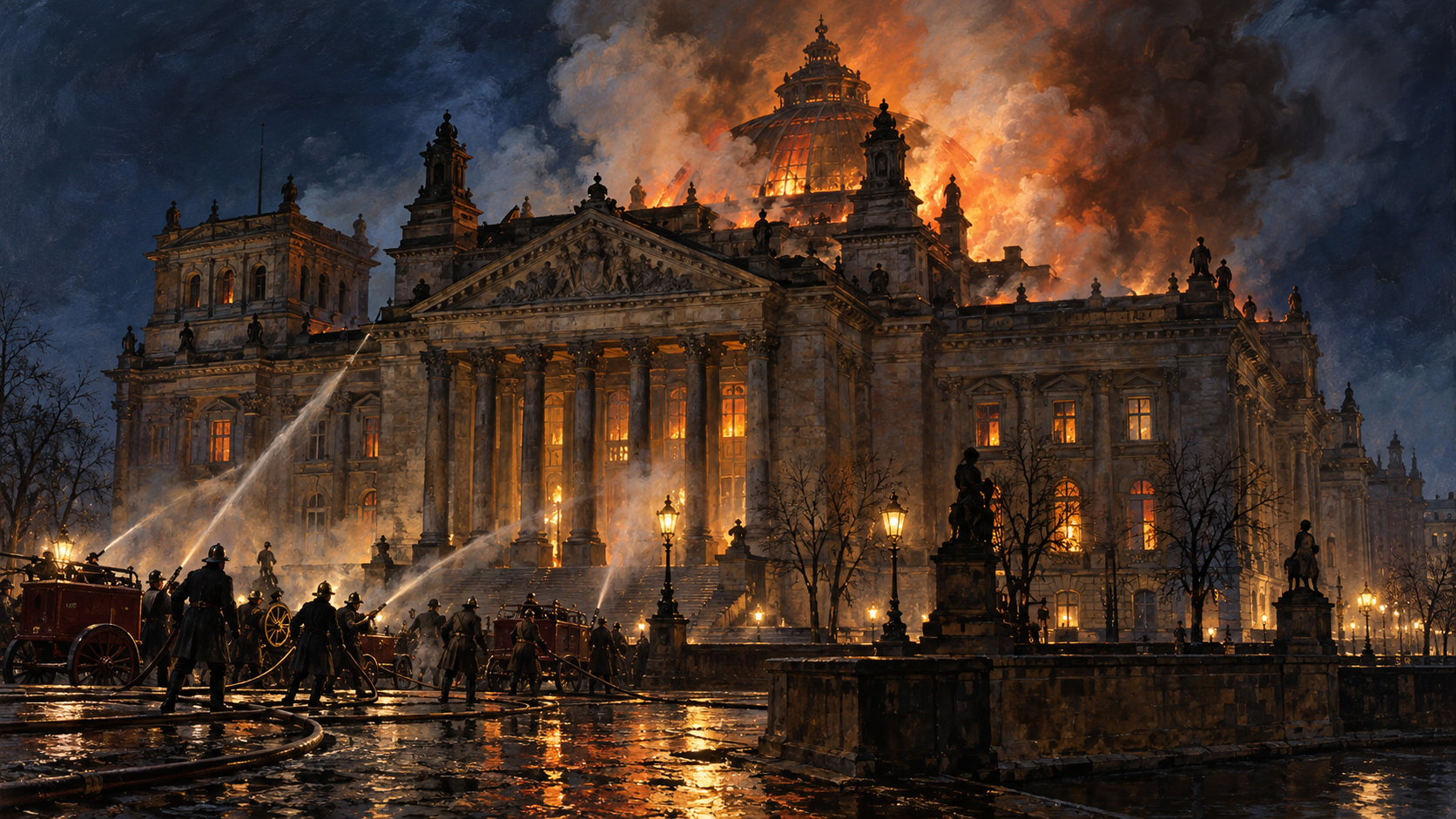
On This Day in Politics: February 27, 1933
On February 27, 1933, fire severely damaged the Reichstag building in Berlin, where Germany’s national parliament met. Adolf Hitler had become chancellor only weeks earlier, and a national election was approaching. Nazi leaders and their allies used the blaze to claim that a Communist uprising threatened the country. The political consequences were immediate and far-reaching: the fire supplied a pretext for emergency measures that dismantled constitutional protections and intensified repression. The event’s importance therefore lies not only in the destruction of a building, but in the decisions by state authorities that converted a crisis into a means of consolidating dictatorship.
The origins and responsibility for the fire have remained subjects of historical dispute. Marinus van der Lubbe was arrested and later convicted, but the episode should not be simplified into an uncontested account of who acted with whom. What is clearly established is the government’s exploitation of the event. Nazi claims of an imminent Communist revolt justified action against political opponents even though that supposed uprising was not a demonstrated fact. The distinction between investigating a crime and suppressing a political movement was deliberately blurred. Fear of disorder became a tool for treating opposition itself as an emergency to be eliminated.
On February 28, President Paul von Hindenburg approved the decree commonly called the Reichstag Fire Decree. It suspended fundamental protections, including freedoms of expression and assembly, and opened the way to detention without the safeguards that had constrained ordinary policing. The central government also gained powers to override regional authorities. These measures transformed the conditions under which political activity could occur before the March election. Parties and citizens could no longer compete on anything resembling an equal footing when opponents faced arrest and their publications and meetings could be suppressed. Emergency rule operated against the institutions that might otherwise have checked the government.
The fire did not create Nazi dictatorship through one isolated act. It formed part of a sequence that included prior restrictions, mass intimidation, and the later Enabling Act, which allowed the government to legislate without normal parliamentary approval. Keeping that sequence visible helps explain how constitutional government can be dismantled through official measures as well as open violence. February 27 marks the crisis that accelerated that process. Its lesson is grounded in the historical record: a claimed threat can be used to remove the very rights needed to contest the claim. The destruction of democratic safeguards followed political choices, and the resulting powers were directed against people whose ability to resist was being systematically taken away.
Hitler had been appointed chancellor in January, and elections were approaching. Repression had begun before the fire.
Responsibility for the blaze remains disputed in historical accounts. The regime’s use of the fire to justify political repression is well documented.
The emergency decree followed on February 28, one day after the fire. It suspended key constitutional safeguards.
Arrests and restrictions on publications and meetings undermined political competition. The emergency powers targeted the opposition’s ability to function.
The later Enabling Act further removed parliamentary restraints. The fire belonged to a sequence of measures establishing dictatorship.
The anniversary demonstrates how fear, coercion, and official legal instruments can combine to destroy the institutions that protect political freedom.
Explore more of "On This Day ..."
Discover more events from the same date across news, politics, technology, sports, and other fields. Each link highlights significant moments that shaped history on different fronts.