

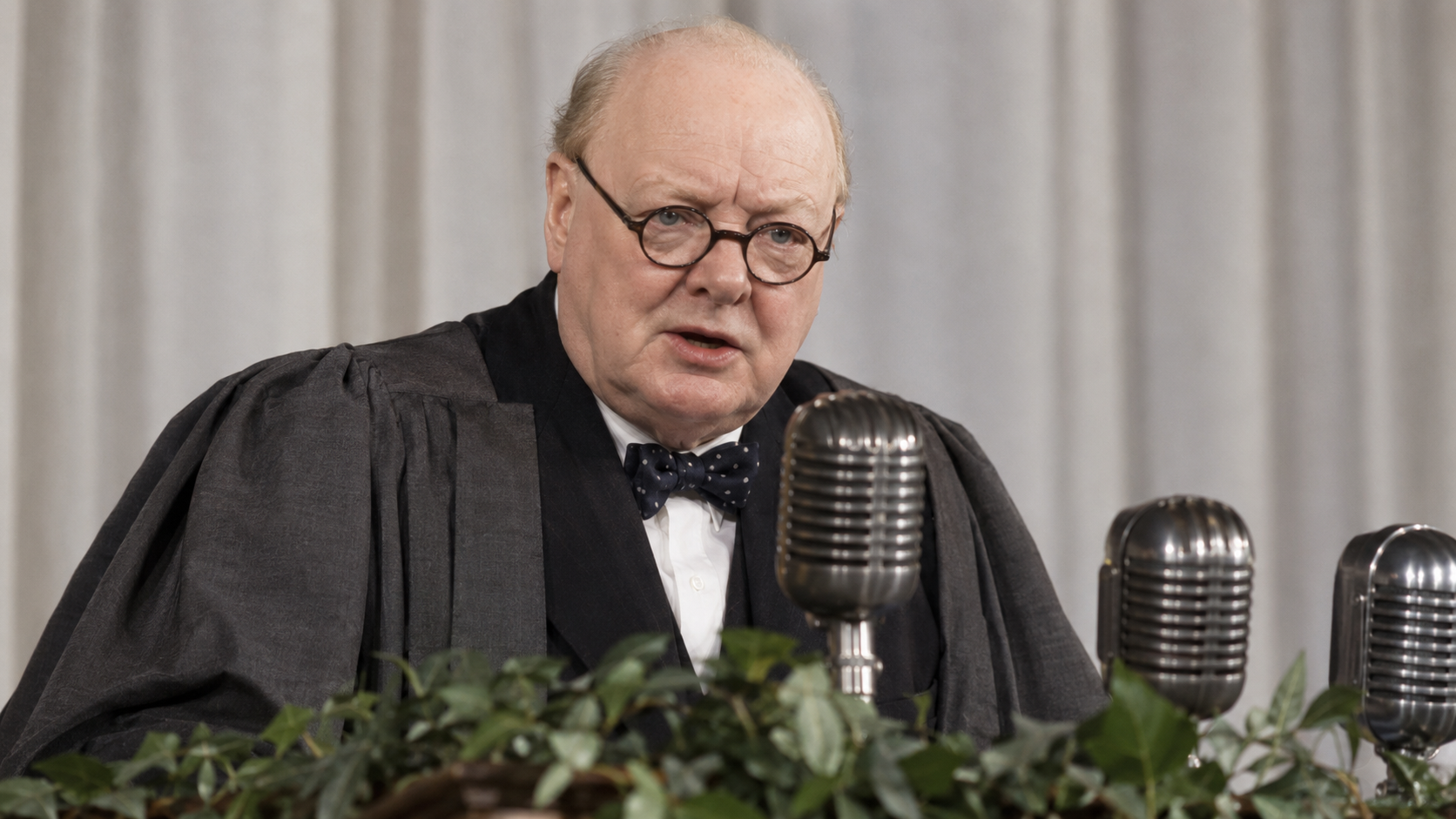
On This Day in Politics: March 5, 1946
On March 5, 1946, Winston Churchill delivered his Sinews of Peace address at Westminster College in Fulton, Missouri, with President Harry S. Truman present. The former British prime minister spoke in a college gymnasium, but the argument reached far beyond the campus. He warned that Soviet influence was dividing Europe and called for close cooperation between the United States and Britain. The address became widely known as the Iron Curtain speech. Its setting gave an international dispute a strikingly local stage: a visiting statesman addressing an American college audience while the sitting American president helped draw attention to his message there.
Churchill was speaking after the defeat of Nazi Germany had removed the common enemy that held the wartime alliance together. The central question was what kind of peace would follow. Wartime cooperation did not resolve disagreements about political control, security, and the future of European countries. Churchill framed the division of the continent as a danger requiring an organized response, rather than an unfortunate arrangement that could safely be ignored. His argument looked toward an enduring partnership between the English-speaking powers, while also assigning a role to the new United Nations. Collective institutions and cooperation among major powers appeared together in his vision of a more secure postwar world.
The circumstances of the speech were politically significant. Churchill was no longer prime minister, and he explicitly described himself as a private visitor speaking for himself. Truman’s presence made the occasion prominent, but it did not turn every statement into an announced American policy. A speech could influence debate without creating a treaty or binding either government to a new commitment. The college setting also mattered: Churchill used an honorary academic occasion to offer counsel about international affairs. Listeners therefore had to distinguish the authority of his experience from the official power he no longer held, even as his wartime reputation gave his warning exceptional public weight.
The address is remembered as an important expression of the emerging Cold War, rather than a single act that created that conflict. The tensions it described had roots in wartime decisions and competing postwar aims, and later policies developed through additional crises, negotiations, and choices by many governments. Its enduring importance lies partly in how it presented those tensions to a broad audience. Churchill supplied a memorable account of Europe’s division and made cooperation between Britain and the United States central to his proposed response. March 5 thus illustrates the political power and limits of public speech: a speaker outside executive office could shape the terms of international discussion, while the decisions needed to translate an argument into policy remained with governments and their citizens.
The address's formal title was Sinews of Peace. Its better-known name comes from the metaphor Churchill used for Europe's political division.
Westminster College's invitation created an academic occasion for an international argument, with Truman's participation greatly increasing its visibility.
Churchill stated that he spoke for himself. He was a former prime minister rather than the serving head of Britain's government.
The speech made no treaty and did not by itself commit the United States to every part of Churchill's proposed approach.
The address became a landmark in public understanding of the Cold War, whose development involved many events and governments.
Its history shows how a prominent figure outside executive office can influence policy debate without possessing the power to carry out a program alone.
Explore more of "On This Day ..."
Discover more events from the same date across news, politics, technology, sports, and other fields. Each link highlights significant moments that shaped history on different fronts.