

On This Day in Politics: April 30, 1789
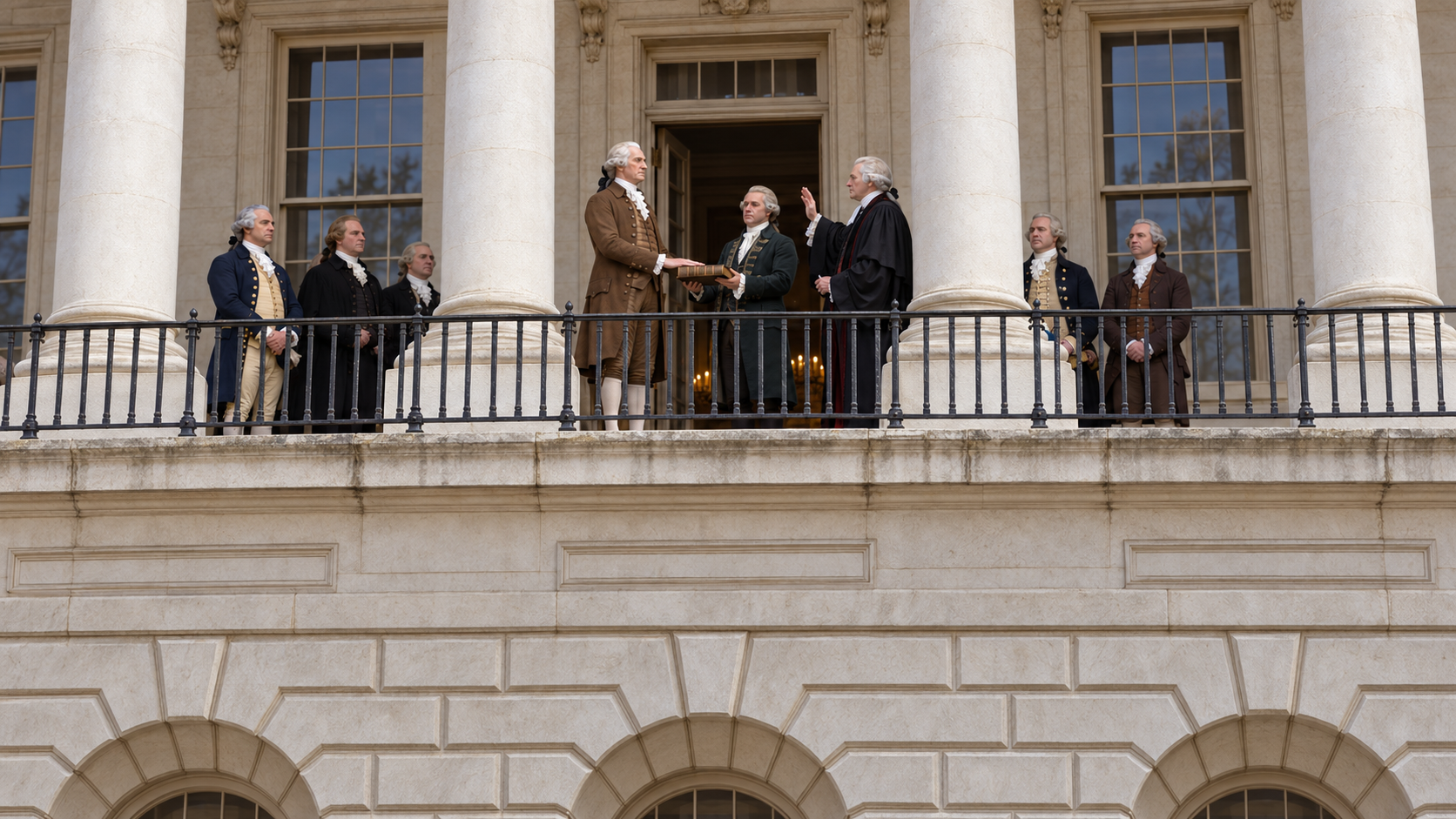
On April 30, 1789, George Washington took the oath of office as the first president of the United States under the Constitution. The ceremony took place on the balcony of Federal Hall in New York City, then the seat of the national government. Robert Livingston, New York’s chancellor, administered the oath before assembled spectators. Washington then returned to the Senate Chamber to deliver an inaugural address to Congress. The event gave a public form to an office whose powers had been written into the Constitution but whose everyday practices were still largely to be established. A constitutional design was becoming a working government.
The setting reflected that newness. New York’s former city hall had been remodeled to accommodate the federal government, and Congress had to decide how the inauguration should be arranged. Moving the oath to an exterior gallery allowed more people to witness it. Washington’s clothing also suited the civilian occasion: he wore a brown broadcloth suit made from American cloth. The ceremony drew on his standing as the former commander of the Continental Army, while placing him in a different role. His authority as president came from the constitutional office, with its prescribed oath and defined responsibilities, rather than a continuing military command over the country.
In his address, Washington expressed anxiety about the responsibilities he was assuming and emphasized duty, public confidence, and the success of republican government. He offered religious thanks and urged Congress to put the general interest ahead of local attachments and political antagonism. Rather than present a detailed legislative program, he referred lawmakers to their constitutional responsibilities. He also acknowledged the question of constitutional amendments in light of objections raised against the new system. The speech’s tone matters as much as its immediate proposals: Washington presented the presidency as a public trust requiring restraint and judgment. The inaugural address itself became a tradition, although the Constitution did not require one.
The work of building the government continued after the ceremony. During its first session, Congress established executive departments and organized the federal judiciary, while Washington’s administration developed practices for carrying out executive responsibilities. Congress also proposed constitutional amendments that would lead to the Bill of Rights. These developments should not be compressed into the inauguration itself; they were subsequent decisions needed to make the new institutions function. April 30 remains significant because it marked the first public assumption of the presidency under the Constitution. The precedents Washington set afterward helped define how a strong executive could operate within a republic, where authority belonged to an office governed by law rather than to a hereditary ruler.
George Washington took the presidential oath on April 30, 1789.
The ceremony was held at the original Federal Hall in New York City.
New York Chancellor Robert Livingston administered the oath.
Washington delivered his inaugural address afterward in the Senate Chamber.
The Constitution required the oath but did not require an inaugural address.
The new government’s departments, procedures, and precedents developed after the ceremony.
Explore more of "On This Day ..."
Discover more events from the same date across news, politics, technology, sports, and other fields. Each link highlights significant moments that shaped history on different fronts.