

On This Day in Politics: May 14, 1948
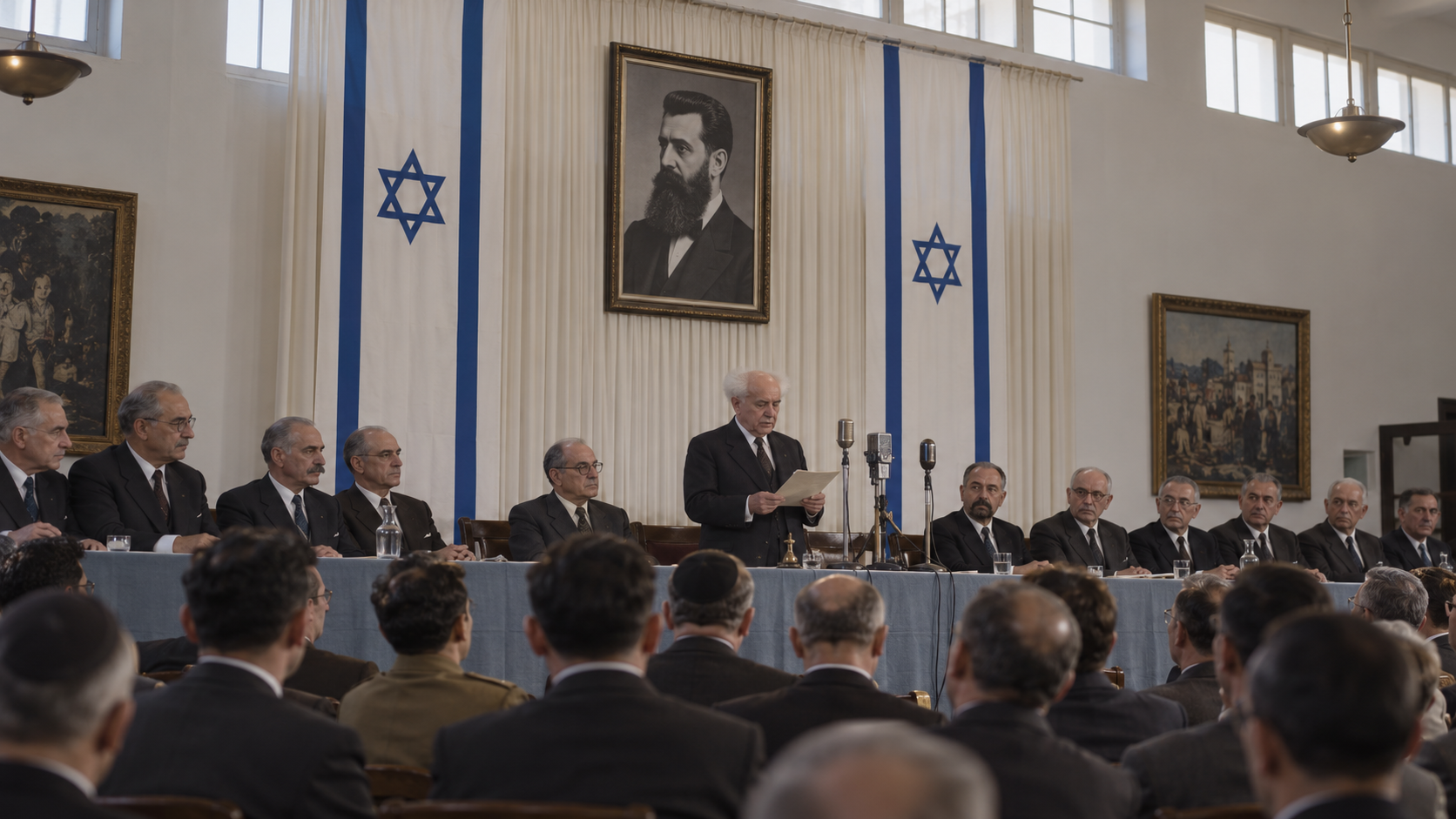
On May 14, 1948, David Ben-Gurion read the declaration establishing the State of Israel at a ceremony in Tel Aviv. The announcement came as Britain’s mandate over Palestine approached its end. Members of the People’s Council signed the declaration, which set out arrangements for provisional government and presented the new state’s claim to independence. For the Zionist movement, the ceremony marked the achievement of a long campaign for Jewish statehood. It also took place during an ongoing conflict over the same territory, where Palestinian Arabs sought their own political future. The declaration changed the political framework without settling the struggle over borders, security, or national rights.
Britain had governed Palestine under a League of Nations mandate after the First World War. Jewish immigration, Arab opposition to the prospect of Jewish statehood, and competing national claims brought mounting conflict. Nazi persecution and the Holocaust intensified the urgency of finding safety and a homeland for surviving Jews. Britain eventually referred the problem to the United Nations. In November 1947, the General Assembly approved a plan to partition Palestine into Jewish and Arab states, with a special international arrangement for Jerusalem. Jewish leaders accepted partition as a basis for statehood, while Arab leaders rejected it. Fighting between the communities preceded the end of British rule and the independence declaration.
The declaration provided for a provisional council and government until regular elected institutions could be established. It also set out commitments concerning equality and freedoms and appealed for peace with neighboring peoples and states. Those statements expressed the founding document’s purposes; they did not by themselves resolve the conflict or guarantee their fulfillment in practice. International recognition began quickly. On May 14, President Harry Truman recognized Israel’s provisional government as the new state’s de facto authority. A contemporary State Department letter recorded that announcement at 6:11 p.m. in Washington. The distinction mattered: the United States initially recognized the government’s effective authority, with formal de jure recognition following in January 1949.
The next phase of war began as armies from neighboring Arab states entered the conflict after the mandate ended. During the fighting surrounding Israel’s establishment, hundreds of thousands of Palestinians fled or were expelled from their homes. Palestinians remember this mass displacement and dispossession as the Nakba, meaning catastrophe. The war’s outcome differed from the partition plan, and no Palestinian Arab state emerged alongside Israel at that time. May 14 therefore carries sharply different historical meanings: the founding of Israel and realization of Jewish national independence, alongside a transformation inseparable from Palestinian loss and displacement. Understanding the date requires holding the declaration, the war, and its consequences together rather than treating the ceremony as an isolated event.
David Ben-Gurion read the declaration in Tel Aviv on May 14, 1948.
The announcement came as Britain’s mandate over Palestine ended.
The declaration established provisional institutions and stated commitments to rights and freedoms.
The United States recognized the provisional government’s de facto authority that day.
War and the flight or expulsion of hundreds of thousands of Palestinians accompanied statehood.
Israelis commemorate independence; Palestinians remember displacement as the Nakba.
Explore more of "On This Day ..."
Discover more events from the same date across news, politics, technology, sports, and other fields. Each link highlights significant moments that shaped history on different fronts.