

On This Day in Politics: May 15, 1955
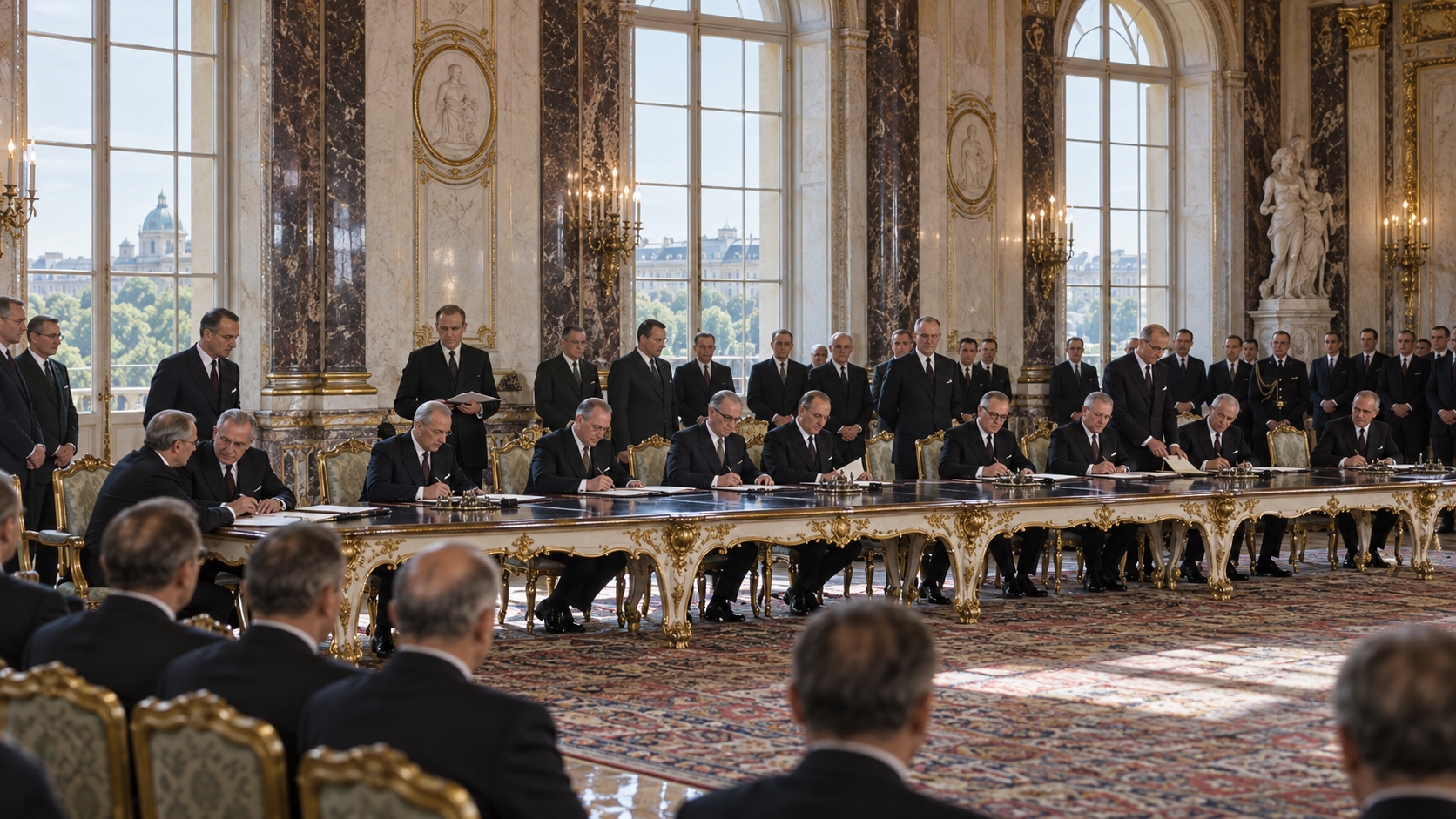
On May 15, 1955, representatives of Austria, the United States, the Soviet Union, Britain, and France signed the Austrian State Treaty at Belvedere Palace in Vienna. The agreement opened the way to ending the Allied occupation and restoring Austria’s full sovereignty after a decade of postwar control. The ceremony brought together powers whose rivalry had repeatedly delayed a settlement. It was a diplomatic breakthrough, although signing did not make every provision effective immediately. Ratification still had to follow, and the treaty entered into force on July 27. The departure of occupation troops came afterward under the timetable established by the agreement.
Austria’s position grew out of the destruction of the Second World War and its incorporation into Nazi Germany in 1938. After Germany’s defeat, the four Allied powers occupied separate zones, while Austria rebuilt democratic institutions and its economy. The country’s future remained entangled with the larger confrontation between East and West. Negotiations involved security as well as property and economic interests, including Soviet claims to assets formerly held by Germans. Those questions could not be resolved by Austria alone. A settlement required agreement among the occupying powers, and worsening Cold War tensions had repeatedly blocked a conclusion despite Austrian demands for independence.
Neutrality helped make a compromise possible. Austrian leaders offered a position outside the rival military alliances, addressing Soviet concerns about the country joining the Western bloc while preserving a democratic political order acceptable to the Western powers. The treaty itself did not contain Austria’s declaration of permanent neutrality. That commitment was implemented separately, with the National Council adopting a constitutional neutrality law on October 26, 1955. Keeping the two steps distinct explains the sequence: the May signature established the agreed settlement, the July entry into force began its implementation, and the October law gave domestic constitutional form to the neutrality policy associated with the negotiations.
The practical consequences extended beyond the signing ceremony. Occupation arrangements ended, foreign troops withdrew, and Austria recovered control over important property and resources under negotiated financial terms. An American report later in 1955 recorded the return of factories, oil interests, agricultural and forest land, and shipping assets, together with Austria’s payment obligations. Independence therefore involved both political freedom of action and demanding economic commitments. Austria also entered the United Nations that December. The May treaty remains significant as a negotiated settlement achieved across Cold War divisions. It did not remove the rivalry between the great powers, but it allowed Austria to move beyond occupation and pursue an international role as a sovereign state.
Austria and the four occupying powers signed the State Treaty on May 15, 1955.
The ceremony took place at Belvedere Palace in Vienna.
The treaty entered into force on July 27 after ratification.
Occupation troops withdrew under the timetable that followed its entry into force.
Permanent neutrality was adopted in a separate constitutional law on October 26.
The settlement restored sovereignty while including substantial economic arrangements.
Explore more of "On This Day ..."
Discover more events from the same date across news, politics, technology, sports, and other fields. Each link highlights significant moments that shaped history on different fronts.