

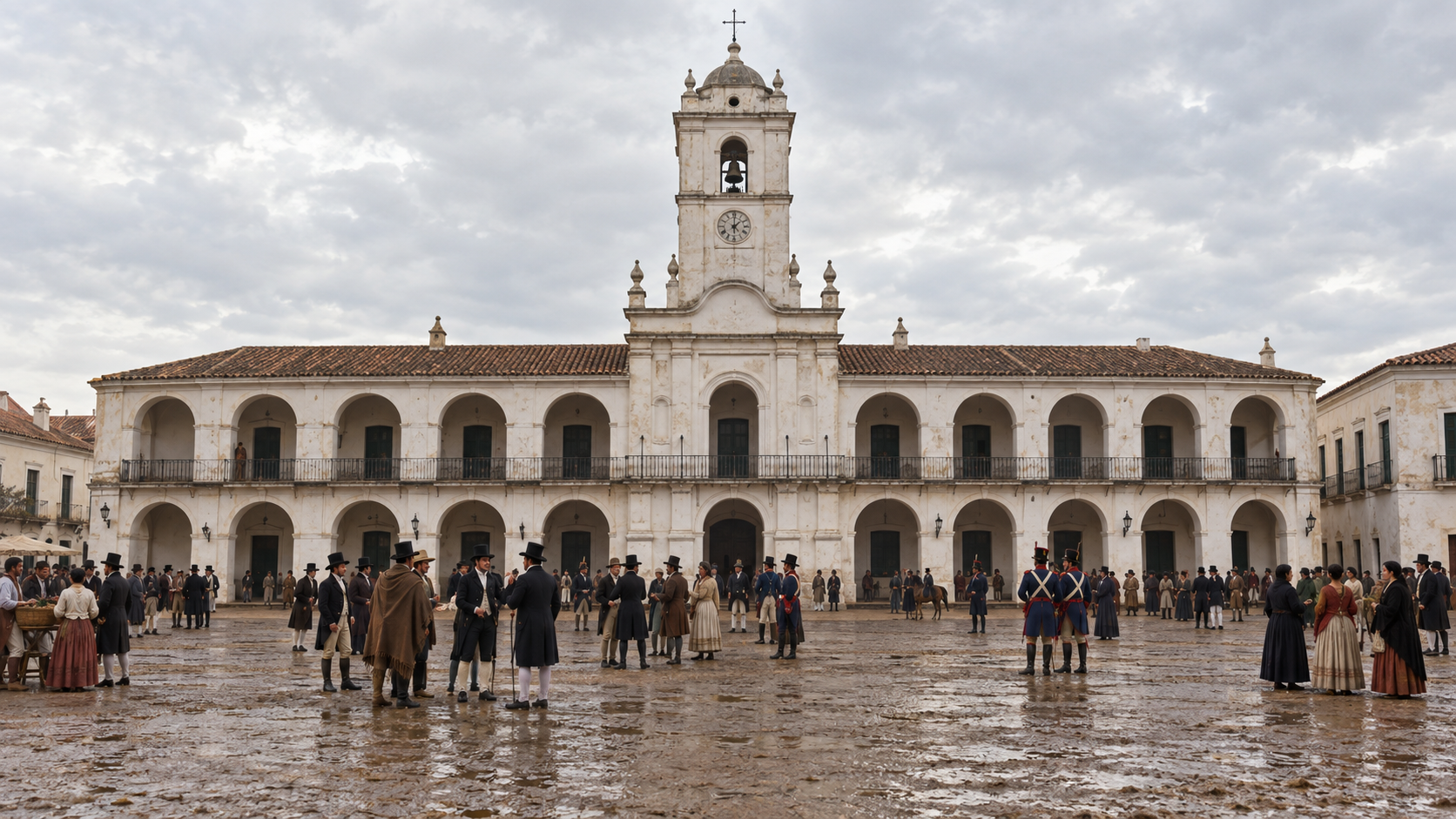
On This Day in Politics: May 25, 1810
On May 25, 1810, a new governing council known as the Primera Junta took power in Buenos Aires, replacing the authority of Viceroy Baltasar Hidalgo de Cisneros. Cornelio Saavedra became its president, with Mariano Moreno and Juan José Paso serving as secretaries. The change was the decisive outcome of the May Revolution and a major step toward self-government in the Río de la Plata. It was not yet the formal declaration of Argentine independence, which came in July 1816. The new council initially acted in the name of the Spanish king, Ferdinand VII, even as the political order beneath that claim was changing.
The junta contained nine members drawn from different parts of the city’s political leadership. Alongside Saavedra and the two secretaries were Manuel Belgrano, Juan José Castelli, Miguel de Azcuénaga, Manuel Alberti, Juan Larrea, and Domingo Matheu. Their backgrounds included law, military service, the church, and commerce. Support from the population and the Patricios regiment helped displace Cisneros and establish the new government. The composition of the council mattered because authority now rested with a collective local body rather than the viceroy. That did not mean all residents had equal political influence, or that everyone across the wider territory accepted Buenos Aires’s decisions.
The surviving record of the junta’s installation shows the combination of change and continuity. It named the new members, required an oath, and described responsibilities for public order and administration. It also called for representatives from other towns to help determine a broader form of government. At the same time, the oath preserved allegiance to Ferdinand VII. These provisions reveal a political transition whose future was still unsettled. The language of royal loyalty coexisted with the creation of a local authority able to make important decisions. Reading the record closely avoids treating the day as if every later development had already been agreed upon in advance.
The revolution opened a prolonged contest over how power should be organized. Successive juntas, triumvirates, and other executive arrangements reflected disagreements among more conservative and more radical participants, as well as conflict over the influence of Buenos Aires. Public proclamations, newspapers, ceremonies, and symbols helped competing leaders explain and legitimize their claims to authority. Independence in 1816 was an important later milestone, but national organization remained a longer process. May 25 is remembered because it broke the existing pattern of colonial government and began a significant experiment in local rule. Its meaning lies in the new political possibilities it created, together with the unresolved disputes that accompanied them.
The Primera Junta took power in Buenos Aires on May 25, 1810.
Cornelio Saavedra presided, with Mariano Moreno and Juan José Paso as secretaries.
The new body replaced Viceroy Cisneros’s authority.
Its formal oath still invoked loyalty to Ferdinand VII.
The declaration of independence followed on July 9, 1816.
Debates over representation and the power of Buenos Aires continued after the revolution.
Explore more of "On This Day ..."
Discover more events from the same date across news, politics, technology, sports, and other fields. Each link highlights significant moments that shaped history on different fronts.