

On This Day in Pop: January 6, 1975
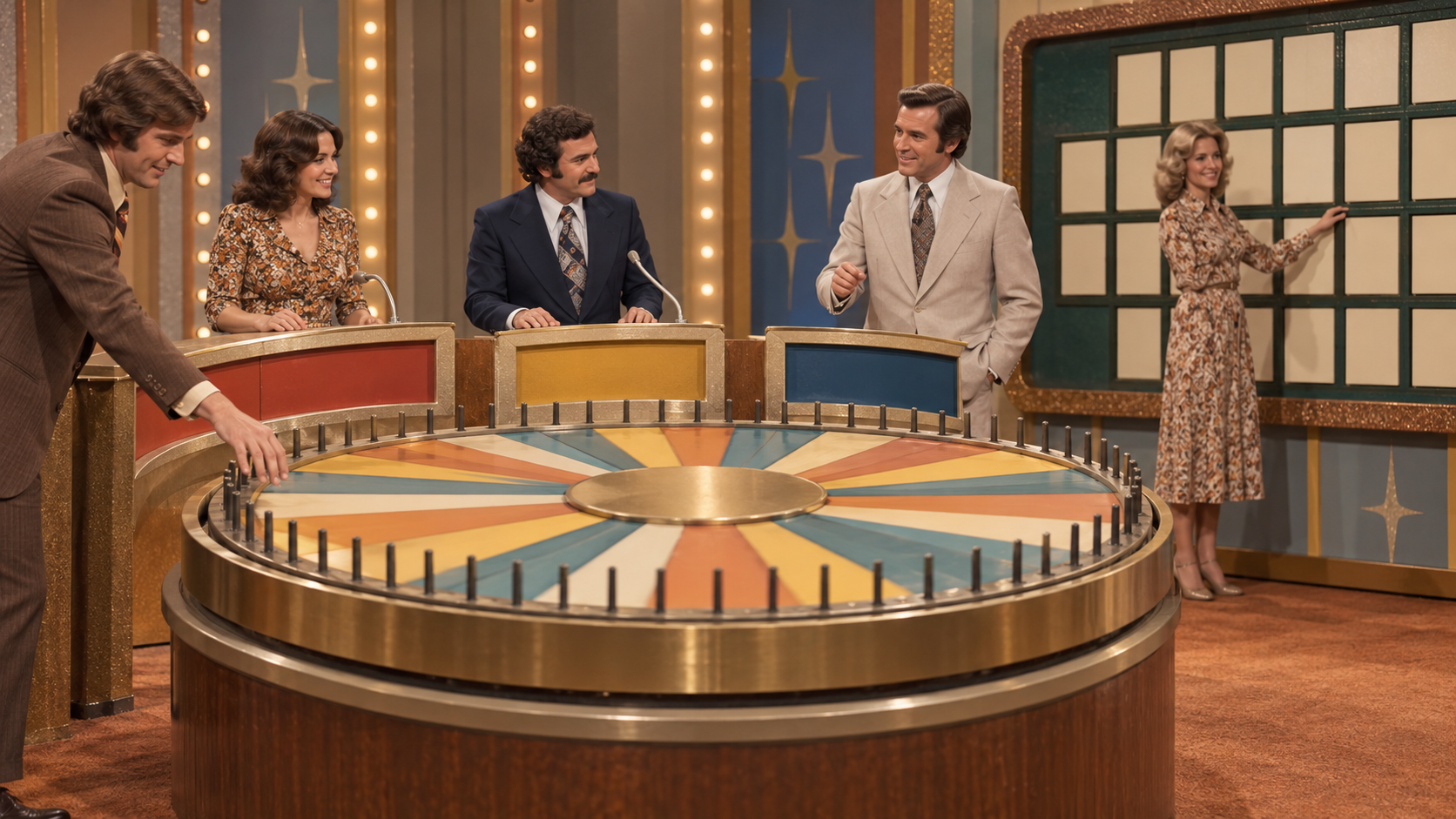
On January 6, 1975, Wheel of Fortune premiered nationally on NBC as a daytime game show hosted by Chuck Woolery, with Susan Stafford revealing letters and Charlie O’Donnell announcing. Created by Merv Griffin, the program joined a hangman-style word puzzle to a large carnival wheel that determined the dollar value of each correct consonant. Contestants spun, guessed letters, bought vowels, and tried to solve phrases before their rivals. The combination was immediately legible: viewers at home could work out the puzzle while the spinning wheel added chance, motion, and the possibility that a strong turn could end with “Bankrupt.”
The debut followed an earlier pilot called Shopper’s Bazaar, which emphasized merchandise and featured a vertically mounted wheel. NBC initially passed on that version. Griffin and his team simplified the idea, repositioned the wheel, and put more attention on the puzzle and the interaction among host, players, and audience. Woolery’s relaxed manner and Stafford’s role at the letter board helped define the first televised version. The board made progress visible one letter at a time, while the wheel gave each contestant an immediate decision about whether to keep playing or protect a possible solution. Prizes were central to the daytime show’s appeal; winners used their earnings in on-air shopping segments, selecting items presented on the set rather than simply leaving with cash.
Wheel of Fortune entered a crowded era of network game shows, and its future was not always secure. NBC moved it around the daytime schedule, while hosts, rules, prize formats, and visual design evolved. Woolery left in 1981, and Pat Sajak became host; Vanna White joined the following year after Stafford’s departure. The syndicated evening edition that began in 1983 removed much of the shopping format and helped turn the program into a prime-access phenomenon. Those later changes are often the version audiences remember, but the essential mechanism visible in 1975—a word puzzle governed by strategic guesses and an unpredictable wheel—remained intact.
That durable structure made the show unusually adaptable. It rewards vocabulary and observation, but a spin can redistribute momentum in seconds, keeping even a simple puzzle suspenseful. The letter board became electronic, prize values rose, and the presentation grew brighter and faster, yet the basic invitation to participate from the sofa never disappeared. Wheel of Fortune’s January 6 premiere did not arrive with its eventual cast or modern polish. It introduced the framework that would survive those transformations and become one of American television’s most recognizable game-show formats, influencing decades of catchphrases, parodies, home games, and shared family viewing.
Merv Griffin combined a word puzzle familiar from hangman with the uncertainty of a casino-style wheel. The design let home viewers solve alongside contestants while each spin reshaped the game.
An earlier pilot, Shopper’s Bazaar, leaned more heavily on merchandise and used a different wheel orientation. NBC’s rejection prompted a clearer version focused on the puzzle and players.
Chuck Woolery hosted the 1975 premiere, Susan Stafford handled the letter board, and Charlie O’Donnell announced. Contestants accumulated value by calling consonants and spent earnings in prize-shopping segments.
The daytime program changed schedules and personnel, and the familiar modern presentation did not exist on opening day. Pat Sajak, Vanna White, and the major syndicated edition all came later.
The 1983 syndicated series broadened the audience and streamlined the format, while electronic boards and changing bonus rounds modernized the production without replacing its central puzzle.
The balance of knowledge, risk, and audience participation made the concept portable across decades and international versions, preserving the core experience introduced on January 6, 1975.
Explore more of "On This Day ..."
Discover more events from the same date across news, politics, technology, sports, and other fields. Each link highlights significant moments that shaped history on different fronts.