

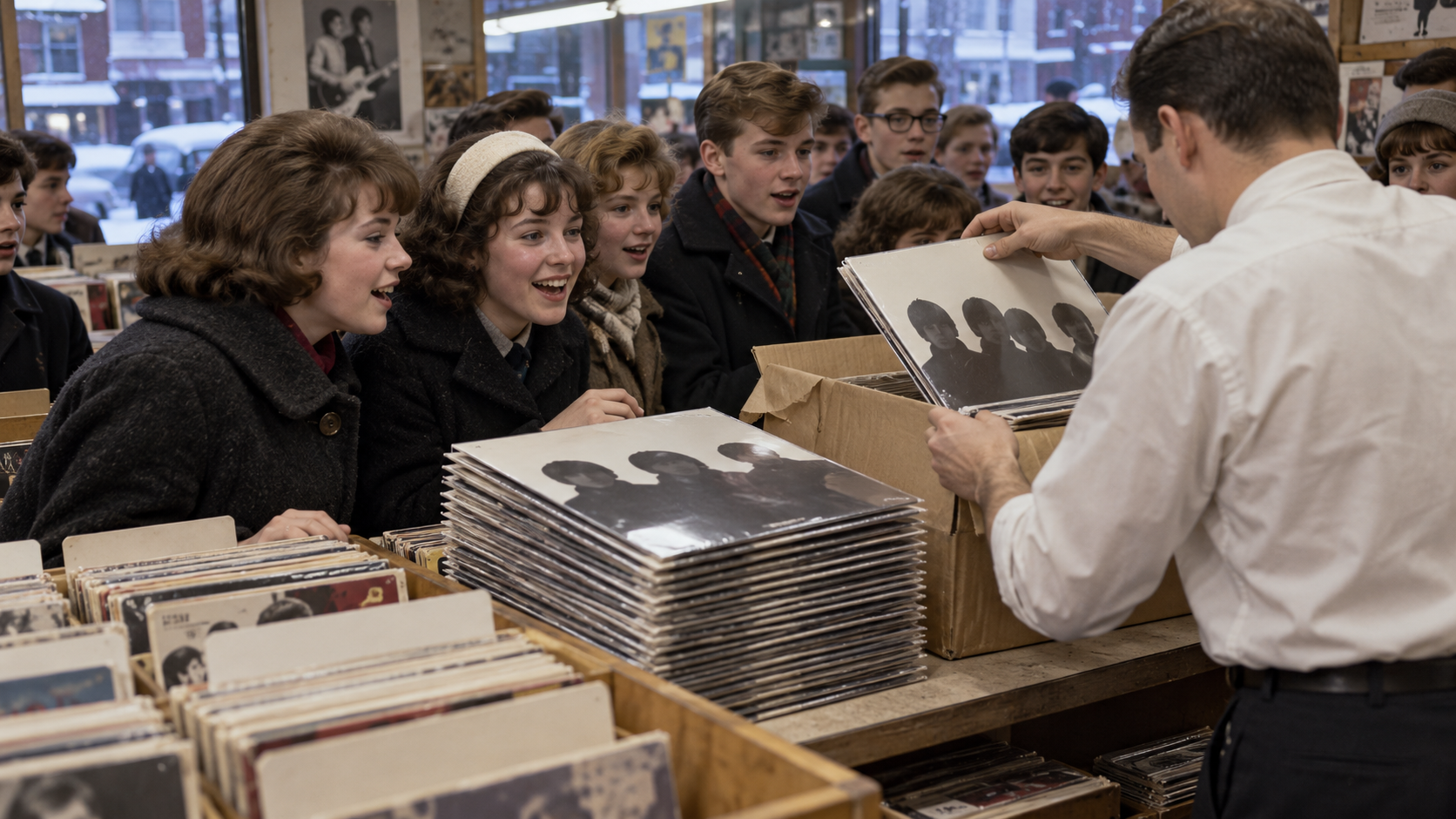
On This Day in Pop: January 20, 1964
Capitol Records released Meet the Beatles! in the United States on January 20, 1964, concentrating the group’s newest British recordings into an album designed for the American market. The stark cover used Robert Freeman’s half-shadowed portrait of John Lennon, Paul McCartney, George Harrison and Ringo Starr, adding blue lettering and an enthusiastic command in the title. The record opened with “I Want to Hold Your Hand,” followed by “I Saw Her Standing There” and “This Boy,” giving new listeners an immediate sequence of singles and original songs. Capitol promoted it as the first Beatles album issued by the company, a phrase that carefully avoided claiming it was the first Beatles LP released anywhere in America.
That distinction reflected a complicated business history. Vee-Jay Records had obtained rights to earlier Beatles recordings and issued Introducing… The Beatles shortly before Capitol’s album, while other labels had tested singles with limited success. Capitol, initially hesitant about the group, changed course after Beatlemania transformed Britain and American radio demand accelerated. The company backed “I Want to Hold Your Hand” with a large campaign, and Ed Sullivan’s announcement that the Beatles would appear on his program intensified anticipation. Meet the Beatles! therefore arrived less as an isolated collection than as part of a coordinated surge of records, radio play, press coverage and television exposure. Most of its tracks came from the British album With the Beatles, but U.S. labels commonly altered running orders and emphasized hit singles.
The album reached number one and stayed there for eleven weeks, helping establish the Beatles not merely as a novelty import but as a group capable of sustaining album-length interest. Its sequencing foregrounded Lennon–McCartney compositions and introduced American listeners to the band’s balance of exuberant rock and roll, close harmony and increasingly distinctive songwriting. The commercial success also accelerated a wider British Invasion, encouraging U.S. labels, broadcasters and promoters to seek other groups from Britain. Yet the album’s history reminds listeners that the familiar shape of a catalog can be created by regional marketing decisions. American fans in 1964 encountered a different set of Beatles albums from British listeners, and those configurations influenced how songs were remembered together for decades. January 20 marks the moment when one carefully assembled package put the group’s faces and sound into millions of American homes just before their historic arrival in New York. It became a compact gateway to a rapidly expanding catalog.
Capitol assembled the album for the U.S. market rather than duplicating a British release exactly.
The portrait and forceful title helped give the emerging Beatlemania a unified visual identity.
Vee-Jay had already issued Beatles material, so Capitol’s “first album” language was deliberately narrow.
American album practices separated singles and rearranged British track lists for commercial effect.
Eleven weeks at number one helped turn a hit single into lasting album-level demand.
The release prepared the ground for the Beatles’ U.S. visit and the broader British Invasion.
Explore more of "On This Day ..."
Discover more events from the same date across news, politics, technology, sports, and other fields. Each link highlights significant moments that shaped history on different fronts.