

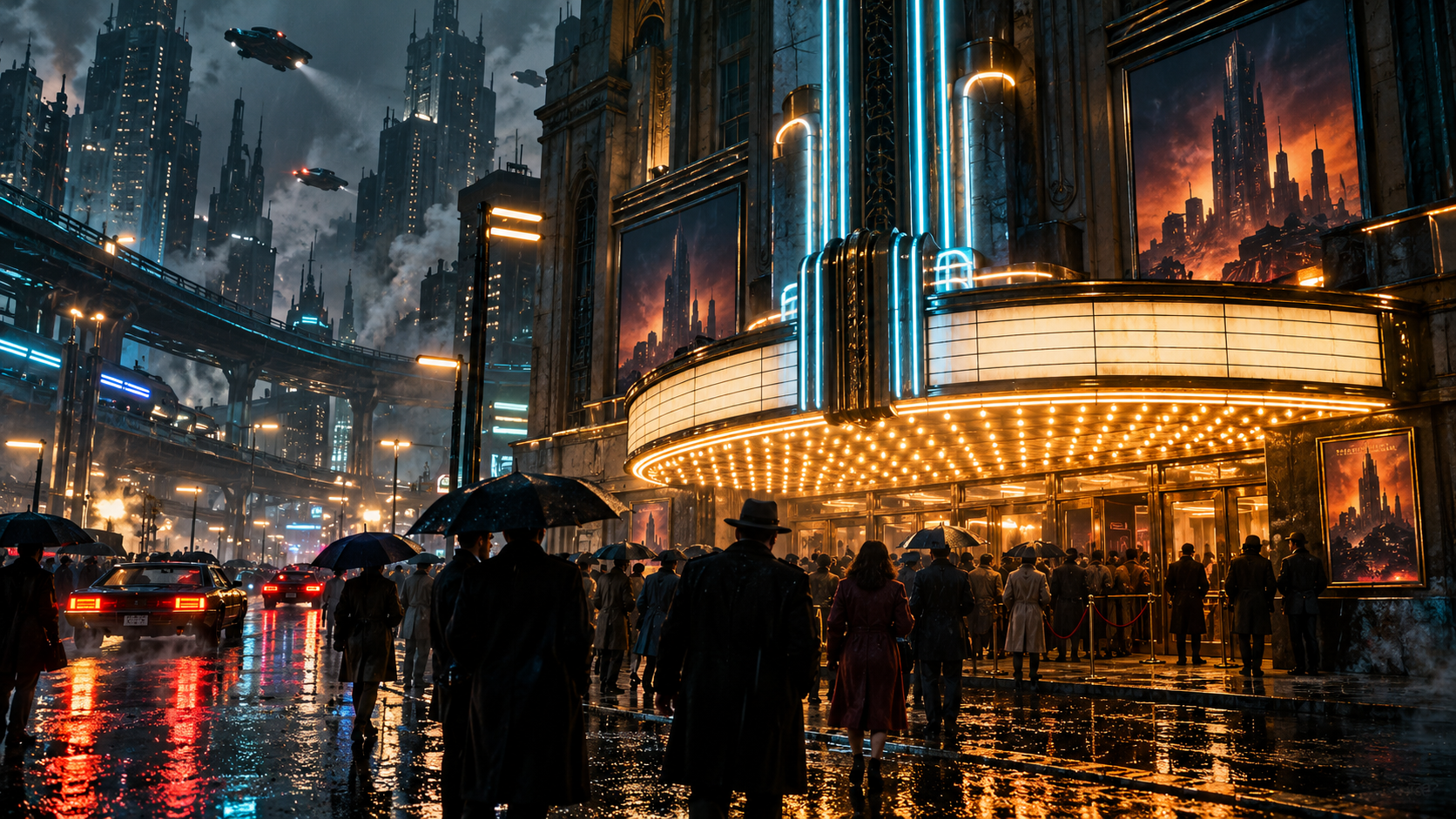
On This Day in Pop: June 25, 1982
On June 25, 1982, Blade Runner opened in New York and Los Angeles. Ridley Scott directed the adaptation of Philip K. Dick’s novel Do Androids Dream of Electric Sheep?, with Harrison Ford as Rick Deckard, a police specialist ordered to hunt bioengineered replicants in the Los Angeles of 2019. Rutger Hauer, Sean Young and Edward James Olmos inhabited a city of crowded streets, corporate pyramids, languages, advertising and relentless rain. Production designer Lawrence G. Paull, visual futurist Syd Mead, cinematographer Jordan Cronenweth and an enormous craft team combined miniatures, sets, matte work and light into a future that felt both advanced and decayed. Vangelis’s electronic score supplied melancholy rather than simple technological excitement.
The opening mattered partly because the immediate response did not predict the film’s future stature. Arriving near E.T. and other summer attractions, Blade Runner drew divided reviews and modest box office. Some viewers found its pace remote and its plot obscured by a studio-requested voice-over and ending. Yet the film’s density rewarded home-video viewing, repertory screenings and repeated interpretation. Its central question—whether a manufactured being’s memories and fear of death make it less human—was carried by performance and atmosphere as much as dialogue. Hauer’s Roy Batty emerged not merely as a target but as the character most urgently alive, complicating Deckard’s authority and the category of personhood.
Multiple versions followed, including a 1992 director’s cut and Scott’s 2007 Final Cut, each changing narration, imagery or implication. That unusual revision history made the film a continuing argument about authorship and meaning. Its visual influence spread through advertising, anime, games and nearly every rain-soaked screen city that mixed neon with urban ruin. The word replicant entered popular language, while debates over Deckard’s identity remain productive because the film does not reduce them to a single mechanical answer. Blade Runner is now preserved in the National Film Registry and regularly treated as a science-fiction landmark. Its June 25 opening reminds us that cultural impact is not always immediate. Some futures arrive quietly, wait for the world to catch up and then become the way the future itself is pictured.
Remembering blade runner opens in new york and los angeles on June 25 is valuable because anniversaries turn a familiar cultural object back into a specific decision, release or broadcast. The surrounding technology, business and audience conditions explain why the moment could happen then, while its later uses show that meaning never stops changing. Seen at that scale, the date is not trivia. It is a checkpoint between creation and memory: a place to separate what occurred from the legend accumulated around it and to ask why the work still attracts attention.
Blade Runner opened in New York and Los Angeles on June 25, 1982.
The moment reached audiences through the media and distribution systems of 1982, influencing how the initial response developed.
Ridley Scott adapted Philip K. Dick's novel with Harrison Ford, Rutger Hauer and Sean Young.
Its early impact was substantial but not universal, and later retellings sometimes compressed a more complicated contemporary response.
Later cuts, home video and critical reassessment transformed an initially divisive release into a science-fiction landmark.
Anniversary coverage continues to place Blade Runner Opens within the broader history of popular culture while distinguishing documented evidence from later legend.
Explore more of "On This Day ..."
Discover more events from the same date across news, politics, technology, sports, and other fields. Each link highlights significant moments that shaped history on different fronts.