

On This Day in Pop: July 25, 1965
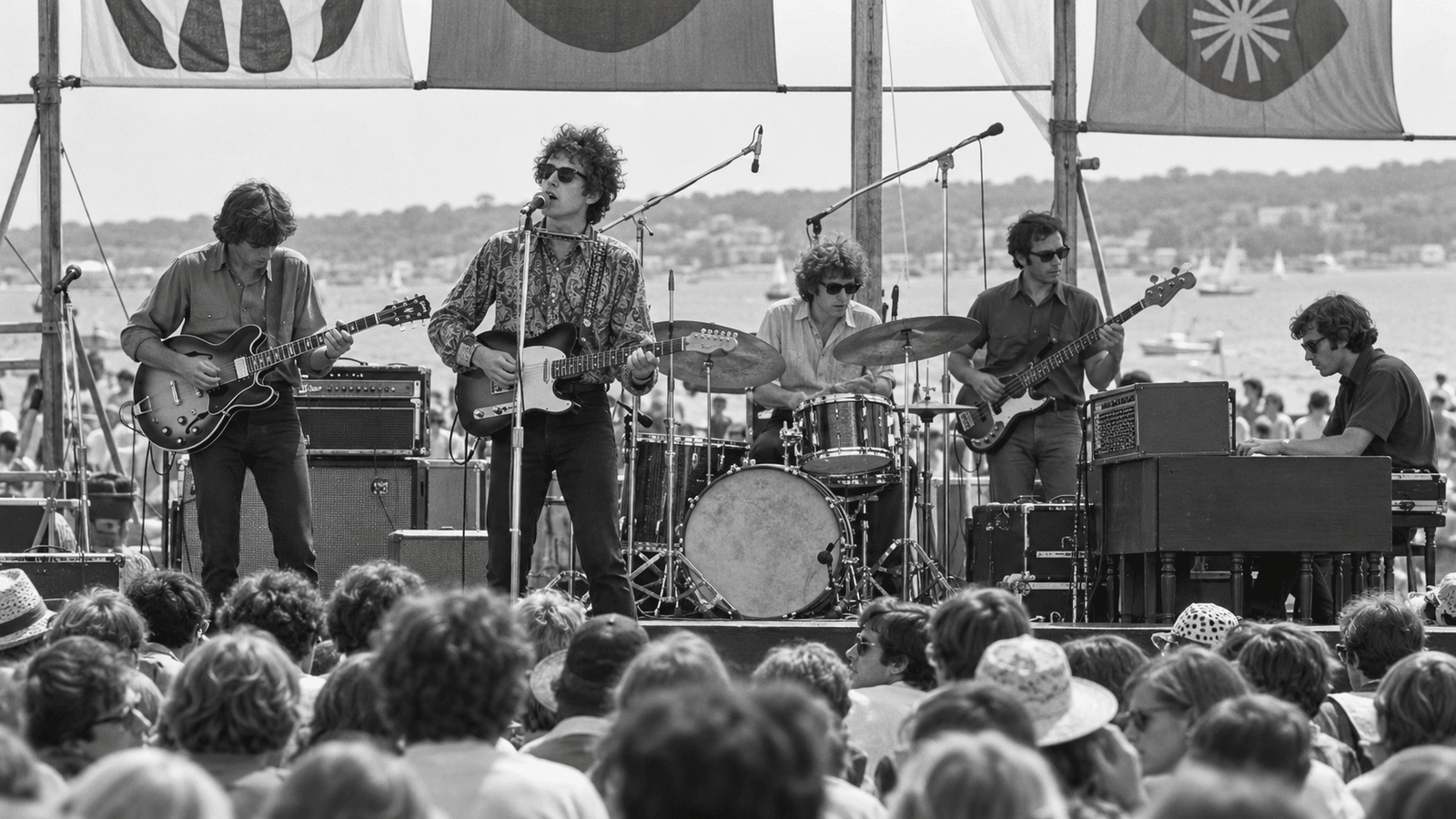
On July 25, 1965, Bob Dylan walked onto the Newport Folk Festival stage with a Fender electric guitar and a hastily assembled band. Mike Bloomfield, Al Kooper, Jerome Arnold, Barry Goldberg and Sam Lay joined him for amplified versions of Maggie’s Farm, Like a Rolling Stone and It Takes a Lot to Laugh, It Takes a Train to Cry. The short set drew a loud, mixed reaction whose exact causes remain disputed. Some listeners objected to the volume or poor sound, some wanted a longer performance and some rejected the symbolic break with acoustic folk. Dylan returned alone with an acoustic guitar for two songs, but the image of him plugged in had already become history.
The moment mattered because folk revival audiences had treated Dylan as a leading writer of topical and protest songs, while his recent records were moving toward a broader electric language. Five days earlier, Like a Rolling Stone had been released as a single. At Newport, the new sound became a public confrontation over authenticity: could an artist rooted in a community change form without betraying it? Stories that Pete Seeger tried to cut the cables have often been exaggerated, and later witnesses disagreed about boos. The uncertainty is revealing. The performance became a myth because it gave listeners a dramatic scene onto which they could project larger tensions between tradition, commerce and experiment.
Dylan continued touring with electric musicians, faced hostile audiences and produced Highway 61 Revisited and Blonde on Blonde, records central to the merger of rock instrumentation with ambitious songwriting. Folk did not disappear, nor did Dylan abandon acoustic performance; the supposed boundary simply became harder to police. Newport also entered the language as shorthand for any artist’s risky stylistic break. July 25 marks less an instant conversion than the public visibility of a change already underway. The surviving footage and conflicting testimony preserve a rare cultural hinge: a few amplified songs that listeners heard as freedom, noise, betrayal or inevitability, and that popular music has kept arguing about ever since.
Remembering bob dylan performs an electric set at the newport folk festival on July 25 is valuable because anniversaries turn a familiar cultural object back into a specific decision, release or broadcast. The surrounding technology, business and audience conditions explain why the moment could happen then, while its later uses show that meaning never stops changing. Seen at that scale, the date is not trivia. It is a checkpoint between creation and memory: a place to separate what occurred from the legend accumulated around it and to ask why the work still attracts attention. That perspective also restores the labor of collaborators, distributors and audiences whose choices helped a single event travel beyond its first setting. Cultural history becomes clearer when the remembered icon is reconnected to the systems and people that made it visible.
Bob Dylan performed a three-song electric set at the Newport Folk Festival on July 25, 1965.
The remembered moment placed Dylan Goes Electric inside the technology, audience habits and creative choices of 1965. Those conditions explain why it could happen then and why contemporary reactions differed from later memory.
The audience reaction mixed cheers and boos, with witnesses disputing whether sound, brevity or stylistic change caused the anger.
Its immediate importance came from the way audiences, distributors and other creators responded. The event gained force beyond its first release or appearance as people repeated, debated and reinterpreted it.
The performance became a symbol of artistic reinvention and the fusion of folk songwriting with rock sound.
Over time, the event became a reference point for later work in popular culture. Its legacy includes both the achievement itself and the changing arguments about what should be celebrated, questioned or rediscovered.
Explore more of "On This Day ..."
Discover more events from the same date across news, politics, technology, sports, and other fields. Each link highlights significant moments that shaped history on different fronts.