

On This Day in Pop: September 26, 1969
On September 26, 1969, the Beatles released Abbey Road in the United Kingdom. Apple Records issued an album that opened with ‘Come Together’ and closed its principal sequence with an intricately connected medley. George Martin returned to a strongly coordinated production as the four Beatles, already divided by business and personal conflict, created one of their most polished recordings. Sessions used eight-track equipment at EMI and the emerging Moog synthesizer alongside guitars, piano, orchestra and close vocal arrangement. George Harrison’s ‘Something’ and ‘Here Comes the Sun’ confirmed his place beside Lennon and McCartney as a major songwriter. The date captures the event before later reputation made its consequences look inevitable, when audiences encountered a new release, performance, institution or public loss with only the expectations available at the time.
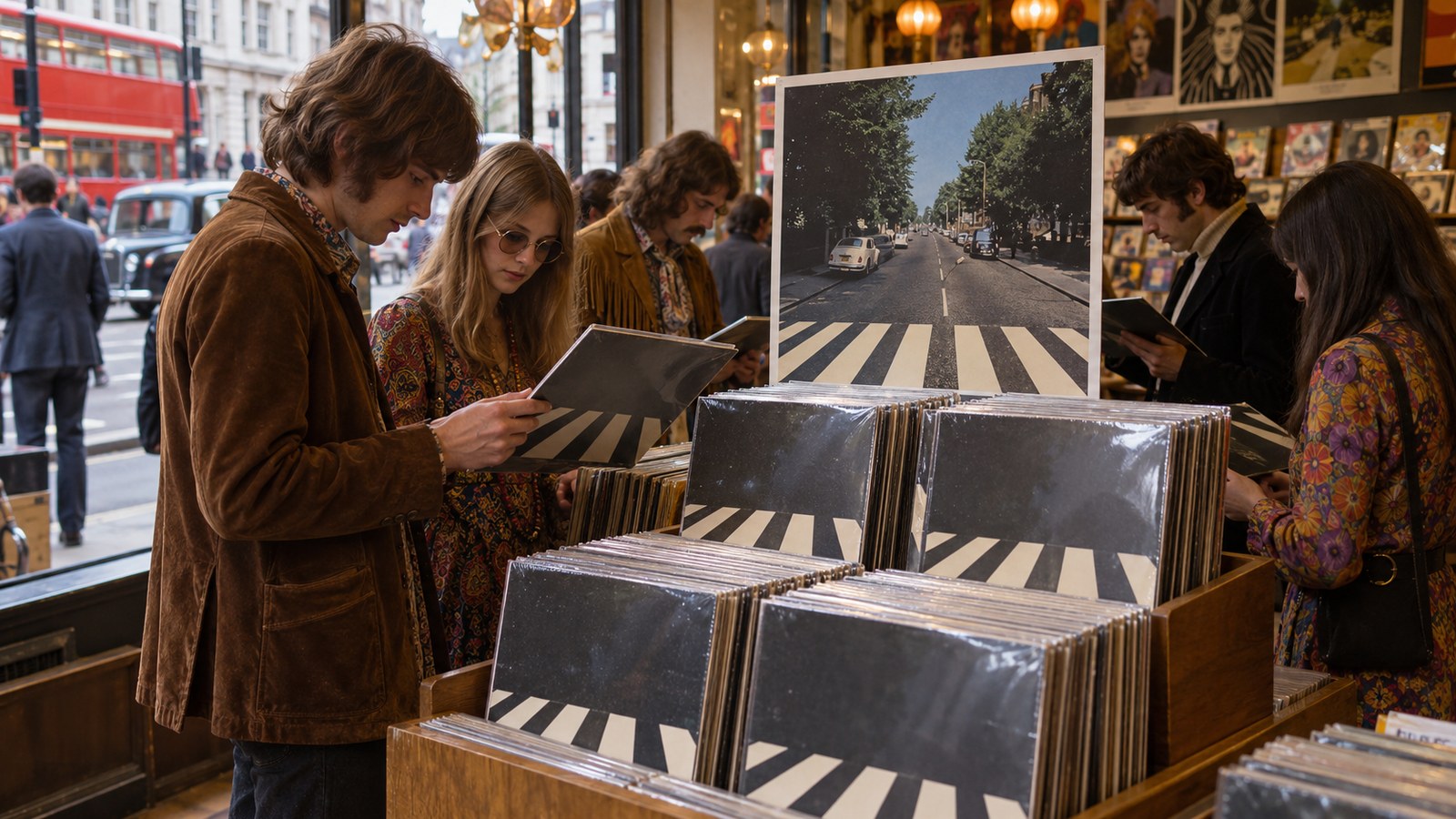
The famous cover offered no printed band name, trusting a simple street photograph to carry recognition. Its calm surface contrasted with difficult meetings and an organization nearing collapse, reminding listeners that artistic coherence does not prove personal harmony. Popular culture is never made by a famous name alone. Writers, producers, technicians, broadcasters, retailers, venues and audiences shape what becomes visible and what survives. Looking at those conditions turns an anniversary from a list entry into a record of choices, limits and competing interests.
Abbey Road topped charts and became the final album the group recorded together, though Let It Be was released later. The crossing outside the studio became a pilgrimage site, and the medley’s structure influenced generations of album-oriented musicians. That afterlife matters because influence does not move in a straight line. Reruns, reissues, new technology, criticism and community memory can change the meaning of a work long after its first appearance. Durable pop history therefore holds creative achievement beside questions of labor, access, power and representation.
September 26 marks a release that sounds like resolution without actually providing it. The Beatles turned fragmentation into sequence, leaving a record whose elegance came from craft applied under strain. Returning to this September date means separating what participants knew then from what later audiences added. Recordings, photographs, broadcasts and recollections keep the moment active, but they also select and reshape it. That distinction protects against hindsight: a chart position, premiere, publication, concert or memorial may become a neat milestone later, but the people present still faced uncertainty. Reading the moment in both directions—through its original conditions and its accumulated meanings—keeps celebration from replacing history. The distance between the immediate event and its continuing interpretation is what makes this episode worth revisiting.
Abbey Road was released in Britain on September 26, 1969.
On September 26, 1969, the Beatles released Abbey Road in the United Kingdom. Apple Records issued an album that opened with 'Come Together' and closed its principal sequence with an intricately connected medley.
It was the final studio album the Beatles recorded together.
The famous cover offered no printed band name, trusting a simple street photograph to carry recognition. Its calm surface contrasted with difficult meetings and an organization nearing collapse, reminding listeners that artistic coherence does not prove personal harmony.
The record featured eight-track production, a Moog synthesizer and a linked side-two medley.
Abbey Road topped charts and became the final album the group recorded together, though Let It Be was released later. The crossing outside the studio became a pilgrimage site, and the medley's structure influenced generations of album-oriented musicians.
Explore more of "On This Day ..."
Discover more events from the same date across news, politics, technology, sports, and other fields. Each link highlights significant moments that shaped history on different fronts.