

On This Day in Science: January 2, 1959
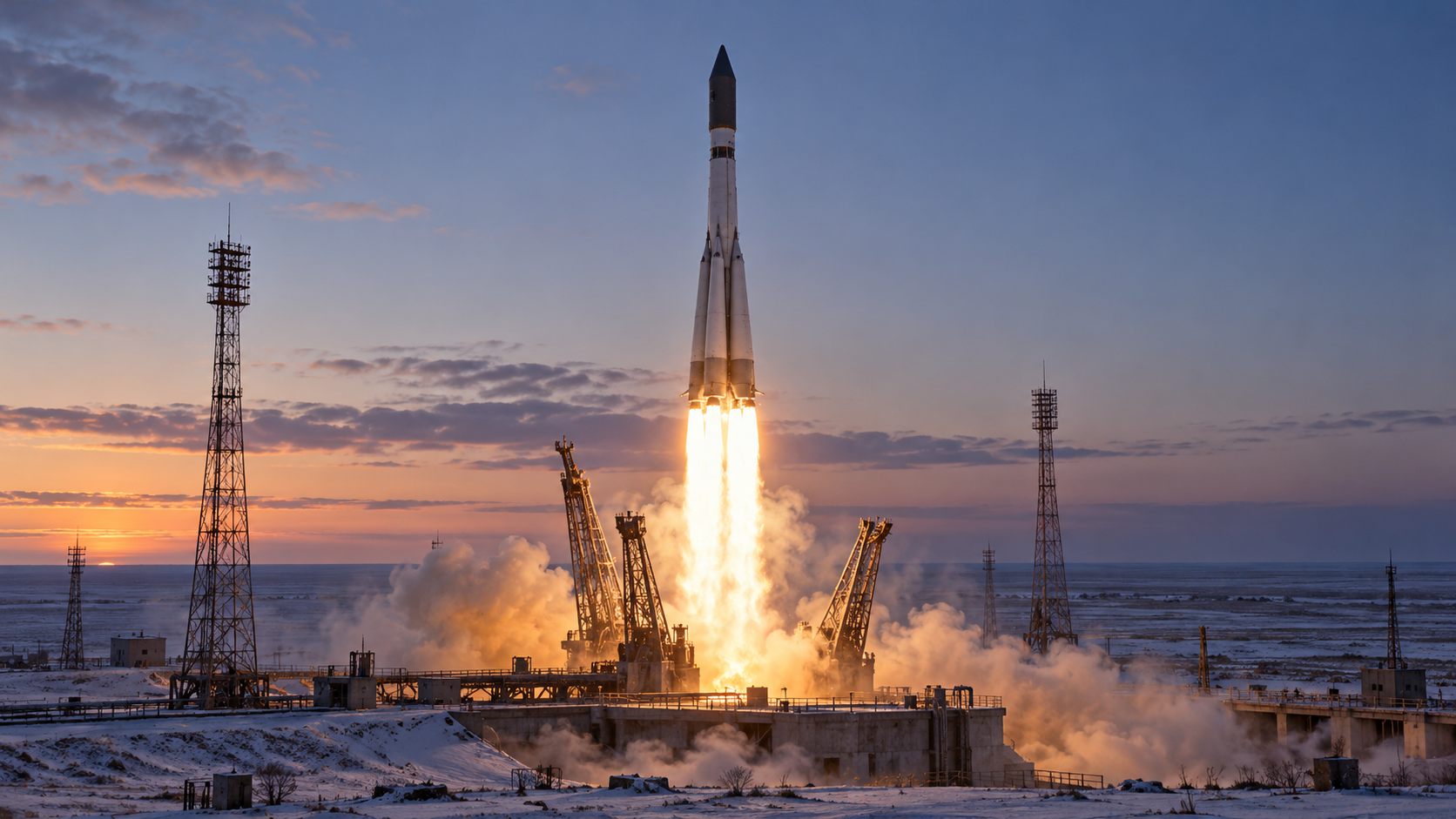
On January 2, 1959, the Soviet Union launched the spacecraft later known as Luna 1 from the Tyuratam launch complex in the Kazakh Soviet Socialist Republic. Built by Sergei Korolev’s OKB-1 organization, the Ye-1 probe rode an R-7-derived rocket toward the Moon at 16:41:21 UTC. Its intended destination was not lunar orbit or a soft landing: engineers aimed to strike the Moon. The compact spherical spacecraft and its upper stage carried instruments for measuring magnetic fields, radiation, charged particles, and micrometeoroids. The launch succeeded where three Soviet lunar attempts in 1958 had failed, giving scientists their first working robotic observatory on a trajectory beyond Earth.
The mission quickly produced an achievement larger than its original plan. Luna 1 reached escape velocity, becoming the first human-made object to break free of Earth’s gravitational hold. On January 3, the attached upper stage released a kilogram of sodium, forming a visible cloud that astronomers could track from Earth while the vehicle was more than 100,000 kilometers away. A guidance error kept the probe from its planned collision course. Instead, it passed roughly 6,000 kilometers from the lunar surface on January 4, making the first close flyby of another world. Controllers lost contact after about 62 hours, but the spacecraft continued onward into orbit around the Sun.
Luna 1’s measurements helped scientists test ideas about the environment between Earth and the Moon. Its instruments found no strong lunar magnetic field and returned information about radiation and the solar wind, a stream of charged particles that had only recently been identified. The mission’s limitations were equally clear. It missed the Moon, contact lasted less than three days, and the technology could not yet steer with the precision later lunar missions would require. Even so, a partial failure had turned into several firsts: escape from Earth, a lunar flyby, and a human-made object in heliocentric orbit.
The flight decisively changed the scale of practical science. Spacecraft were no longer confined to circling Earth; they could carry instruments across interplanetary distances and investigate conditions that telescopes could not sample directly. Soviet engineers applied the lessons to Luna 2, which reached the Moon later in 1959, and Luna 3, which photographed the far side. For the wider space community, Luna 1 demonstrated that deep-space navigation was difficult but achievable. Its January 2 launch marked the moment robotic planetary exploration moved from an aspiration into an operating scientific enterprise.
Luna 1 carried field and particle instruments beyond Earth's immediate neighborhood, allowing direct measurements along a path toward the Moon rather than from the ground.
Its R-7-derived launcher supplied enough speed for the probe to escape Earth, an essential capability for every later robotic mission to another planet.
A guidance error prevented the planned lunar impact, but the resulting flyby produced the first close spacecraft encounter with another celestial body.
The short communications window and imprecise trajectory showed how much navigation, tracking, and spacecraft reliability still had to improve.
Data and operational experience from Luna 1 informed the Soviet program's rapid follow-up, including Luna 2's lunar impact and Luna 3's far-side photographs.
Its heliocentric path also established a new scientific domain: instruments could be sent into interplanetary space to study environments directly.
Explore more of "On This Day ..."
Discover more events from the same date across news, politics, technology, sports, and other fields. Each link highlights significant moments that shaped history on different fronts.