

On This Day in Science: January 11, 1787
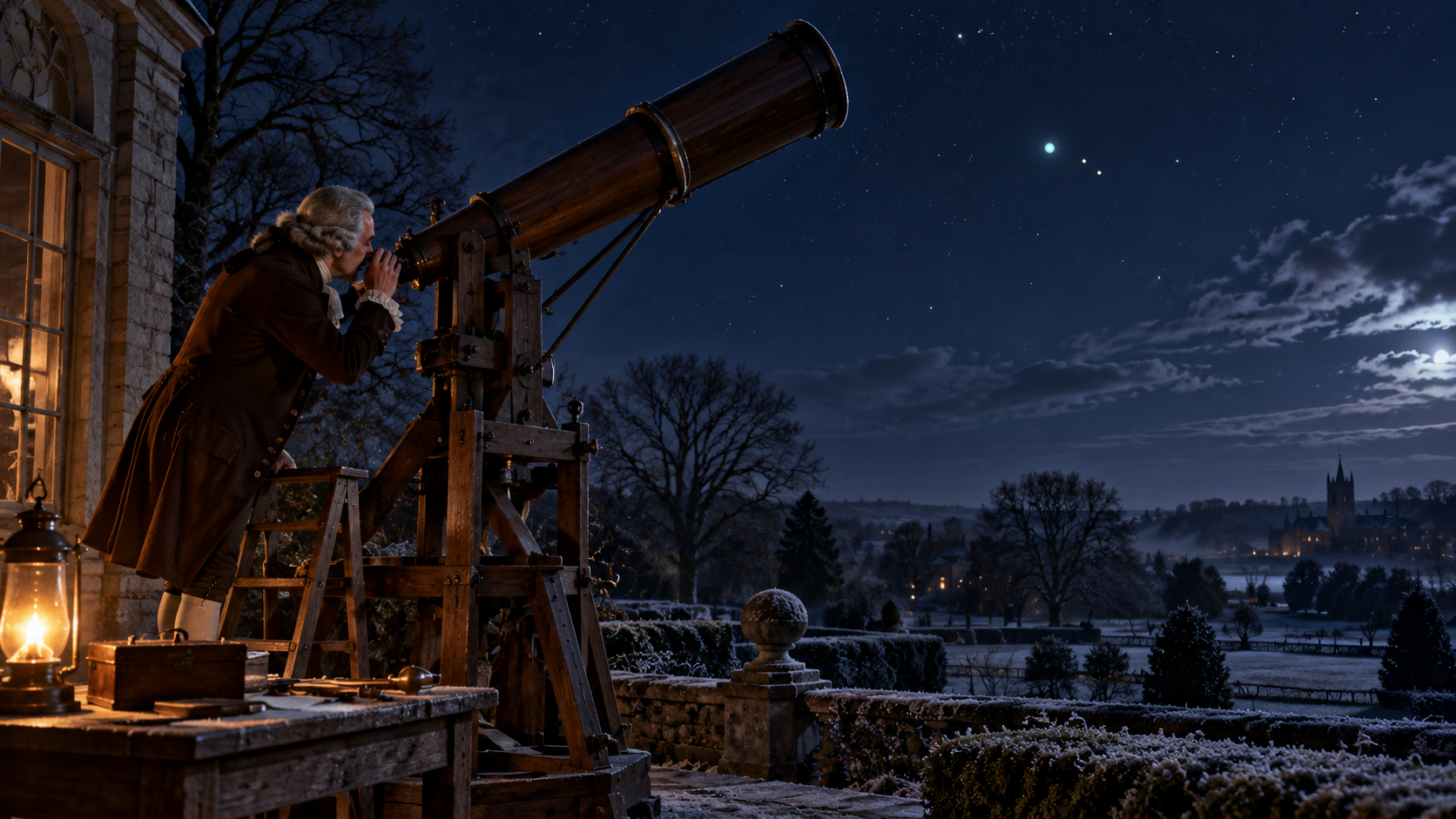
On January 11, 1787, William Herschel observed two faint companions near Uranus and recognized what became known as the moons Titania and Oberon. Herschel had discovered Uranus itself in 1781, expanding the known solar system beyond Saturn for the first time in recorded history. From his home in Slough, England, he built large reflecting telescopes and repeatedly examined the dim planet. The new points were difficult targets, lost easily in glare and atmospheric haze, so confirmation depended on later observations showing that they stayed with Uranus while changing position around it.
Titania and Oberon are the largest and second-largest moons of Uranus. Their modern names came decades later from John Herschel, William’s son, drawing on characters by Shakespeare rather than the Greek and Roman mythology commonly used for planetary satellites. Herschel’s discovery was technically demanding because Uranus is faint, the moons are much fainter, and early mirrors tarnished quickly. Other supposed satellites reported in the same era did not survive scrutiny. Ariel and Umbriel were discovered in 1851, Miranda in 1948, and spacecraft eventually raised the count far beyond the five large moons visible from Earth.
For nearly two centuries, Titania and Oberon remained small points whose orbits revealed more than their surfaces. That changed in January 1986 when Voyager 2 crossed the Uranian system. Its images showed dark, icy worlds marked by impact craters, valleys, faults, and bright material. Titania’s enormous fault systems suggest that its interior expanded and fractured its crust, while Oberon is heavily cratered and preserves signs of ancient geological change. Voyager’s brief encounter remains the only close spacecraft reconnaissance of either moon, so many details of their composition and internal history are still uncertain.
The January 11 observation extended a pattern that had begun with Galileo: planets could possess their own systems of moons, and careful measurements could reveal them even when no surface detail was visible. Herschel’s work also linked instrument making directly to discovery. Larger mirrors and disciplined repeated observations opened a region of the solar system that previous telescopes could barely reach. Titania and Oberon are now considered possible ocean-bearing icy worlds, making them targets for future exploration. Their discovery reminds us that a pair of nearly invisible lights can mark entire worlds awaiting closer study. Each improvement in sensitivity has continued that expansion, revealing smaller Uranian moons and making the original pair part of a complex dynamical family rather than isolated companions.
Titania and Oberon were extremely faint beside Uranus, so Herschel needed a large reflecting telescope and repeat observations.
Their changing positions around the planet separated true satellites from stars and optical artifacts.
John Herschel later named the moons Titania and Oberon, figures from A Midsummer Night's Dream.
The Uranian system developed a literary naming tradition distinct from the classical mythology used for many other moons.
Voyager 2 images in 1986 transformed the moons from points of light into cratered and fractured icy worlds.
The brief flyby remains their only close reconnaissance, leaving their interiors and possible buried oceans open questions.
Explore more of "On This Day ..."
Discover more events from the same date across news, politics, technology, sports, and other fields. Each link highlights significant moments that shaped history on different fronts.