

On This Day in Science: January 15, 2006
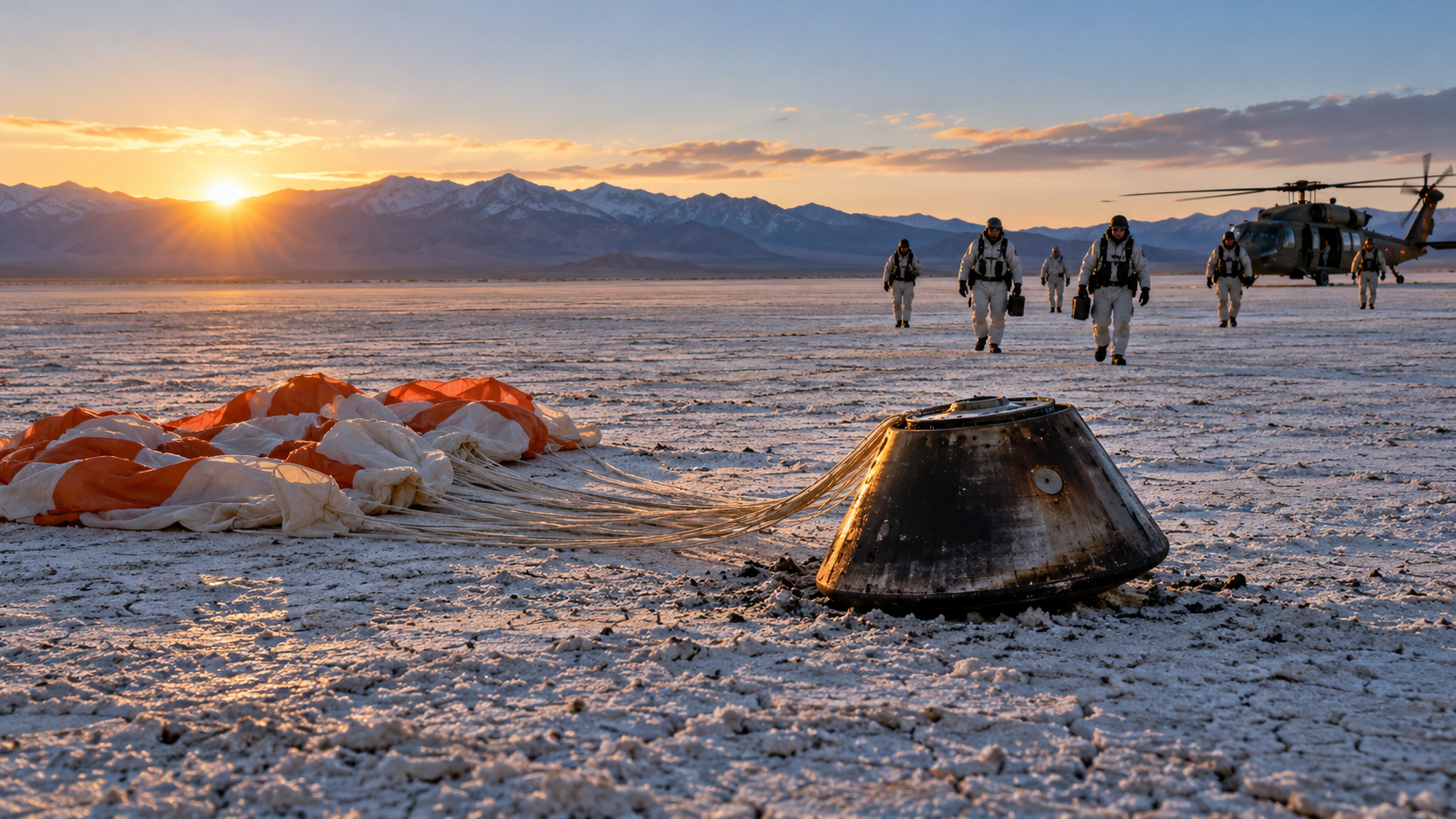
On January 15, 2006, NASA’s Stardust sample-return capsule landed on the Utah Test and Training Range carrying particles from comet Wild 2 and grains collected from interstellar space. The main spacecraft released the capsule about four hours before entry, then diverted away from Earth. Traveling at roughly 12.9 kilometers per second, the capsule became the fastest human-made object to enter Earth’s atmosphere at that time. A heat shield absorbed the extreme energy, a drogue parachute stabilized the descent, and a main parachute lowered the capsule onto the desert floor at 10:10 UTC.
Stardust had launched in 1999 and reached Wild 2 on January 2, 2004. As it passed the comet’s nucleus, a tennis-racket-shaped collector exposed tiles of aerogel, an ultralight silica material mostly made of empty space. High-speed dust grains burrowed into the aerogel and slowed gradually, leaving carrot-shaped tracks without being completely destroyed. Protective shields guarded the spacecraft from larger debris, and a camera recorded a rugged nucleus with cliffs, pits, and jets. The collector then folded into the return capsule for the long trip home.
Recovery teams found the capsule less than an hour after landing and moved it to a clean facility before shipment to NASA’s Johnson Space Center. More than ten thousand particles larger than a micrometer were recovered. Laboratory studies found high-temperature minerals that must have formed near the young Sun before being transported to the cold outer solar system, as well as carbon-rich compounds and evidence of water-related processes. The samples were tiny and vulnerable to contamination, so the mission’s value depended on careful curation and distributing fragments to specialized laboratories around the world.
Stardust transformed a comet encounter into a resource that can be reexamined as analytical instruments improve. Remote spacecraft measurements describe a target in its environment, while returned samples allow isotope analysis, microscopy, and chemical tests that cannot be performed aboard a small probe. The bus continued operating and later flew past Tempel 1 as Stardust-NExT, but the January 15 landing completed its defining task. For the first time, pieces of a comet had been intentionally captured in space and delivered intact to Earth, giving researchers direct material from the solar system’s deep history. The collection remains finite, so curators balance present experiments against preserving untouched grains for questions and technologies still to come. That stewardship makes curation an active part of the mission rather than an afterthought. Each allocated grain must justify material that cannot be replaced.
Aerogel slowed particles across a long track, reducing the shock that would have destroyed them against a conventional collector.
The transparent material also preserved each impact path, helping curators locate grains smaller than a speck of dust.
The capsule entered faster than any earlier human-made return vehicle and relied on a heat shield plus two parachutes.
Rapid recovery and clean handling protected fragile samples from weather and terrestrial contamination.
Earth laboratories can apply larger, more sensitive instruments than a spacecraft could carry to a comet.
Because the collection is curated, future researchers can test the same material with methods that did not exist in 2006.
Explore more of "On This Day ..."
Discover more events from the same date across news, politics, technology, sports, and other fields. Each link highlights significant moments that shaped history on different fronts.