

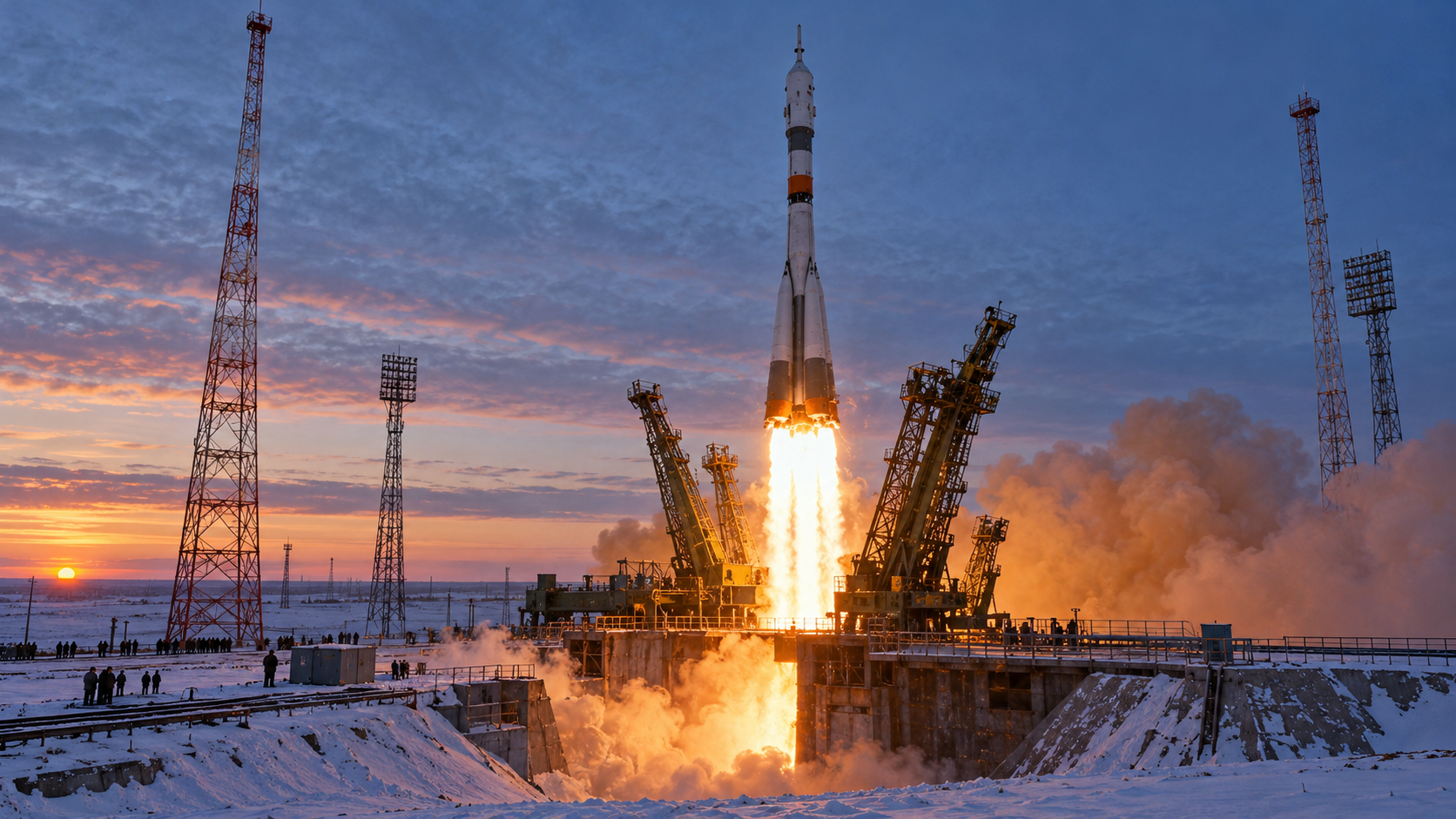
On This Day in Science: January 20, 1978
On January 20, 1978, the Soviet Union launched Progress 1 from Baikonur, beginning the first mission by an uncrewed spacecraft built specifically to resupply an occupied space station. Based on the Soyuz design, Progress carried no return capsule or crew life-support system. The saved mass and volume became cargo capacity for Salyut 6 and its resident cosmonauts Yuri Romanenko and Georgi Grechko. Two days after launch, the vehicle automatically rendezvoused and docked at the station’s aft port, turning orbital resupply from an experiment into an operating capability.
Progress 1 delivered about 2,300 kilograms of supplies, including food, mail, replacement equipment, scientific hardware, oxygen, and propellant. Dry cargo occupied the pressurized forward compartment, while tanks replaced the crewed Soyuz return section. Pumps transferred fuel to Salyut 6, and gases replenished the station’s atmosphere. The visiting craft could also use its engines to adjust the station’s orbit. After unloading, the crew filled it with trash and equipment no longer needed. Progress later undocked and burned up during a controlled atmospheric reentry.
These functions addressed the central limit on long stays in orbit: a station cannot carry all future consumables, spare parts, and fuel at launch. Salyut 6 had two docking ports, allowing a cargo ship to arrive while a crewed Soyuz remained attached as the astronauts’ return vehicle. That architecture supported longer expeditions and more ambitious research. Progress 1 was not reusable and could not bring samples home, but disposability simplified the vehicle and gave crews a way to remove waste from a small closed habitat.
Updated Progress spacecraft have flown for decades, supporting Salyut, Mir, and the International Space Station. Other cargo vehicles now share the work, some capable of returning material and others designed to burn up. The underlying logistics remain recognizable: autonomous rendezvous, standardized docking, pressurized and unpressurized cargo, propellant transfer, orbit maintenance, and planned disposal. The January 20 launch changed a space station from a facility limited by the supplies packed at liftoff into an outpost that could be maintained repeatedly. Long-duration human research in orbit depends as much on that quiet supply chain as on the laboratory itself. Mission planning now treats food, water, spare parts, storage, and waste capacity as an integrated engineering system rather than background support. Every extension of crew endurance begins with that inventory discipline. Resupply schedules create resilience by giving crews more chances to replace failures before they threaten a mission. That reliability sustains science in orbit.
Removing seats, crew systems, and the return capsule created room for supplies, gas, and propellant.
The familiar Soyuz-based systems reduced development risk while adapting the vehicle to a new logistical role.
Progress could transfer fuel and gases, help adjust the station's orbit, and provide temporary storage.
Crews loaded waste after unloading supplies, and the disposable ship carried it into a destructive reentry.
Regular cargo flights made longer station stays possible because consumables and replacement parts no longer had to launch with the outpost.
Modern station programs still depend on the rendezvous, docking, and resupply pattern demonstrated by Progress 1.
Explore more of "On This Day ..."
Discover more events from the same date across news, politics, technology, sports, and other fields. Each link highlights significant moments that shaped history on different fronts.