

On This Day in Science: January 23, 1960
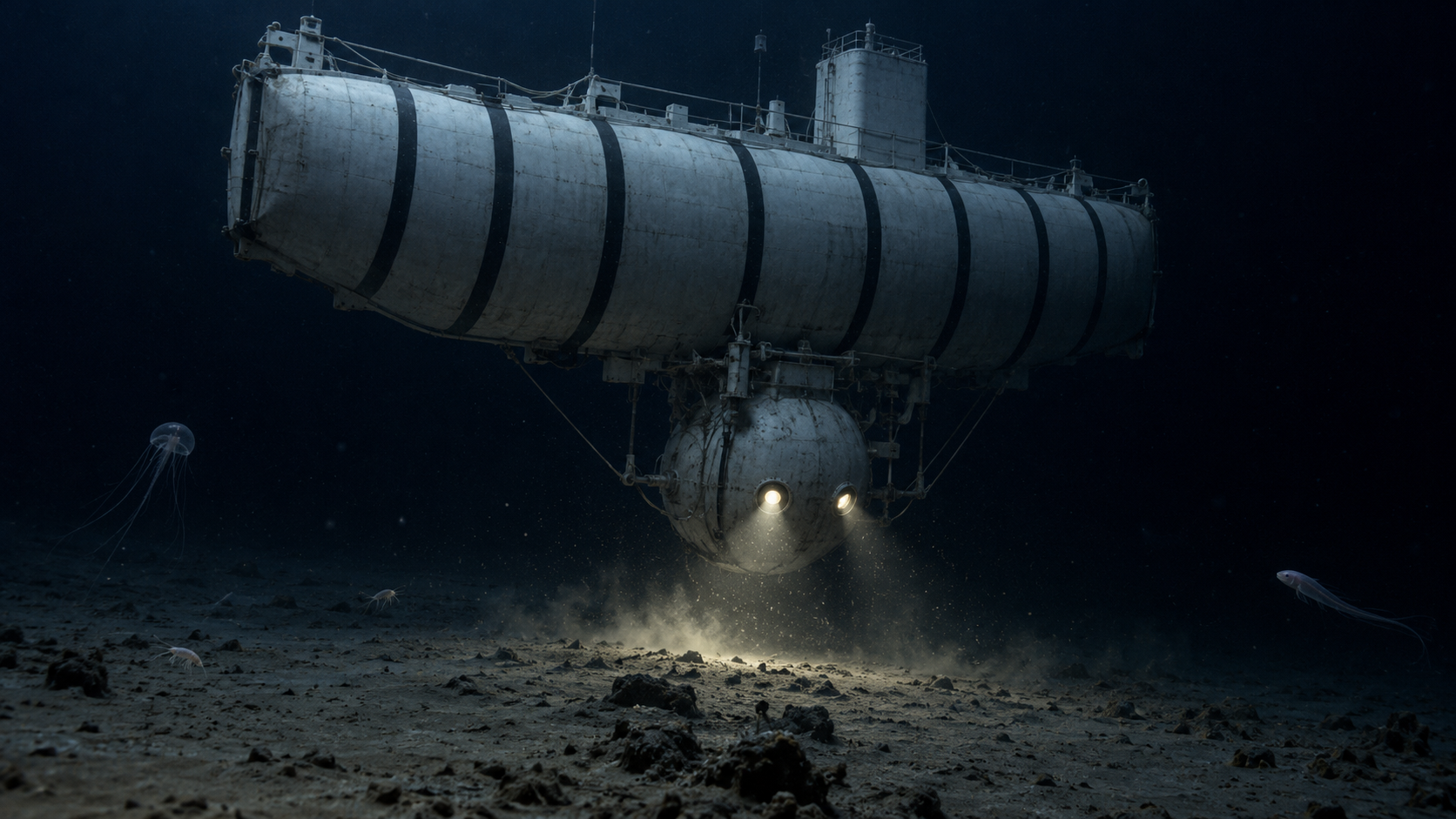
On January 23, 1960, the bathyscaphe Trieste carried Jacques Piccard and U.S. Navy Lieutenant Don Walsh to the floor of Challenger Deep in the Mariana Trench. The descent began in the western Pacific near Guam and lasted almost five hours. Trieste worked more like an underwater balloon than a conventional submarine: a large float filled with gasoline supplied buoyancy because gasoline is lighter than seawater and resists compression, while the two men occupied a small steel pressure sphere suspended beneath it. Iron shot provided ballast and could be released to begin the return.
As the craft descended, increasing pressure surrounded the sphere with thousands of pounds of force per square inch. At about 9,000 meters the crew heard a loud crack when an outer window panel fractured, but the pressure hull remained safe and the dive continued. Trieste finally settled in soft sediment at a depth later calculated at roughly 10,900 meters. The men spent about twenty minutes on the bottom, looking through small ports and communicating with the support ship by sonar telephone. Disturbed sediment limited their view, and later debate questioned an early report of a flatfish.
The dive established that a crewed vehicle could reach the deepest known part of the ocean and return. Trieste’s instruments and short bottom time did not create a comprehensive biological or geological survey; the achievement was primarily one of access, pressure engineering, and direct observation. The cabin pressure remained near normal while the sphere’s thick walls carried the external load. To ascend, the crew released ballast, allowing the gasoline float to lift the craft. The return took a little more than three hours, bringing both explorers safely back to the surface.
No person returned to Challenger Deep for fifty-two years, even as uncrewed vehicles improved deep-ocean mapping and sampling. Later dives used more maneuverable craft, better imaging, and precise depth measurements, revealing that the trench contains active microbial ecosystems as well as pollutants carried into the deepest sea. The January 23 descent remains a foundational demonstration of hadal exploration. It also illustrates the limits of a first: reaching an extreme location is not the same as understanding it. Trieste opened the door, while generations of instruments and repeated observations have begun the much longer scientific task beyond that threshold. Because depth varies across the seafloor and measurement methods improve, modern surveys also refine the number attached to the historic dive without diminishing its achievement.
A gasoline-filled float supplied buoyancy, while the crew rode in a compact steel sphere designed to withstand pressure.
Releasable iron ballast made ascent fail-safe because dropping weight allowed the vehicle to rise without propulsion.
The descent took nearly five hours, but stirred sediment and operational limits allowed only a short stay on the bottom.
The dive proved access to the deepest zone more than it provided a complete survey of that environment.
Uncrewed vehicles later supplied mapping, samples, and long observations that a pioneering crewed dive could not.
Modern visits show the hadal ocean as an ecosystem and a sink for human pollution, not an isolated empty trench.
Explore more of "On This Day ..."
Discover more events from the same date across news, politics, technology, sports, and other fields. Each link highlights significant moments that shaped history on different fronts.