

On This Day in Science: January 19, 2006
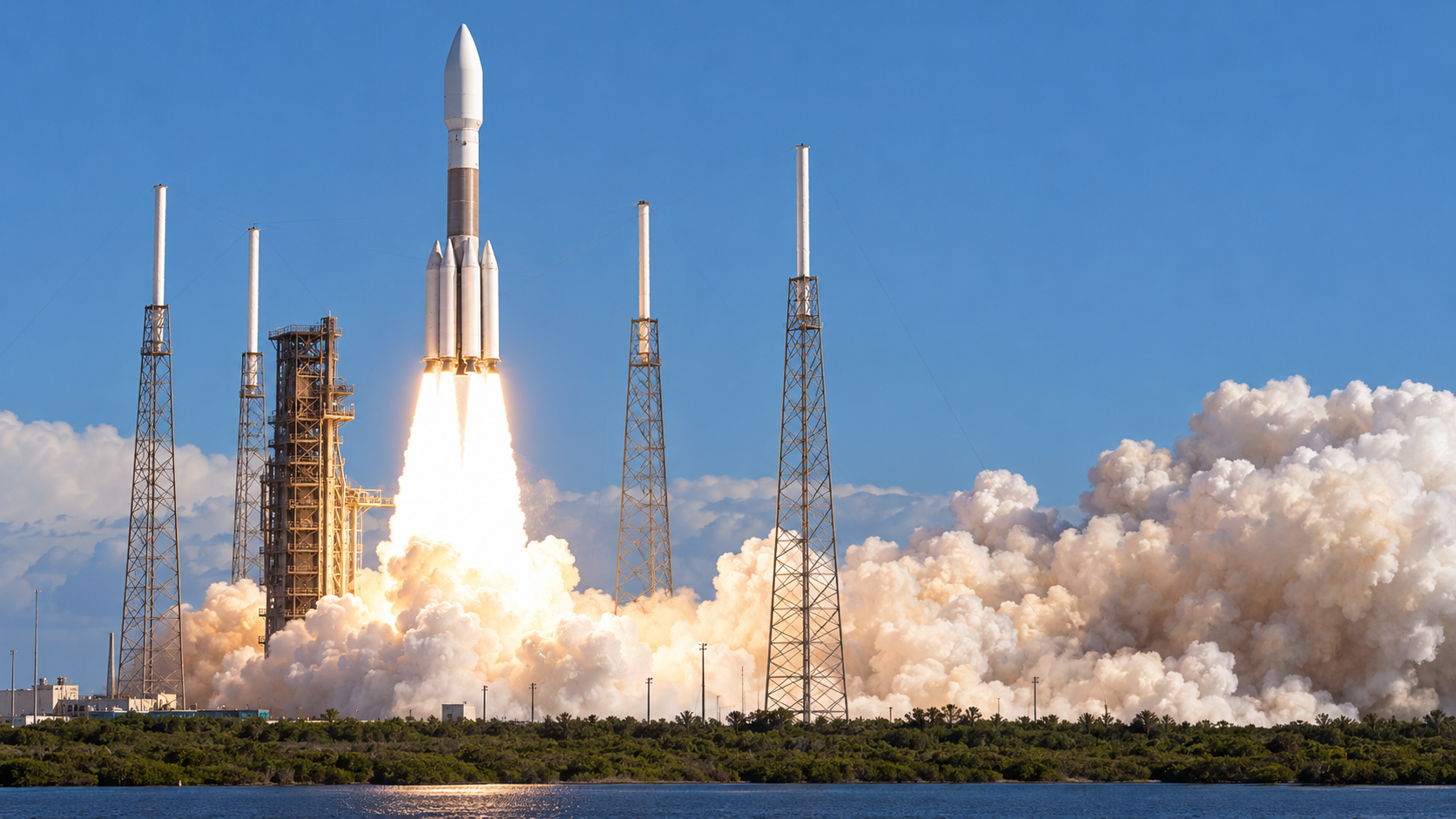
On January 19, 2006, NASA’s New Horizons spacecraft launched from Cape Canaveral aboard an Atlas V 551 rocket. A powerful Centaur stage and Star 48B solid motor accelerated the compact probe to more than 16 kilometers per second relative to Earth, the fastest departure then achieved by a spacecraft. It crossed the Moon’s orbital distance in about nine hours, but Pluto still lay nearly a decade away. The mission carried seven instruments to map geology and composition, study atmospheres and particles, measure dust, and photograph a planetary system that no spacecraft had visited.
New Horizons used a Jupiter flyby in February 2007 to increase its speed and shorten the trip by several years. The encounter also served as a full rehearsal, with instruments observing Jupiter’s atmosphere, rings, magnetosphere, and moons. Most of the long cruise was spent in electronic hibernation to reduce wear and the burden on flight controllers. Because sunlight is weak at Pluto, the spacecraft relied on a radioisotope power source. Commands and data crossed billions of kilometers through NASA’s Deep Space Network, with one-way signal time measured in hours near the target.
On July 14, 2015, New Horizons passed about 12,500 kilometers above Pluto. The images revealed mountains of water ice, glaciers of nitrogen ice, layered haze, and the bright heart-shaped region dominated by Sputnik Planitia. Charon showed enormous canyons and a dark polar cap, while the smaller moons appeared as irregular bodies. The flyby gathered its closest observations in hours, then transmitted the stored data over many months. It turned Pluto from a blurred disk into an active world and showed that small, cold bodies can support unexpectedly complex geology.
The mission continued into the Kuiper Belt and flew past Arrokoth on January 1, 2019, the most distant object ever explored close up. Arrokoth’s gently joined lobes preserved clues about how small bodies assembled early in solar-system history. The spacecraft now studies dust, charged particles, and the distant environment while continuing outward. New Horizons launched before the International Astronomical Union classified Pluto as a dwarf planet, but the label never reduced its scientific value. The January 19 departure began a reconnaissance of a new planetary frontier, demonstrating that focused instruments and patient operations could reveal worlds at the edge of the Sun’s domain. Every major observation also depended on years of navigation and a communications system built to recover faint signals across interplanetary distances. The patience of the cruise was as fundamental to the science as the speed of launch.
Atlas V, Centaur, and a solid third stage sent New Horizons past lunar distance in roughly nine hours.
Even at that speed, the spacecraft needed a Jupiter gravity assist and almost ten years to reach Pluto.
The closest observations were compressed into a rapid flyby because New Horizons carried no fuel to brake into orbit.
Its instruments stored data onboard and returned the full record slowly across the enormous distance to Earth.
The 2019 Arrokoth flyby examined a primitive contact binary more distant than any previous close spacecraft target.
New Horizons continues measuring the outer solar system, extending a mission that began with one unexplored world.
Explore more of "On This Day ..."
Discover more events from the same date across news, politics, technology, sports, and other fields. Each link highlights significant moments that shaped history on different fronts.