

On This Day in Science: February 5, 1971
On February 5, 1971, Apollo 14’s lunar module Antares landed in the Fra Mauro highlands. Commander Alan Shepard and lunar module pilot Edgar Mitchell reached a region that had been the destination of the aborted Apollo 13 mission, while Stuart Roosa remained in lunar orbit aboard the command module Kitty Hawk. The landing restored momentum after Apollo 13’s near disaster and placed astronauts in geologically older, heavily cratered terrain. Fra Mauro was believed to contain material excavated by the enormous Imbrium impact, offering a chance to investigate a major event in the Moon’s early history.
The descent was not routine. Before separation, the crew had worked through a docking problem that required several attempts. During the landing phase, a faulty abort signal threatened to trigger the computer, and the landing radar was slow to acquire the surface. Ground teams and the crew used a quickly developed software procedure to bypass the false signal, then restored the radar in time for the computer to guide the final approach. Antares touched down close to its planned point, giving the astronauts a workable route for two surface excursions.
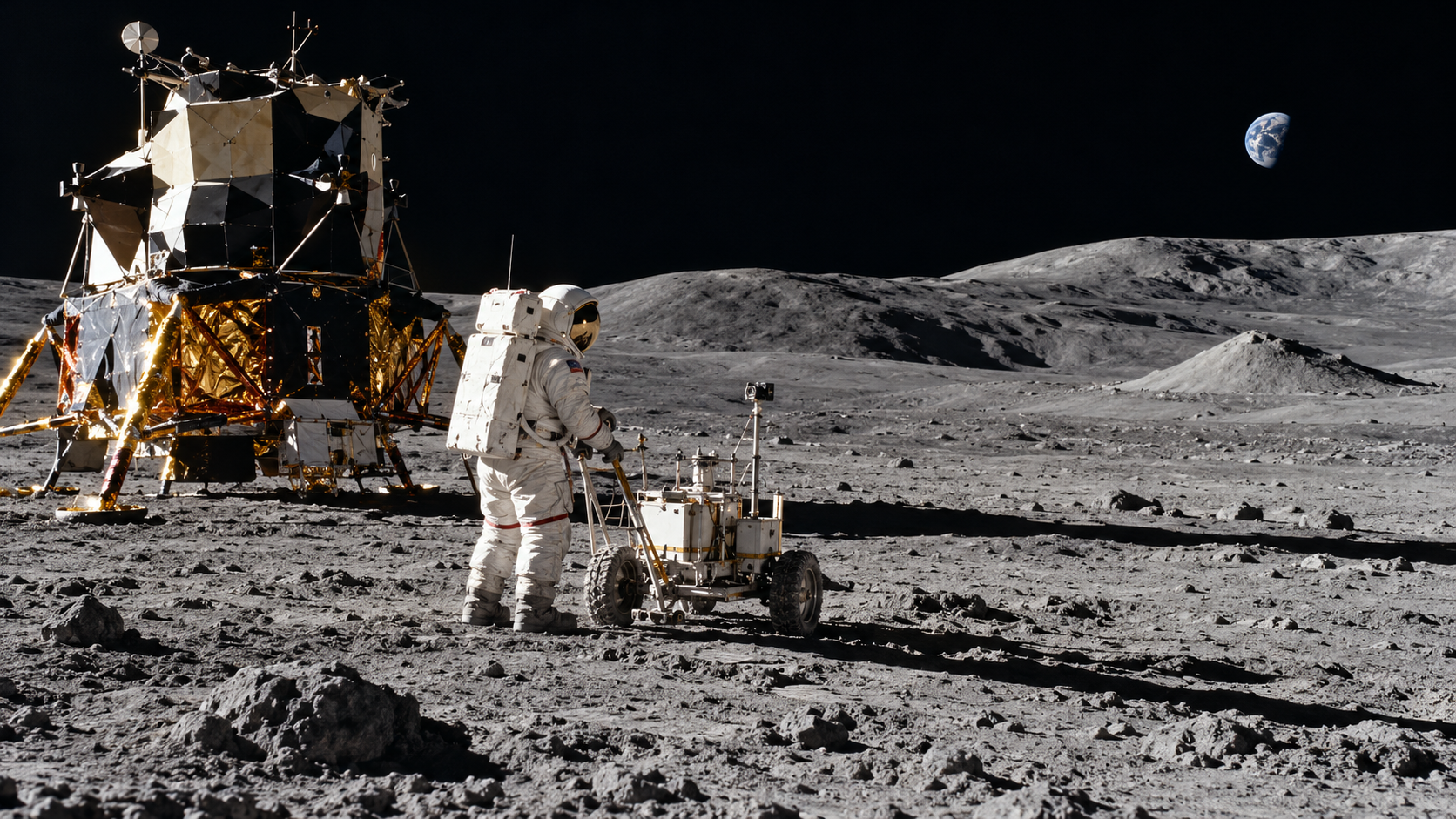
Shepard and Mitchell deployed experiments, photographed the site, and collected about forty-three kilograms of rocks and soil. On their second excursion they pulled a two-wheeled equipment carrier toward Cone Crater, hoping to sample material thrown from deep below the surface. The crater’s rolling terrain and misleading landmarks made navigation difficult, and the crew turned back when they were unknowingly near the rim. Even without reaching the exact target, their samples included impact breccias that helped scientists estimate the age and character of the Imbrium event.
Apollo 14 spent roughly thirty-three and a half hours on the Moon and returned safely on February 9. The mission is often remembered for Shepard striking two golf balls, but its larger importance lies in recovery, field science, and disciplined improvisation. Hardware alarms did not disappear simply because a destination was historic; astronauts, engineers, and mission controllers had to diagnose them under time pressure. The rocks from Fra Mauro became part of a comparative record that still informs lunar chronology. Apollo 14 showed that exploration could resume after failure only by carrying its lessons into the next design, checklist, and decision. For science history, the episode is also a case study in how evidence moves from an observation or engineered test into a durable body of knowledge. Instruments supplied measurements, specialists debated interpretation, and later work refined what the first result could mean. Archives preserve the early record while new methods let researchers ask different questions of it. That continuing revision is not a weakness in the original achievement; it is the process through which a dated milestone remains scientifically useful.
Apollo 14 carried the Fra Mauro mission that Apollo 13 had been unable to complete.
Alan Shepard and Edgar Mitchell landed in Antares while Stuart Roosa continued in lunar orbit.
The crew and controllers bypassed a false abort signal and recovered the landing radar during descent.
Their response combined prepared procedures with software changes developed while the mission was already underway.
The astronauts gathered impact breccias and deployed instruments during two moonwalks.
Fra Mauro samples helped researchers investigate the age and scale of the ancient Imbrium impact.
Explore more of "On This Day ..."
Discover more events from the same date across news, politics, technology, sports, and other fields. Each link highlights significant moments that shaped history on different fronts.