

On This Day in Science: February 10, 2009
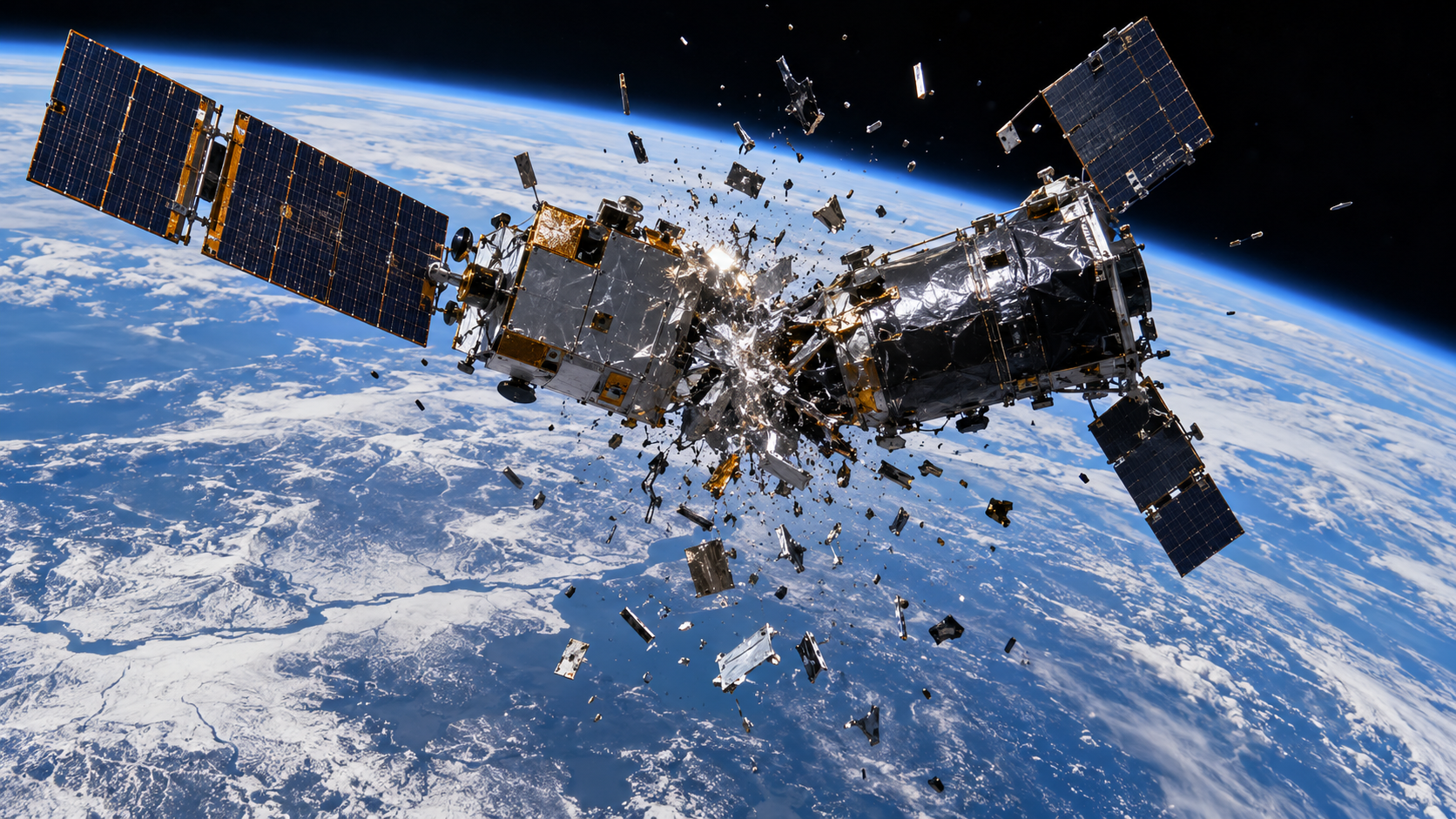
On February 10, 2009, the active communications satellite Iridium 33 and the inactive Russian military satellite Cosmos 2251 collided about 790 kilometers above Siberia. They met at a relative speed of roughly eleven kilometers per second, fast enough to shatter both spacecraft. It was the first known accidental collision between two intact satellites in orbit. Previous impacts had involved smaller debris or deliberate tests, but this event showed that two substantial objects on crossing paths could turn into thousands of trackable fragments in seconds.
Both satellites had been cataloged, yet the conjunction was not treated as an imminent collision requiring a maneuver. At the time, screening systems, warning thresholds, and communication practices were less mature than they are today. Predicted positions contain uncertainty because orbital paths respond to atmospheric drag, gravitational effects, and limited tracking observations. A close-approach estimate is therefore a probability problem, not a simple pair of lines on a map. Operators must decide whether the risk justifies moving a spacecraft while considering fuel, mission constraints, and the chance that updated data will shift the prediction.
The collision generated two expanding debris clouds. Many fragments were large enough to be tracked from the ground, while smaller pieces remained capable of damaging spacecraft. At those speeds, even a modest object carries destructive kinetic energy. The new debris crossed orbital regions used by Earth-observation, weather, research, and communications missions, creating hazards that would persist for years or decades. International Space Station teams and other operators incorporated the fragments into later collision-avoidance assessments as the clouds gradually spread around Earth.
Iridium-Cosmos accelerated improvements in conjunction data, operator coordination, and space situational awareness. It also strengthened arguments for designing satellites that can be safely removed from crowded orbits at the end of their service. No single rule can eliminate collision risk, especially when dead spacecraft cannot maneuver, but shared tracking and timely warnings can reduce it. The 2009 impact changed orbital debris from a largely abstract accumulation problem into a vivid operational one. Near-Earth space is vast, yet useful orbital bands are finite environments whose safety depends on collective stewardship. Seen across a longer timeline, the event also shows that scientific milestones are junctions rather than isolated beginnings. Earlier experiments, tools, and institutions made the work possible, while later teams tested its limits and carried the result into new settings. What survives is more than an anniversary fact: it is a traceable chain of evidence, correction, and application that allows one moment to remain relevant as knowledge and technology continue to change.
Iridium 33 and the inactive Cosmos 2251 struck one another above Siberia at enormous relative speed.
The event was the first known accidental collision of two intact satellites.
Tracking data produces ranges of possible future positions rather than perfectly certain trajectories.
Operators must weigh collision probability against fuel limits, mission plans, and changing observations.
The breakup created thousands of tracked fragments and many smaller pieces in a busy orbital region.
The collision drove stronger warning systems, coordination practices, and end-of-life planning for spacecraft.
Explore more of "On This Day ..."
Discover more events from the same date across news, politics, technology, sports, and other fields. Each link highlights significant moments that shaped history on different fronts.