

On This Day in Science: February 9, 1996
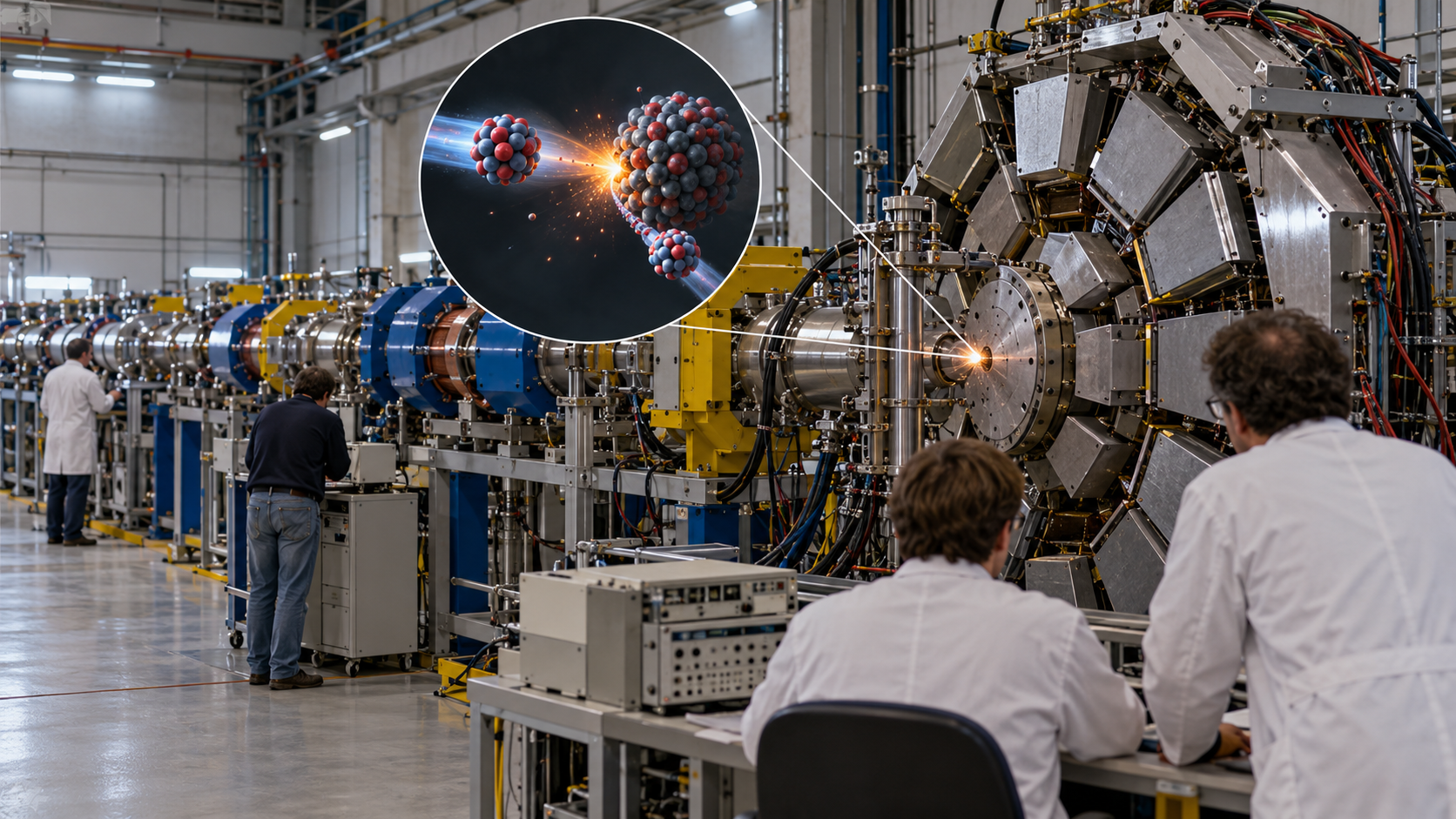
On February 9, 1996, a team at the GSI Helmholtz Centre for Heavy Ion Research in Darmstadt, Germany, produced evidence of a new element with atomic number 112. Researchers accelerated zinc-70 nuclei and directed them into a target containing lead-208. In an extraordinarily rare fusion event, the nuclei combined to form a much heavier atom. The result was not a speck of material that could be placed in a vial. It was a single, short-lived nucleus whose existence had to be inferred from the sequence of particles released as it decayed.
Creating a superheavy element requires overcoming the electrical repulsion between two positively charged nuclei. A heavy-ion accelerator gives the projectile enormous speed, but most collisions still scatter, fragment, or produce other reactions. The few promising products pass through a velocity filter that separates them from the intense background and guides them to detectors. Scientists then compare the energies and timing of successive alpha decays with known daughter nuclei. A linked decay chain can serve like a family record, connecting the unknown parent to better-established descendants.
The Darmstadt group reported a chain consistent with an isotope of element 112 containing 277 nucleons. Independent work and later experiments were needed before international scientific bodies accepted the discovery. In 2009, the element received the name copernicium, symbol Cn, honoring Nicolaus Copernicus. Its placement below mercury in the periodic table raises intriguing questions about how extreme nuclear charge and relativistic electron behavior alter chemistry. Because only small numbers of rapidly decaying atoms can be made, researchers often learn through nuclear properties before chemical measurements become possible.
Copernicium illustrates how the periodic table is extended one atom at a time. Discovery claims depend on instruments, statistical judgment, reproducibility, and agreement about what counts as adequate identification. The February experiment was therefore both a feat of accelerator engineering and an exercise in scientific proof. It linked a fleeting signal to an ordered framework built over centuries. Superheavy-element research continues to test how long nuclei can survive and whether more stable combinations may exist beyond those already known, using brief events to probe the limits of matter. For science history, the episode is also a case study in how evidence moves from an observation or engineered test into a durable body of knowledge. Instruments supplied measurements, specialists debated interpretation, and later work refined what the first result could mean. Archives preserve the early record while new methods let researchers ask different questions of it. That continuing revision is not a weakness in the original achievement; it is the process through which a dated milestone remains scientifically useful.
Zinc nuclei were accelerated into a lead target in the hope that a rare collision would fuse them.
The successful product existed only briefly and could not be collected as a visible sample.
Detectors recorded the energies and timing of alpha particles emitted by the new nucleus and its descendants.
Those linked signals allowed researchers to connect the unknown parent to nuclei with better-known properties.
International review and later experiments preceded official recognition of element 112.
The name copernicium honors Nicolaus Copernicus, and its symbol is Cn.
Explore more of "On This Day ..."
Discover more events from the same date across news, politics, technology, sports, and other fields. Each link highlights significant moments that shaped history on different fronts.