

On This Day in Science: February 12, 1961
On February 12, 1961, the Soviet Union launched the spacecraft later known as Venera 1 toward Venus. A Molniya rocket first placed the probe and its upper stage into Earth orbit; the upper stage then fired again, sending the spacecraft onto an interplanetary trajectory. It was the first successful departure from Earth orbit toward another planet, a milestone reached less than four years after Sputnik. The mission aimed to pass Venus, return scientific measurements, and demonstrate the communications and navigation techniques needed for exploration far beyond the Moon.
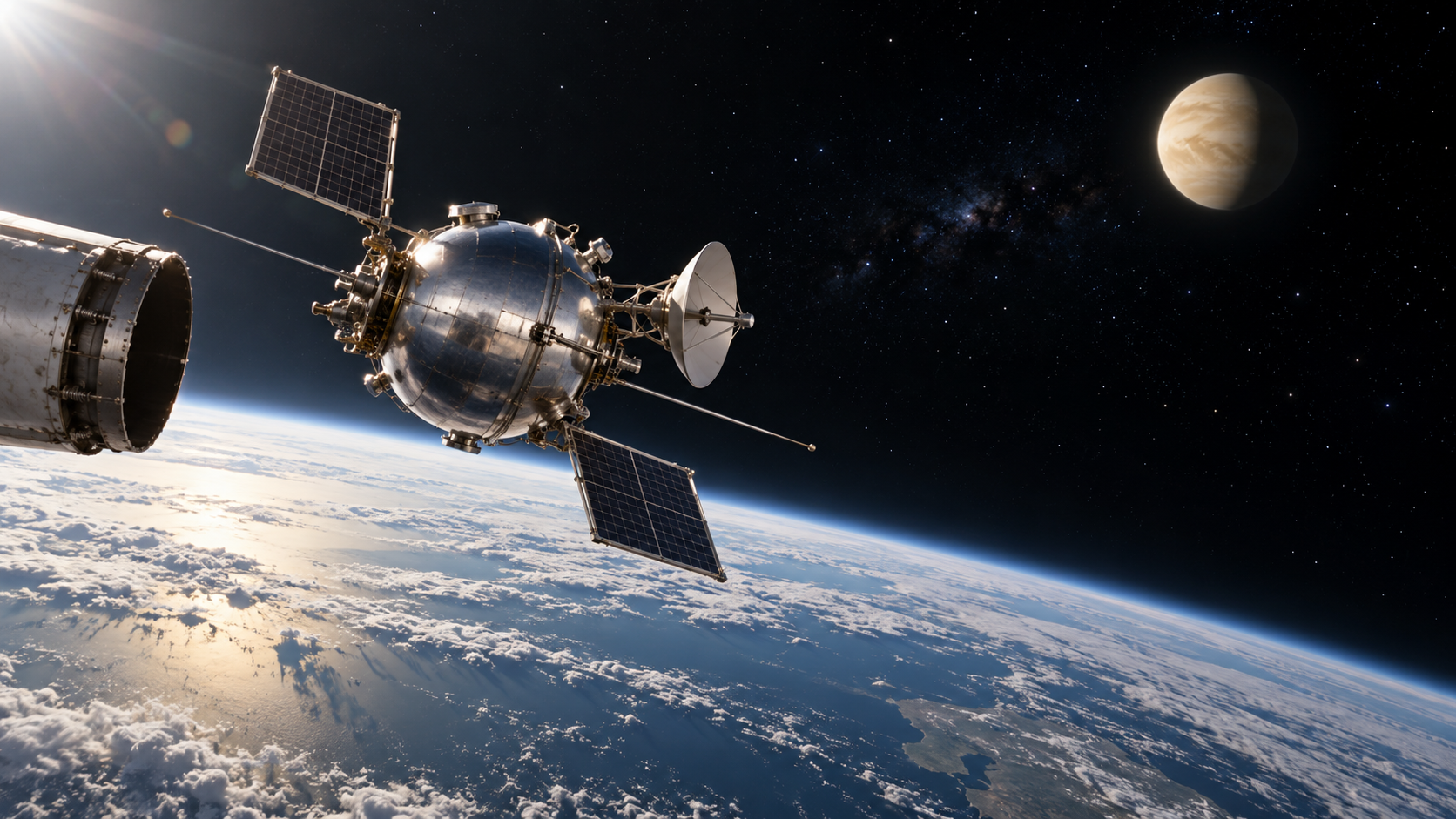
Venera 1 was a roughly spherical probe with solar panels, a high-gain antenna, and instruments for measuring magnetic fields, charged particles, micrometeoroids, and solar plasma. It also carried systems to keep its temperature controlled and orient the craft in space. Those components addressed problems that did not arise in brief near-Earth flights. Sunlight, heat rejection, long-distance radio, and precise pointing all had to remain balanced for months while the spacecraft traveled millions of kilometers without servicing.
Controllers communicated with Venera 1 during the early cruise and received useful data, but contact ended about a week after launch when the probe was roughly two million kilometers from Earth. The spacecraft continued along its predicted path and is believed to have passed within about one hundred thousand kilometers of Venus in May, unable to transmit its observations. The loss prevented the planned planetary measurements, yet the launch and interplanetary injection had already demonstrated that a spacecraft could escape Earth’s immediate neighborhood on a targeted route.
The mission’s partial success helped define the engineering challenge of planetary exploration. A rocket can provide the initial velocity, but a useful mission also requires durable electronics, attitude control, power, thermal design, antennas, ground tracking, and fault tolerance across long communication delays. Soviet engineers incorporated lessons from Venera 1 into later Venus probes, which eventually returned atmospheric data, descended through the clouds, and survived briefly on the surface. The February departure marked the beginning of that lineage and the first time a functioning probe set out from Earth on a path intended to reach another planet. Its place on the calendar is therefore useful as an entry point, not an endpoint. The people involved worked with the instruments, assumptions, and social conditions of their time, and later research has both extended and corrected their conclusions. Reconstructing the event carefully means separating what was known that day from what became clear afterward. That distinction protects the history from myth while showing how cumulative evidence turns a memorable episode into lasting scientific knowledge.
Venera 1 used an Earth parking orbit and an upper-stage burn to begin a targeted flight toward Venus.
That successful injection made it the first spacecraft placed on an interplanetary trajectory.
Solar panels, antennas, orientation systems, and thermal controls supported a mission lasting months rather than hours.
Its instruments were designed to measure magnetic fields, particles, plasma, and micrometeoroids during the cruise.
Radio communication ended roughly a week after launch, long before the spacecraft passed Venus.
Later Venera missions built on the flight's experience and achieved increasingly ambitious studies of the planet.
Explore more of "On This Day ..."
Discover more events from the same date across news, politics, technology, sports, and other fields. Each link highlights significant moments that shaped history on different fronts.