

On This Day in Science: February 13, 2012
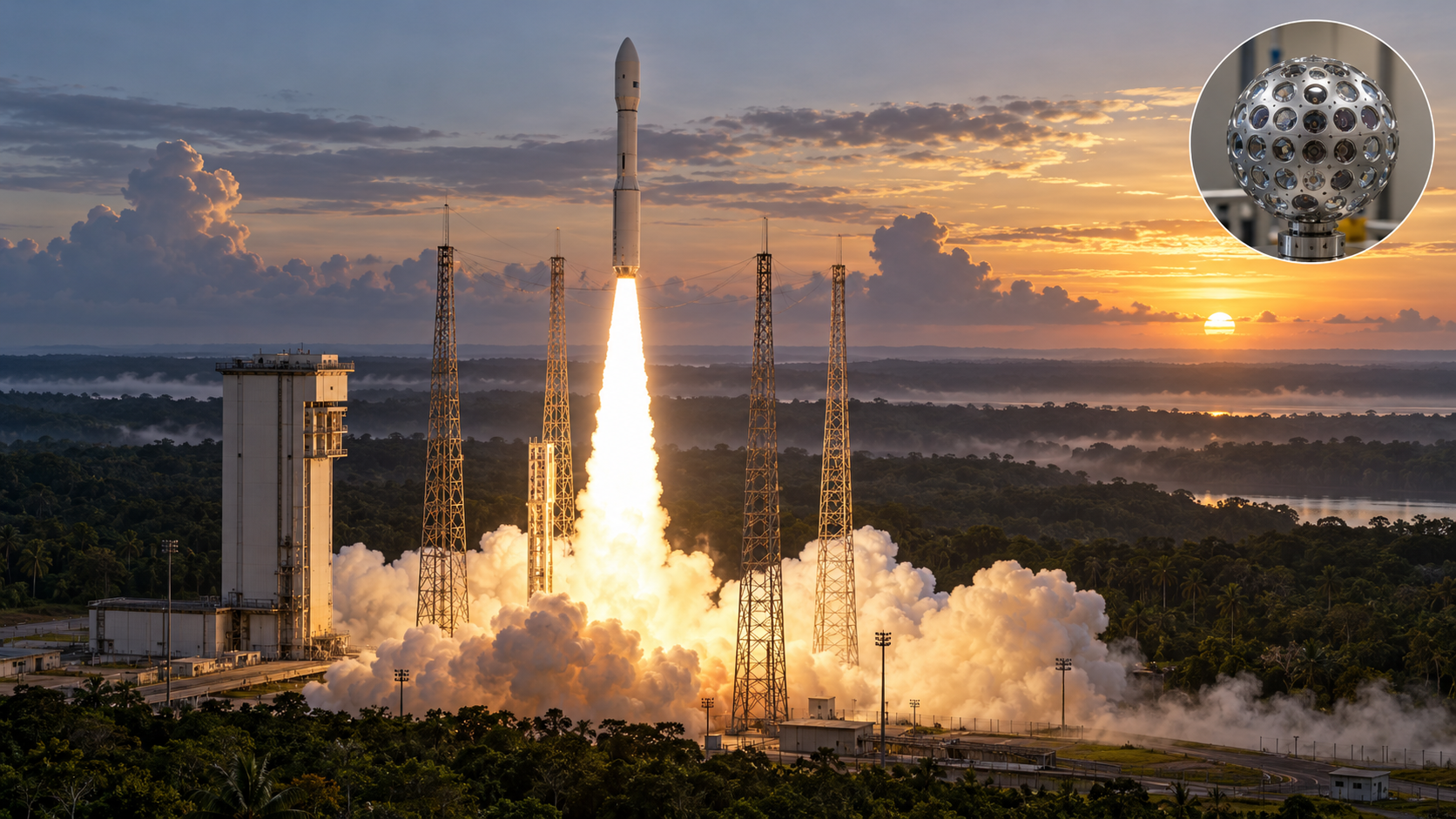
On February 13, 2012, Europe’s Vega launch vehicle lifted off for the first time from the Guiana Space Centre in Kourou, French Guiana. The slender four-stage rocket was designed for small scientific, Earth-observation, and technology payloads that did not require the capacity of the larger Ariane 5. Its qualification flight, designated VV01, had to prove the complete system in the environment that mattered most: ignition, ascent, staging, guidance, payload deployment, and safe disposal of the upper stage.
Vega’s first three stages used solid propellant, providing compact, high-thrust propulsion, while the liquid-fueled AVUM upper stage supplied precise orbital insertion and restart capability. The architecture brought together contributions from several European countries under European Space Agency leadership, with Italy playing a central role in development. A new mobile gantry, launch table, control systems, and processing flow were also part of the project. A launcher is more than a rocket; it is an operating system of factories, transport, range safety, software, and ground crews.
The maiden flight carried nine spacecraft. Its primary payload was LARES, a dense spherical satellite covered with laser reflectors and designed for precise measurements related to general relativity and Earth’s gravitational field. The mission also deployed ESA’s ALMASat-1 technology satellite and seven university-built CubeSats. Releasing different spacecraft into the planned orbit tested sequencing and separation hardware while giving students and researchers access to space on the qualification flight. Ground stations later confirmed that the payloads had been deployed successfully.
VV01 established a new European route to orbit for lighter missions and opened a series of operational Vega launches. Later variants increased performance and changed major propulsion elements, while failures and redesigns demonstrated that launch systems require continuous scrutiny after qualification. The first flight remains important because it connected years of multinational development to a real orbital service. Small satellites were becoming more capable and numerous, and a vehicle tailored to them offered schedule and orbit choices that sharing a larger rocket could not always provide. Vega’s ascent marked both an engineering debut and a change in the launch market it was built to serve. For science history, the episode is also a case study in how evidence moves from an observation or engineered test into a durable body of knowledge. Instruments supplied measurements, specialists debated interpretation, and later work refined what the first result could mean. Archives preserve the early record while new methods let researchers ask different questions of it. That continuing revision is not a weakness in the original achievement; it is the process through which a dated milestone remains scientifically useful.
Vega was developed to carry scientific and Earth-observation payloads below the class served by Ariane 5.
Three solid stages provided ascent thrust, and a liquid upper stage handled accurate orbital placement.
The main passenger was the laser-reflector satellite LARES, built for precise geodesy and relativity research.
ALMASat-1 and seven student CubeSats were also released during the qualification mission.
The successful flight validated not only the vehicle but also its launch pad, processing, software, and operations.
Vega later became an operational family serving lightweight institutional and commercial missions.
Explore more of "On This Day ..."
Discover more events from the same date across news, politics, technology, sports, and other fields. Each link highlights significant moments that shaped history on different fronts.