

On This Day in Science: February 26, 2008
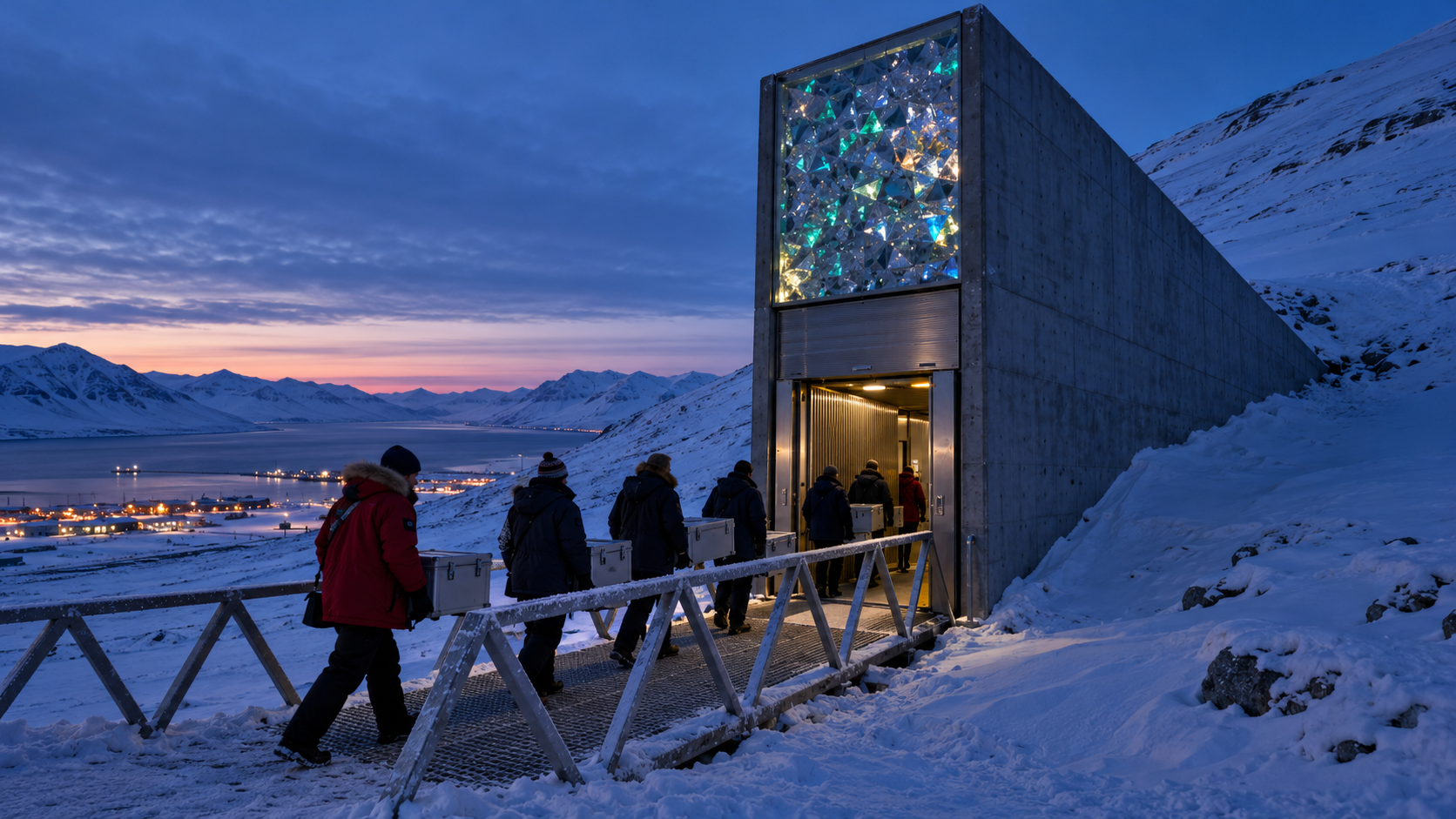
On February 26, 2008, the Svalbard Global Seed Vault opened on a Norwegian Arctic island, receiving its first deposits of crop seeds from collections around the world. The facility was built inside a sandstone mountain near Longyearbyen to serve as a backup for gene banks, which preserve the genetic diversity used by farmers and plant breeders. Often called a doomsday vault, it is better understood as agricultural insurance. Depositors retain ownership of their material, and the sealed seed packages are stored as duplicates rather than becoming a shared collection for routine distribution.
Seeds enter through a distinctive concrete portal and travel deep into the mountain to storage rooms cooled to about minus eighteen degrees Celsius. Refrigeration maintains the target temperature, while surrounding permafrost and rock provide an additional layer of thermal stability. Low temperature and low moisture slow the biological reactions that age seeds, allowing many varieties to remain viable for decades or longer. The remote location, geological stability, political support, and existing Arctic infrastructure all contributed to the choice of Svalbard.
The vault addresses a distributed vulnerability. National and international gene banks can be threatened by war, power failures, funding shortages, natural disasters, equipment problems, or simple handling mistakes. At the same time, crop diversity is essential for responding to pests, disease, drought, heat, and changing diets. A breeder searching for resistance may need a trait found in a traditional variety that is no longer widely grown. Safeguarding duplicate samples prevents a local loss from erasing options that future agriculture may require.
The backup system has already been used. Beginning in 2015, the international agricultural research center ICARDA withdrew seeds to replace a collection disrupted by the war in Syria, multiplied them at new sites, and later returned fresh duplicates to Svalbard. That cycle showed the vault functioning as intended, not waiting for a single global catastrophe. The February opening represented cooperation across countries and institutions on a timescale longer than ordinary political planning. Every box inside is modest, but together they protect a library of biological solutions shaped by thousands of years of farming and evolution. Seen across a longer timeline, the event also shows that scientific milestones are junctions rather than isolated beginnings. Earlier experiments, tools, and institutions made the work possible, while later teams tested its limits and carried the result into new settings. What survives is more than an anniversary fact: it is a traceable chain of evidence, correction, and application that allows one moment to remain relevant as knowledge and technology continue to change.
The vault stores duplicate seed samples sent by gene banks that continue managing the original collections.
Depositors retain control of their boxes and can request their own material back when needed.
Seed rooms sit deep inside Arctic rock and are mechanically cooled to about minus eighteen degrees Celsius.
Permafrost and the mountain provide additional protection if refrigeration is interrupted.
Stored varieties may contain traits that help crops resist disease, drought, heat, or other emerging pressures.
ICARDA's withdrawal and later redeposit demonstrated how the vault can help restore a disrupted collection.
Explore more of "On This Day ..."
Discover more events from the same date across news, politics, technology, sports, and other fields. Each link highlights significant moments that shaped history on different fronts.