

On This Day in Science: February 27, 1932
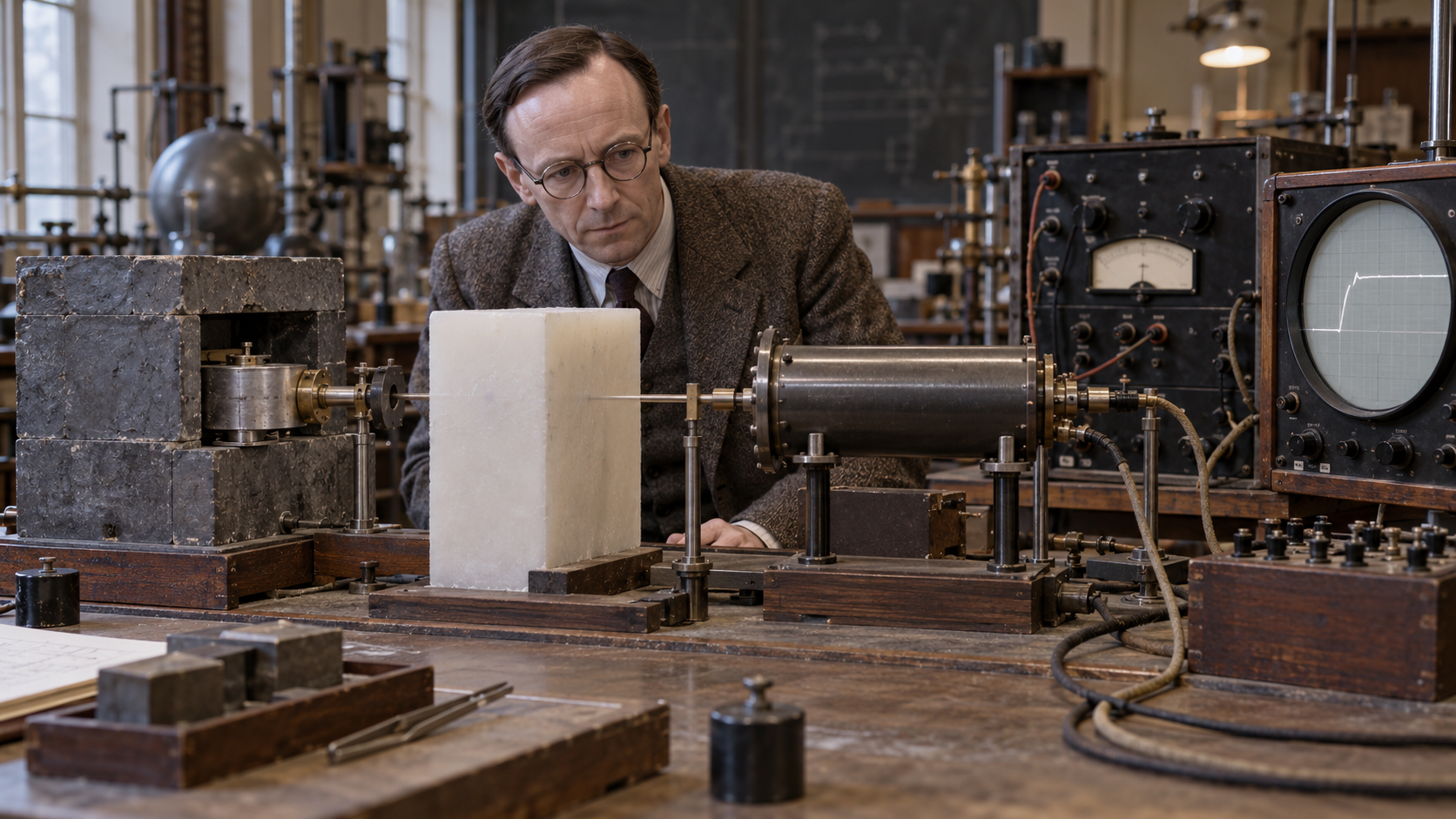
On February 27, 1932, Nature published James Chadwick’s short paper “Possible Existence of a Neutron.” From experiments at the Cavendish Laboratory in Cambridge, Chadwick argued that an unusual penetrating radiation was best explained by a new particle with about the mass of a proton but no electrical charge. Physicists already knew that atomic nuclei contained positive charge, yet models using only protons and electrons created serious difficulties. A neutral nuclear constituent offered a simpler account of isotopes, nuclear mass, and the radiation produced when certain light elements were bombarded.
The immediate puzzle began with experiments by Walther Bothe and Herbert Becker, who observed penetrating radiation from beryllium struck by alpha particles. Irène Curie and Frédéric Joliot found that this radiation could knock protons from hydrogen-rich paraffin and interpreted it as extremely energetic gamma rays. Chadwick tested that explanation by exposing several target materials and measuring the recoil particles. The energies required by a gamma-ray model were implausible, while collisions with a neutral particle of nearly proton mass fit the results much better.
Because neutrons carry no electric charge, they can penetrate the electrical barrier surrounding a nucleus more readily than charged particles. That property quickly made them powerful probes and tools for creating nuclear reactions. Researchers used neutrons to produce new isotopes, investigate nuclear structure, and eventually induce fission in heavy elements. Those developments led to nuclear energy and nuclear weapons, consequences that extended far beyond the modest apparatus of paraffin, ionization chambers, counters, and radioactive sources used in the discovery.
Chadwick followed the brief letter with a fuller paper in May and received the 1935 Nobel Prize in Physics. Later work refined the neutron’s mass and showed that free neutrons decay, while neutrons bound in stable nuclei can persist. The February publication is a landmark because it converted scattered anomalies into a particle that reorganized the model of the atom. It also shows how discovery often depends on questioning the accepted interpretation of another team’s result. Chadwick did not simply detect stronger radiation; he asked what kind of object could transfer the measured momentum and let conservation laws lead toward an unseen constituent of matter. The anniversary also highlights the difference between a first result and a finished understanding. A successful observation can settle one question while opening several harder ones, and even a failed objective can return measurements that reshape later designs. Preserved data, specimens, photographs, and hardware allow new generations to revisit the work with better tools. Science advances through that continuity, where a specific date marks progress without pretending that inquiry stopped there.
Beryllium bombarded with alpha particles emitted radiation that could eject protons from paraffin.
Treating the effect as gamma rays required energies that Chadwick found physically implausible.
Recoil measurements made sense if the radiation contained particles with no charge and about proton mass.
The proposed neutron resolved important problems in models of atomic nuclei and isotopes.
Without electrical charge, neutrons can approach and enter nuclei more readily than charged projectiles.
That feature soon enabled new isotope research, nuclear fission studies, energy technology, and weapons.
Explore more of "On This Day ..."
Discover more events from the same date across news, politics, technology, sports, and other fields. Each link highlights significant moments that shaped history on different fronts.