

On This Day in Science: March 8, 1979
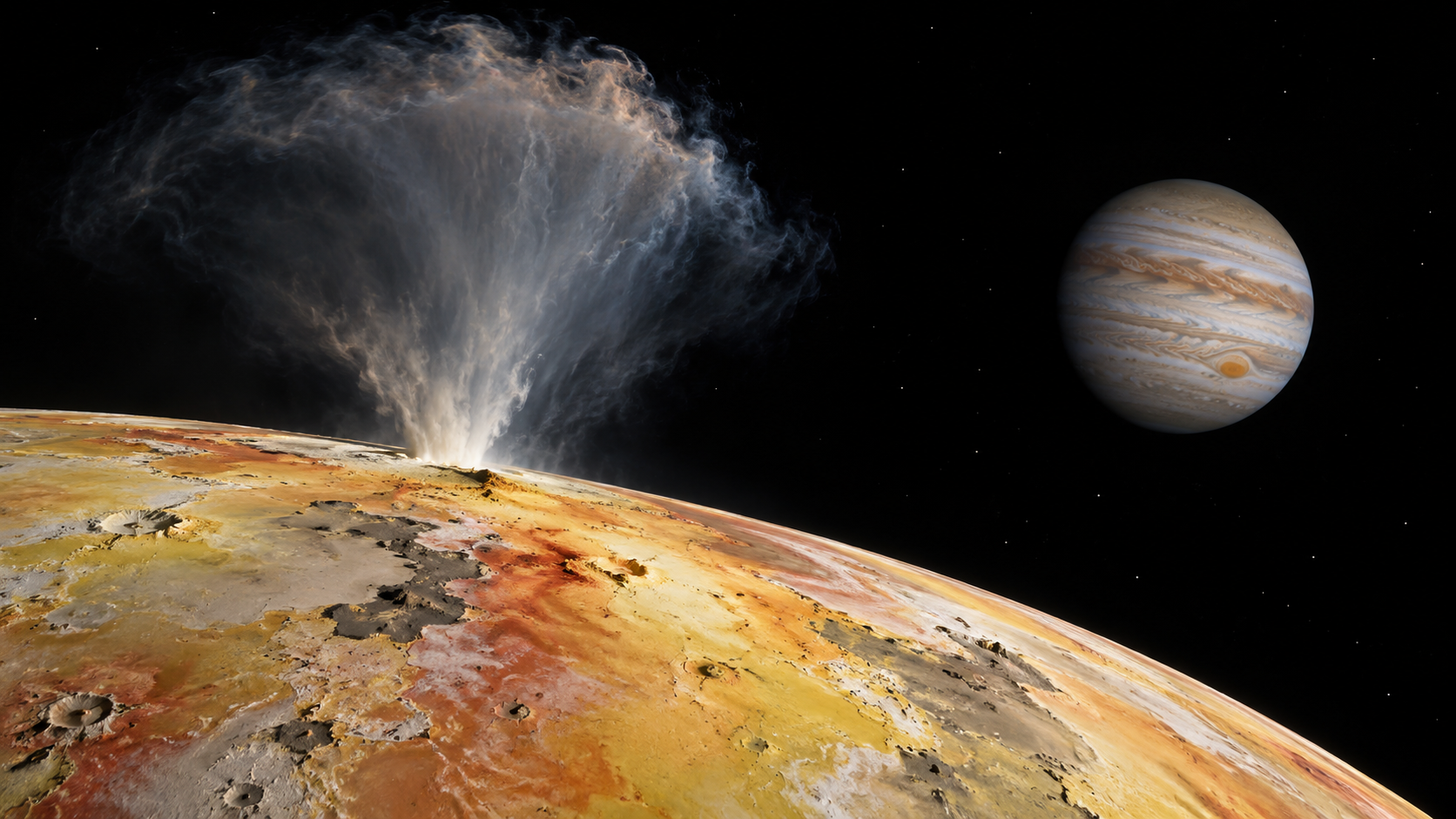
On March 8, 1979, Voyager 1 recorded an image of Jupiter’s moon Io that contained something unprecedented: a vast plume rising above the limb. Navigation engineer Linda Morabito noticed the unusual feature while examining optical-navigation frames after the Jupiter flyby. The image supplied the first observation of an active volcano beyond Earth, confirming that a small moon could be among the most geologically energetic worlds in the Solar System.
Before the encounter, theorists had calculated that Jupiter’s gravity, combined with orbital interactions involving Europa and Ganymede, could flex Io’s interior and generate intense heat. Voyager’s close images showed a colorful surface with few impact craters and many unusual depressions and deposits. The plume provided direct evidence that material was erupting at that moment, connecting orbital dynamics with active geology in a way that cameras could see.
Io’s orbit is slightly eccentric, so Jupiter’s enormous tidal pull changes as the moon travels around the planet. Repeated squeezing dissipates energy inside Io, melting rock and driving widespread volcanism. Sulfur compounds help color the surface, while lava and plume deposits continually cover older terrain. Later spacecraft and ground-based telescopes found many active centers and measured eruptions powerful enough to reshape large regions.
The discovery changed expectations for planetary activity. A world did not need to be Earth-sized or recently formed to remain hot inside; gravitational tides could supply energy continuously. The image also illustrates the scientific value of navigation data and attentive review. A frame made to help steer a spacecraft became evidence for a new category of geology, because an observer recognized that a bright arc was not simply another star or camera artifact. Its place on the calendar is therefore useful as an entry point, not an endpoint. The people involved worked with the instruments, assumptions, and social conditions of their time, and later research has both extended and corrected their conclusions. Reconstructing the event carefully means separating what was known that day from what became clear afterward. That distinction protects the history from myth while showing how cumulative evidence turns a memorable episode into lasting scientific knowledge. For science history, the episode is also a case study in how evidence moves from an observation or engineered test into a durable body of knowledge. Instruments supplied measurements, specialists debated interpretation, and later work refined what the first result could mean. Archives preserve the early record while new methods let researchers ask different questions of it. That continuing revision is not a weakness in the original achievement; it is the process through which a dated milestone remains scientifically useful. Seen across a longer timeline, the event also shows that scientific milestones are junctions rather than isolated beginnings. Earlier experiments, tools, and institutions made the work possible, while later teams tested its limits and carried the result into new settings. What survives is more than an anniversary fact: it is a traceable chain of evidence, correction, and application that allows one moment to remain relevant as knowledge and technology continue to change.
Linda Morabito recognized a bright eruption cloud in Voyager optical-navigation images of Io.
It was the first active volcanic plume observed on a world beyond Earth.
Jupiter's gravity repeatedly flexes Io as orbital interactions keep the moon's path slightly eccentric.
Friction from that deformation supplies heat for widespread volcanism.
Frequent eruptions resurface Io and erase many impact craters.
The discovery proved that gravitational energy can sustain intense geology on a small moon.
Explore more of "On This Day ..."
Discover more events from the same date across news, politics, technology, sports, and other fields. Each link highlights significant moments that shaped history on different fronts.